
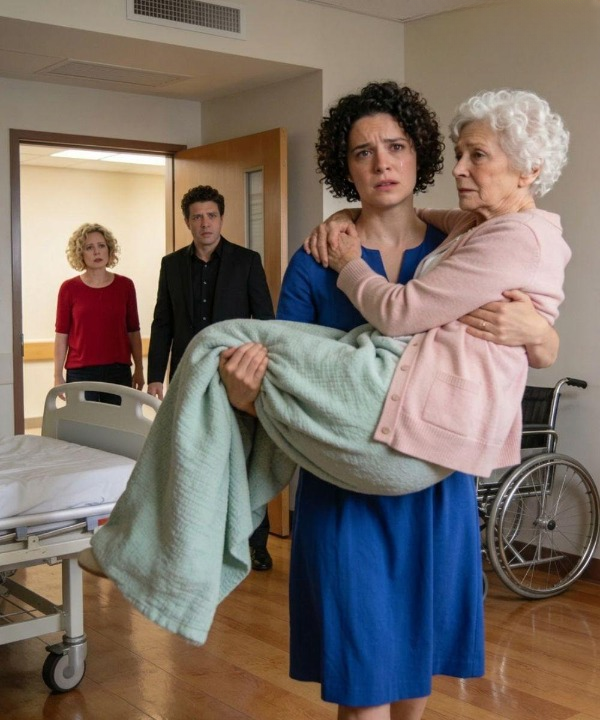
My husband thought he could walk away from our marriage, move in with another woman, and leave me to handle the one responsibility he had avoided for years.
He was wrong.
For seven years, I cared for his mother. I fed her, bathed her, changed her sheets, managed her medications, and stayed awake through countless sleepless nights. Meanwhile, Daniel would sit nearby on his phone, occasionally saying, “You’re better at this than I am,” as if that excused everything.
Then one night, I saw a message:
“This place feels better than home. I’m staying here again tonight.”
I didn’t argue. I didn’t cry. I didn’t confront him.
I made a plan.
The next morning, I packed everything his mother needed—her medication, medical files, blankets, and supplies. I gently helped her into her wheelchair, loaded her into the car, and drove straight to the apartment where he had started his new life.
When Daniel opened the door and saw me standing there—with his bedridden mother beside me—his face went pale.
Before leaving, I said one sentence that left them both speechless.
Daniel and I had been married for seven years. It wasn’t perfect, but I believed in commitment—especially when things got hard. That belief began when I agreed to let his mother, Elena, move in with us.
She had suffered a stroke before our wedding and was partially paralyzed. She relied on help for everything. At first, I thought it would be temporary. But months turned into years, and I became her full-time caregiver while her own son slowly stepped away from responsibility.
Each day followed the same routine—caring for her from morning to night, always alert, always present. Daniel, on the other hand, would come home, disengage, and leave everything to me.
Whenever I asked for help, he’d say, “You do it better than I would.”
For a long time, I accepted it. I told myself this was what marriage meant—sacrifice, patience, carrying more than your share.
Until I found that message.
In that moment, everything became clear. He wasn’t overwhelmed or busy—he had simply chosen someone else.
I asked him one question:
“So what are you going to do about your mother?”
He didn’t answer.
The next day, he left. No explanation, no responsibility—just gone.
But Elena didn’t know. She kept asking about him, smiling at the mention of his name. And I continued caring for her… because someone had to.
A week later, I called him.
“I’m bringing your mother to you,” I said calmly. “It’s your turn.”
He said nothing and hung up.
That afternoon, I prepared everything, got Elena ready, and told her we were going to visit Daniel. She was happy—she had no idea what was really happening.
When we arrived, I rang the doorbell.
Daniel opened it. Behind him stood the other woman—perfect, polished, clearly unprepared for reality.
They both froze.
I wheeled Elena inside, settled her in, and placed her medical bag on the table. The apartment smelled new and pristine—but the silence was heavy.
Finally, Daniel asked, “What are you doing?”
I looked at him calmly.
“She’s your mother. I’m just your wife. I’ve taken care of her for seven years. That’s enough.”
The other woman went pale.
Daniel tried to stop me, but I stepped back.
“Her medication and instructions are all there,” I said, pointing to the bag. “Everything you never bothered to learn.”
Then I looked him straight in the eye and added:
“You wanted my place in your life? Fine. Now take the part you ignored.”
And then I finished:
“I filed for divorce this morning. And I’ve already reported how you used your mother’s disability money to pay for this apartment.”
That was when everything changed.
People might see this as revenge—the dramatic moment, the shocked faces, the wheelchair at the door.
But it wasn’t about that.
For seven years, I carried a responsibility he abandoned. And that day, I didn’t leave a burden behind—I returned it.
What truly shattered them wasn’t anger.
It was the truth.
It was reality.
It was the moment I stopped protecting the man who had been quietly destroying everything—and finally chose to protect myself.
Because in the end, what left them speechless…
wasn’t just what I said.
It was what I could prove.