
While placing flowers on my twins’ grave, a little boy suddenly pointed at the headstone and said, “Mom… those girls are in my class.” For a moment, I froze, thinking my grief had tricked me again. But that moment brought buried truths to the surface and forced me to face the night my daughters died—and the blame I’d been carrying alone.
If someone had told me two years ago that I’d be speaking to strangers in cemeteries, I’d have laughed—or slammed the door. Now, laughter was scarce.
I counted my steps to the grave: 34, 35, 36… when a child’s voice cut through the wind. My hands still clutched the lilies I had bought—white for Ava, pink for Mia. I hadn’t even reached the headstone yet.
It was March, the wind sharp enough to sting, carrying memories I’d spent a year trying to bury. I turned to see a small boy, red-cheeked and wide-eyed, pointing at my daughters’ smiling faces in the cold stone.
“Eli, come say hi to your dad,” a woman called, trying to hush him.
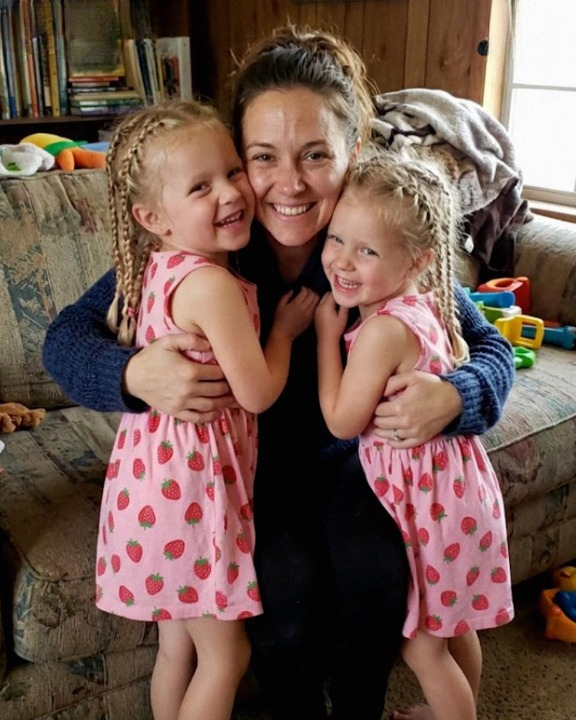
Ava and Mia were five when they died. I remembered their laughter bouncing around the house—the playful dares, the silly competitions, their sticky faces from ice cream. That was the last normal moment I had with them.
The memories after that night came in fragments: a ringing phone, sirens, Stuart calling my name, and me tasting blood from biting my tongue to keep from screaming. I don’t remember the priest’s words at the funeral—just Stuart leaving the room that first night, the door click louder than everything else.
Now, kneeling at their grave, I pushed the lilies into the grass beneath their photograph. “Hi, babies. I brought the flowers you like,” I murmured. My voice sounded smaller than I expected. “I’m trying to visit more.”
Then the boy’s voice again: “Mom! Those girls are in my class.”
I turned, realizing it wasn’t coincidence. Eli, maybe six or seven, held his mother’s hand and pointed at the photo. “Demi brought them,” he explained when I asked. “They’re her sisters, and they live in the clouds now.”
That name—Demi—hit me. I asked if she was his friend; he nodded, saying she missed them. The mother explained it was for a school project about “who’s in your heart.” My heart raced as the pieces fell into place.
Back home, I paced, piecing together memories. Macy, the babysitter, and her daughter Demi—why had she kept a photo from that night? I called the school, eventually speaking with Ms. Edwards, Demi’s teacher. On the memory board, taped among the children’s drawings, was the photo: Ava and Mia, sticky-faced from ice cream, Demi in the middle.
Macy had given it to Demi, she said, to help her remember. I chose not to remove it.
Finally, I called Macy. She admitted the truth: that night, she had taken Demi and the twins out for ice cream, not because of an emergency, but because she wanted to make Demi happy. “I lied to the police,” she confessed, “and I let you believe it was your fault. I’m so sorry.”
I forced myself to speak: “Did Stuart know?” She nodded, tears falling. Two years, and I had carried the blame alone.
The next day, at a fundraiser, I confronted Stuart in front of everyone. “For two years, you let people think I caused our daughters’ deaths. You let Macy hide what she did. You let me carry the blame!” He had no defense.
A week later, kneeling at their grave, I pressed tulips into the earth. “I’m still here, girls. I loved you. I trusted the wrong people. But none of this was my shame to carry. I carried the blame long enough. I’m leaving that here now.”
I stood, finally free, and walked away.