
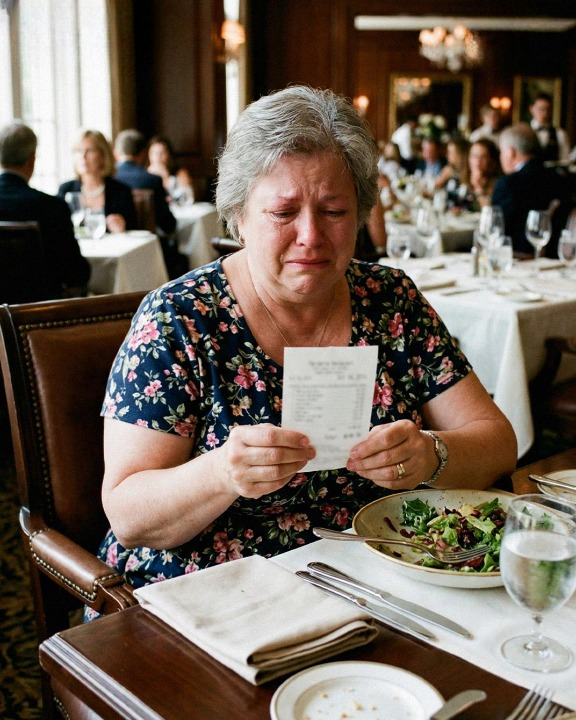
I thought my future mother-in-law was finally making an effort when she invited my mom to a fancy dinner—but by the end of the night, my mom was in tears, I was racing across town, and I realized the family I was about to marry into was far worse than I’d allowed myself to admit.
My mom had never met my fiancé’s mother, Karen, though it should have happened months ago. Karen always had an excuse: “I’ve been so busy,” or “I want it to be special.” Then one week, she called sounding unusually cheerful.
“My sisters and I want to take your mother to dinner,” she said. “A proper first meeting. Our treat.”
When she named the restaurant—a white-tablecloth, tiny-portions, intimidatingly fancy place—I hesitated. My mom hated that kind of stuff. But Karen insisted. “It’ll be elegant for once. Our treat. I insist.”
My mom was touched and excited. I almost told her not to go. I should have.
Karen and her sisters had money, but they wielded it like a weapon. They turned generosity into a game, keeping score, pretending to be kind until it cost them nothing.
The dinner was scheduled for 7 p.m. At nearly midnight, my phone rang. It was my mom, strained and quiet.
“Honey… something’s wrong.”
I rushed her through the story: Karen and her sisters had disappeared one by one, leaving my mom alone at the table. Then the waiter brought the bill—$2,300.
I told her to stay put and not pay a dime. I called Karen—straight to voicemail. Finally, I got her on the third try.
“Why did you leave my mother with a $2,300 bill?” I asked evenly.
“Oh, is she upset?” Karen laughed. “She should contribute.”
“Contribute?” I said. “She had a salad and water.”
“You’re overreacting,” she said, coldly. “She can handle it like an adult.”
I realized immediately what she had planned: trap my mom with shame, confusion, and embarrassment, hoping she’d quietly pay.
When I arrived, my mom was still seated, tense and apologetic. I stayed calm, got the manager, and explained the situation. He called the number on the reservation and confirmed that Karen had claimed the dinner as her treat.
Karen called me back, furious. I told her, “You wouldn’t have had to face this if you hadn’t left my mother alone with the bill.” She had no comeback.
Soon, Karen and her sisters marched back into the restaurant, faces tight with embarrassment. I stood between them and my mom as the manager presented the card reader. Karen reluctantly paid, humiliated in front of witnesses. The manager offered complimentary dessert and a car service for my mom.
I took my mom home, and she kept apologizing for “ruining things.” I told her, “Nothing was ruined. That dinner saved me.”
Because what Karen thought was humiliation ended up showing me exactly what kind of family I was about to marry into—and why I didn’t want any part of it.