
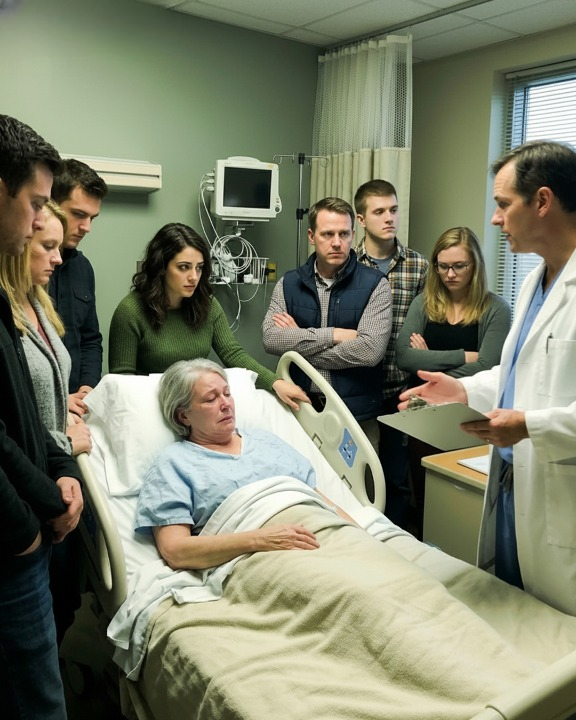
When the doctor said our mother could no longer live alone safely, my siblings suddenly had excuses lined up. I was the one no one expected to step forward, which is why what I said next surprised everyone—and changed everything.
The doctor looked around at all seven of us. “Your mother’s balance is deteriorating. She’s already had two serious falls this year. Living alone is risky.”
A heavy silence fell.
Mom, Margaret, sat on the hospital bed, offering that quiet, hopeful smile older parents give when they still expect their children to rise to the occasion.
One by one, my six siblings spoke.
Jack, the oldest, shrugged. “I wish I could help, Mom, but we’re barely keeping up with the mortgage.”
Eliza sighed. “I’m moving to Dallas soon. Everything’s already planned.”
Nick avoided her gaze. “If I miss work, I’ll lose my job.”
Kirk said, “My wife wouldn’t allow it.”
Nancy offered a tight smile. “My place is too small.”
Sam shrugged. “I can check in on weekends.”
Excuse after excuse. Mom’s smile faded, not completely, but enough to let reality seep through.
I was always the youngest, the unexpected seventh child. Not her favorite—not out of dislike, but circumstance. She’d survived alone after Dad left when I was born, stretched every penny, every ounce of energy. She’d kept me at a distance, but it wasn’t rejection—it was survival.
Still, something inside me shifted as I saw her there, holding back tears.
I stepped forward. “I’ll take Mom in.”
The room froze. Surprise rippled across my siblings’ faces. They assumed I was doing it out of guilt. I shook my head. “But only if we sell the house.”
Their relief instantly turned into tension.
“What?” Jack said. “No way.”
“No,” Eliza added.
I stayed calm. “We need to talk about this tomorrow, six p.m., at the house. Properly.”
Jack scoffed. “And you think we’ll agree to sell it?”
“I think the sooner we decide, the sooner Mom gets the care she needs,” I replied. Silence followed, and slowly, they nodded.
That afternoon, sitting in my car, I understood: they weren’t just avoiding responsibility—they were protecting the house. Their inheritance.
The next day, I arrived at Mom’s early, prepared breakfast, and spoke honestly. “Why did you keep me at a distance?”
She looked away. “It wasn’t because of you. It was timing. I thought keeping distance would protect both of us.”
I realized then: I had been loved, carefully, from afar.
When my siblings arrived, the conversation was tense. I set firm boundaries. “The house is unsafe for Mom to live alone. None of you are willing to take responsibility. Selling it ensures she gets the care she needs.”
No one offered a better solution. I began calling real estate agents. Within days, the house sold, and most of the proceeds were set aside for Mom’s care.
Meanwhile, I took her to Dr. Harris for a thorough evaluation. We discovered that much of her decline wasn’t the illness itself, but mismanaged medication. Adjustments were made, and soon, she was more aware, alert, and present.
Gradually, my siblings began to contribute. Sam brought groceries. Nick fixed things. Eliza called more often. Even Jack visited.
One evening, Mom turned to me. “I didn’t expect it to be you.”
“Neither did I,” I said.
She smiled softly. “I wish I’d done things differently.”
“I understand,” I replied. “You were trying to survive.”
And for the first time, everything felt enough—not perfect, but understood.