
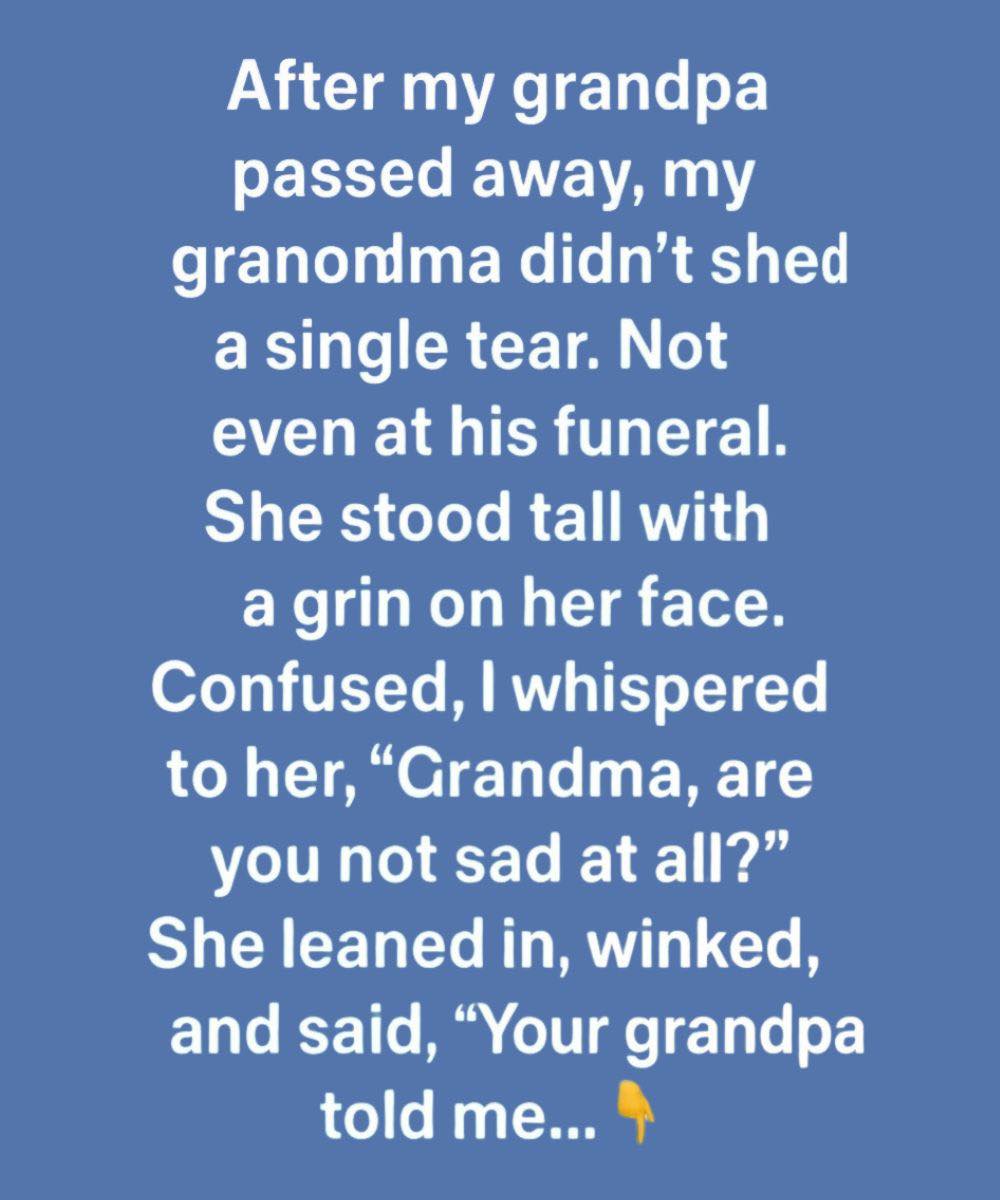
The day we laid my grandfather to rest felt heavy, as though even the sky itself had darkened in mourning. Family members gathered in quiet clusters, speaking in hushed tones, each person carrying their own grief in different ways.
But what unsettled me most was my grandmother.
I expected to see sorrow etched across her face, to see her broken like the rest of us. Instead, she stood with a calm posture, steady and composed, even offering a faint, gentle smile. It didn’t make sense to me—how could she appear so unshaken when she had just lost the man she had spent her entire life with?
After the service, I finally approached her. Quietly, I asked, “Grandma… aren’t you sad?”
She looked at me with soft eyes, filled not with emptiness, but with something deeper—something peaceful.
After a pause, she spoke.
“Your grandfather told me something long ago,” she said gently. “He said that when his time came, he didn’t want sorrow to define the moment.”
I listened closely as she continued.
“He told me that love doesn’t end when someone dies. It changes shape. And if I truly loved him, I wouldn’t only carry the pain of losing him—I would carry everything good we shared instead.”
Her voice didn’t waver.
“He didn’t want me to fall apart. He wanted me to remember our life, not just his death.”
Her words lingered in the air long after she finished speaking.
That night, I understood something I hadn’t before. Grief isn’t always loud or visible. Sometimes it looks like quiet strength. Sometimes it looks like a small smile that holds decades of love inside it.
My grandmother wasn’t untouched by loss—she had simply chosen to carry love forward instead of letting it end in pain.
And in that moment, I realized my grandfather hadn’t truly disappeared.
He lived on in her memories, in her peace, and in the love that still filled every space he once occupied.