
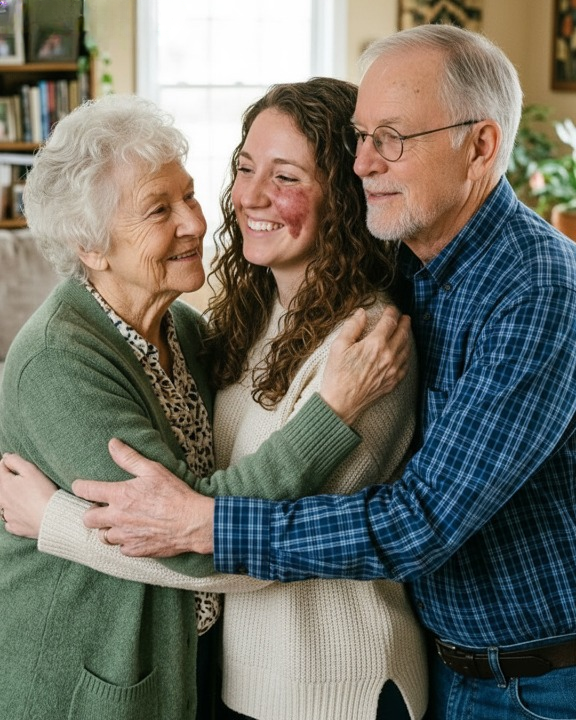
We adopted a little girl everyone else had turned away because of a birthmark — and 25 years later, a letter from her biological mother revealed the hidden truth about her early life.
I’m Margaret, 75, and my husband Thomas and I have been married for over fifty years. For decades, it was just the two of us, longing for children. We tried for years, endured tests and treatments, but a doctor finally told me, “Your chances are extremely low. I’m so sorry.”
We grieved and accepted it. Then one day, our neighbor mentioned a little girl at the children’s home who had been there since birth. “No one comes back for her,” she said. “She has a large birthmark on her face. People see it and decide it’s too hard.”
That night, I brought it up to Thomas. He listened quietly, then said, “Do you want to meet her? Just meet her. No promises.”
Two days later, we arrived at the children’s home. Lily sat at a small table, coloring carefully, her dress too big and worn. The birthmark covered most of one side of her face, but her eyes were sharp and cautious. She asked blunt questions — about our age, about whether we might die soon. We assured her she was safe, that she was ours.
The adoption paperwork took months, but eventually, Lily came home with us. She held her stuffed rabbit tightly, unsure, testing if we truly meant it. At first, she asked permission for everything, afraid she might do something wrong. Slowly, she learned she didn’t have to ask to exist in our home.
School was rough. Kids noticed her birthmark and taunted her. One day she came home crying, saying someone called her “monster face.” I held her hand and said, “You are not a monster. Anyone who says that is wrong. Not you. Them.”
We never hid that she was adopted. She grew up knowing she came from another woman’s womb but into our hearts. By 16, she decided she wanted to be a doctor, to show kids who feel different that they aren’t broken. She worked hard, got into college, then medical school.
Then, a letter arrived. No return address, just my name on the envelope. Inside, three pages from Emily — Lily’s biological mother. Emily explained that she had been 17 when she gave birth, that her parents called the birthmark a punishment, and forced her to place Lily for adoption. She had secretly visited Lily at the children’s home but was too ashamed to intervene. Now sick with cancer, she only wanted Lily to know she had been loved.
We called Lily. She read the letter in silence, a single tear marking the page. Relief washed over her as she realized she hadn’t been abandoned because of her face — it was far more complicated. She looked at us and said, “You and Thomas are my parents. That doesn’t change.”
Weeks later, Lily met Emily. There were tears, apologies, and shared sorrow. It didn’t “fix” everything, but it ended the wondering.
Now Lily no longer thinks of herself as unwanted. She knows she was wanted twice: first by a scared teenager who couldn’t fight her parents, and second by two people who saw the truth in her and loved her unconditionally.