
I didn’t think much about the trip until I received a phone call I couldn’t ignore. The next day, when I walked into the school, I had no idea what my son had already set into motion.
My name is Sarah, I’m 45, and raising Leo alone has shown me what quiet resilience really means.
He’s 12 now—kind in ways people don’t always notice at first. He feels things deeply, but he rarely opens up, especially after his father died three years ago.
He just doesn’t talk much anymore.
Last week, he came home from school acting different.
Not loud or hyper—just bright, like something had sparked in him.
He dropped his backpack and said with unusual excitement, “Sam wants to come too… but they said he can’t.”
I paused. “You mean the hiking trip?”
He nodded.
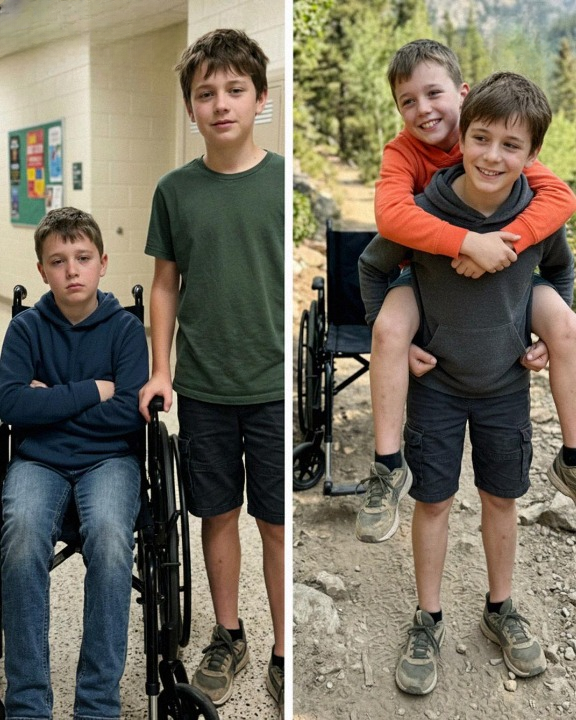
Sam has been his best friend since third grade—a clever, funny kid who usually stays on the sidelines because he’s been in a wheelchair since birth.
“They said the trail is too difficult for Sam,” Leo added.
“And what did you say?”
“Nothing,” he replied. “But it isn’t fair.”
I assumed that was the end of it.
I couldn’t have been more wrong.
On Saturday afternoon, the school buses returned and parents gathered in the parking lot.
I saw Leo immediately when he got off the bus—and something about him looked completely drained.
His clothes were covered in dirt, his shirt was soaked, and he looked like he’d been carrying an unbearable weight for hours.
I hurried over.
“Leo… what happened?” I asked, alarmed.
He looked at me, exhausted but calm, and said quietly, “We didn’t leave him.”
Before I could understand, another parent explained.
The hike was six miles of rough terrain—steep climbs and uneven paths. And somehow, Leo had carried Sam on his back the entire way.
My stomach dropped as I tried to process it.
According to what the kids said, Leo kept repeating, “Hold on, I’ve got you,” refusing to stop even when it became difficult.
When I looked at him again, his legs were still shaking.
Then his teacher arrived, clearly upset.
“Sarah, your son broke protocol,” he said sharply. “He took a dangerous detour. Students who couldn’t continue were supposed to stay behind at the campsite.”
I apologized immediately, though my hands were trembling—while something inside me swelled with pride.
Still, not everyone was pleased. The staff seemed frustrated, and I expected the matter to end there.
It didn’t.
The next morning, my phone rang.
It was the school.
“Sarah?” Principal Harris said, her voice tense. “You need to come to the school immediately.”
My stomach tightened.
“Is Leo okay?”
A pause.
“There are men here asking for him.”
I froze.
“I’m on my way.”
My mind raced the entire drive, each possibility worse than the last.
When I arrived, I saw them immediately—five men in military uniforms standing outside the office, serious and composed.
One of them stepped forward.
“Ma’am, I’m Lieutenant Carlson,” he said. “We need to speak with you inside.”
Inside, the teacher stood in the corner looking displeased, while Leo was brought in moments later.
The second he saw the room full of adults, panic hit him.
“Mom?” he said, frightened.
I rushed to him. “It’s okay. I’m here.”
“I didn’t mean to get in trouble,” he said quickly. “I won’t do it again.”
My heart broke hearing that.
Before I could respond, the teacher muttered something dismissive, making things worse.
Leo began to panic, insisting he just wanted his friend included.
I held him tightly. “No one is taking you anywhere.”
Then one of the officers spoke gently.
“We’re not here to punish him,” he said. “We’re here because of what he did—for Sam.”
Leo slowly began to calm.
“We’re here to honor him,” the officer added.
I blinked in confusion.
Then the door opened again.
A woman entered—and I recognized her instantly.
It was Sam’s mother.
She explained she had to come because Sam hadn’t stopped talking about the hike—about how much it meant to him.
She looked at Leo.
“He said you told him, ‘As long as we’re friends, I’ll never leave you behind.’”
My chest tightened.
Sam had experienced something he hadn’t felt since before his father, a soldier, died in combat.
And Leo had given him that.
The room fell silent.
Then the officers explained further.
They had known Sam’s father—he had served with them. He used to carry Sam everywhere so he wouldn’t miss out on life.
After his death, Sam’s mother had tried to keep that spirit alive, but couldn’t always manage it.
Until this hike.
One officer stepped forward.
“We want you to know what your son did mattered,” he said. “Not just physically—but emotionally.”
Then came the surprise.
A scholarship had been created in Leo’s name.
For a moment, I couldn’t even speak.
Leo just stood there, stunned.
Then the officer placed a military patch on his shoulder.
“You earned this,” he said. “His father would be proud.”
Tears filled my eyes.
I pulled Leo close and whispered, “Your dad would be proud too.”
Afterward, the tension faded.
Sam’s mother thanked us.
And later, when Leo finally saw Sam in the hallway, the two boys ran toward each other like nothing had happened.
They laughed, joked, and talked like the world hadn’t shifted—but it had.
Because now Sam wasn’t the one left behind.
And Leo wasn’t just a quiet boy anymore.
He was someone who chose to carry another person when it mattered most.
That night, I stood outside his bedroom for a moment.
He was already asleep. The military patch sat on his desk.
And I realized something simple but powerful:
We can’t always control what life asks of our children.
But sometimes, we get to witness exactly who they choose to become when it does.