
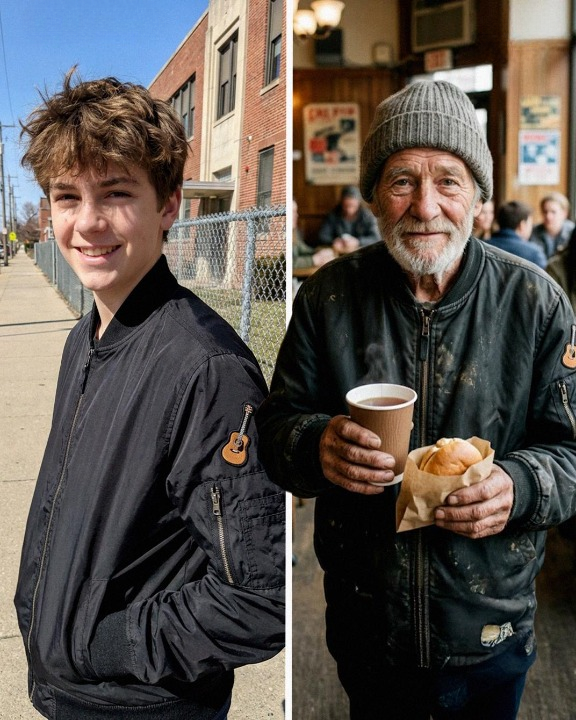
Nearly a year after my teenage son vanished, I saw a homeless man enter a café wearing my son’s jacket — the very one I had mended with my own hands. When he told me a boy had given it to him, I followed him to an abandoned house. What I discovered there turned everything I believed about my son’s disappearance upside down.
The last time I saw Daniel, he was in the hallway slipping on his sneakers, his backpack dangling from one shoulder.
“Did you complete your history assignment?” I asked.
“Yes, Mom.” He picked up his jacket, leaned in, and kissed my cheek. “See you tonight.”
Then the door shut behind him, and he was gone.
I watched from the window as he walked down the street.
That night, Daniel never returned home.
At first, I wasn’t concerned.
Sometimes he stayed after school to play guitar with his friends, or wandered to the park and lingered there until it got dark.
He always sent a text when he did, but I figured maybe his phone had run out of battery.
That’s what I kept telling myself as I cooked dinner, as I sat down to eat by myself, as I cleaned up and left his portion warming in the oven.
But when night fell and his room remained empty, I couldn’t push away the uneasy feeling that something wasn’t right anymore.
I tried calling his phone, but it went straight to voicemail.
By ten that night, I was driving around the neighborhood looking for him.
By midnight, I was at the police station filing a missing person report.
The officer asked a series of questions, wrote everything down, and then said, “Sometimes teenagers take off for a few days — after an argument with their parents or something like that.”
“Daniel wouldn’t do that.”
“And why do you say that?”
“Daniel is gentle and soft-hearted. He’s the type of kid who says sorry even when someone else runs into him.”
The officer offered me a polite, understanding smile. “We’ll submit a report, ma’am.”
But I could see it in his expression — he believed I was just another frantic parent who didn’t truly know her own child.
I had no idea then how much truth there was in that assumption.
The following morning, I went to Daniel’s school.
The principal was compassionate and allowed me to review the security footage from the cameras pointed at the main entrance.
I sat in a cramped office, replaying the footage from the afternoon before.
Crowds of students streamed out of the building in groups, laughing, shoving one another, scrolling through their phones.
Then I spotted Daniel walking next to a girl.
At first, I didn’t recognize her. But when she turned her head slightly, I caught a better view of her face.
“Maya,” I murmured.
Maya had come over to see Daniel a few times before. She was quiet — polite, but in a guarded sort of way.
In the footage, the two of them walked through the gate and headed toward the bus stop.
They boarded a city bus together — and then disappeared from view.
“I need to talk to Maya,” I said, turning to the principal. “Is that possible?”
“Maya no longer goes here,” she replied, motioning toward the screen. “She transferred unexpectedly. That was her final day at this school.”
I went straight to Maya’s house.
A man opened the door.
“Please, may I speak with Maya? She was with my son the day he disappeared. I need to know if he told her anything.”
The man studied me with a deep frown. After a long pause, his expression hardened.
“Maya isn’t here. She’s staying with her grandparents for a while.” He began to shut the door, then hesitated. “I’ll ask her if she knows something, alright?”
I remained on the doorstep, at a loss for words, a nagging instinct urging me to press further — but I didn’t know what else to say.
Then the door clicked shut.
The weeks that followed were some of the darkest of my life.
We plastered flyers everywhere and shared posts on every local Facebook group and community board we could find.
The police joined the search, but as months passed, their efforts gradually waned. Soon, people began labeling Daniel as a runaway.
I knew my son. Daniel would never disappear without a word.
And no matter how long it took, I refused to stop searching for him.
Nearly a year later, I found myself in another city for a business meeting.
I had gradually forced myself back into a semblance of normal life — working, grocery shopping, and Sunday evening phone calls with my sister.
After the meeting ended, I stopped at a small café.
I ordered a coffee and waited at the counter when the door opened behind me. I turned around.
An elderly man had come in, moving slowly, counting coins in his hand, bundled up against the chill. He looked as if he might be homeless.
And he was wearing my son’s jacket.
It wasn’t just a jacket like my son’s — it was the exact one he had worn the day he left for school.
I recognized it immediately because of the guitar-shaped patch I had sewn by hand over the torn sleeve. The faint paint stain on the back was unmistakable when the man turned toward the counter to order tea.
I pointed at him. “Add that man’s tea and a bun to my order.”
The barista looked at him and nodded.
The old man turned toward me. “Thank you, ma’am, you’re so—”
“Where did you get that jacket?” I asked.
The man looked down at the jacket. “A boy gave it to me.”
“Brown hair? Around sixteen?” I asked.
He nodded.
The barista handed him his order, but at that moment, a man in a suit and a woman in a pencil skirt came between us. I sidestepped to get around them, but the old man had already slipped away.
I scanned the café, and saw him moving out onto the sidewalk.
“Wait, please!” I called, chasing after him.
I tried to catch up, but the sidewalks were packed. People stepped aside for him, but not for me.
After two blocks, I noticed something: the old man hadn’t once paused to ask anyone for spare change. He hadn’t touched the bun or sipped the tea either. He was walking with intention.
My gut told me to stop trying to overtake him and just follow at a distance.
So that’s what I did.
I trailed him all the way to the outskirts of the city.
He moved with purpose.
He came to a halt in front of an old, abandoned house.
The property was overrun with weeds, the wild garden blending almost seamlessly into the forest behind it.
It was clear no one had tended to the place in years.
The old man rapped softly on the door.
I edged closer, and when he glanced around, I slipped behind a tree to avoid being seen.
Then I heard the door creak open.
“You said I should let you know if anyone ever asked about the jacket…” the old man said.
I peeked out from behind the tree, and when I saw who was in the doorway of that crumbling old house, I felt like I might collapse.
“Daniel!” I called, stumbling toward the door.
My son looked up, his eyes wide with fear.
A shadow shifted behind him. He glanced back at me one last time — and then did the most unimaginable thing.
He ran.
“Daniel, wait!” I shouted, breaking into a run past the old man and into the house.
A door banged shut behind me. I sprinted down the hallway and skidded into the kitchen, yanking open the back door just in time to see Daniel and a girl darting into the woods.
I chased after them, calling his name, but they were too quick.
I lost them.
I drove immediately to the nearest police station and told the desk officer everything.
“Why would he run from you?” the officer asked.
“I don’t know,” I admitted. “But you have to help me find him before he disappears again.”
“I’ll issue an alert, ma’am,” the officer replied.
I sat down, my nerves taut with every door opening. My thoughts ran in endless circles: What if he’s already on a bus? What if he’s gone? What if that was my only chance?
Close to midnight, the officer approached.
“We found him. He was near the bus terminal. They’re bringing him in now.”
A wave of relief washed over me. “And the girl who was with him?”
The officer shook his head. “He was alone.”
They led Daniel into a small interview room. I didn’t even realize I was crying until I felt the tears on my cheeks.
“You’re alive. Do you have any idea how worried I’ve been? And when I finally found you… why did you run from me?”
He kept his eyes on the table. “I didn’t run from you.”
“Then what—”
“I ran because of Maya.”
And then he told me everything.
In the weeks leading up to Daniel’s disappearance, Maya had opened up to him.
She explained that her stepfather had been growing increasingly volatile and unpredictable, yelling and breaking things almost every night.
“She said she couldn’t stay there anymore,” Daniel said. “She was frightened.”
“I think I met him,” I said. “I went to her house to ask if she knew anything about you, and a man answered the door. He said Maya was staying with her grandparents.”
Daniel shook his head. “He lied.”
I sank back into my chair. “All this time… but why didn’t she tell a teacher? And what does this have to do with you running away?”
“She didn’t think anyone would believe her, and I… I didn’t know what else to do.” His face crumpled. “She came to school that day with a bag already packed. She said she was leaving that afternoon. I tried to convince her not to go, but she wouldn’t listen.”
“So you went with her.”
He nodded. “I couldn’t let her go alone, Mom. I wanted to call you so many times.”
“Then why didn’t you?”
“Because I promised Maya I wouldn’t say where we were.” He swallowed. “She was afraid that if anyone found us, they’d make her go back.”
“And today, when you saw me?”
“I was afraid the police would find her.”
I raked my hands through my hair. “Alright… alright. But what about that old man? He said you told him to let you know if anyone asked about the jacket.”
He cast his eyes downward. “I thought… if anyone ever recognized it… maybe they’d realize I was still alive.”
I looked at him. “You wanted me to find you?”
He shrugged. “I’m not sure. Maybe. Mostly, I just didn’t want you to believe I was gone for good.”
A few days later, the police located Maya.
After speaking with her privately, the full truth emerged. An investigation was launched. Her stepfather was removed from the home, and Maya was placed in protective care.
For the first time in a long while, she was truly safe.
A few weeks later, I stood in the doorway of my living room, watching the two of them on the couch.
They were watching a movie, a bowl of popcorn between them, looking like ordinary kids.
For nearly a year, I had believed my son had disappeared without a trace, leaving without a word or a backward glance.
But he hadn’t run away — at least, not in the way anyone had assumed.
He had stayed close to someone who was scared, moving through every city, every shelter, every cold, abandoned building, because he was the kind of boy who couldn’t let anyone face danger alone.
He was also the kind of boy who left his jacket behind as a signal for someone who loved him to find him.
I’m grateful that I did.