
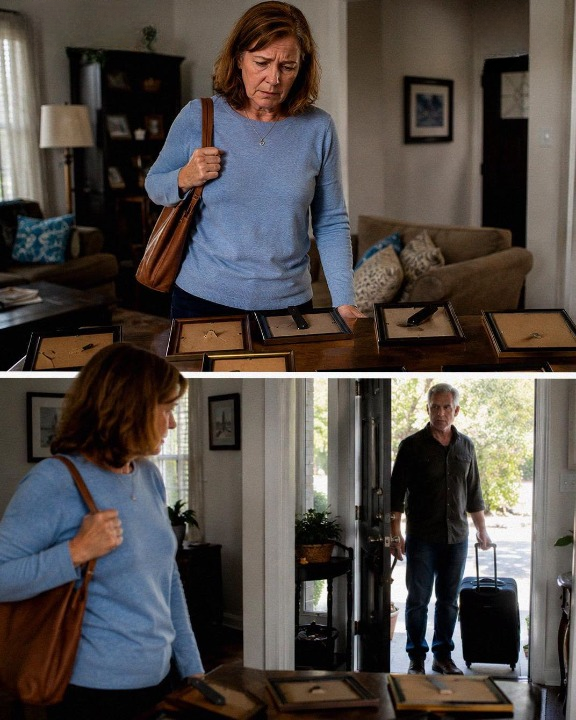
I came home that day expecting nothing unusual, but the moment I stepped inside, I knew something was off.
Nothing was stolen. My purse was still on the table, my laptop untouched, even our valuables were exactly where they should be.
But then I saw the photos.
Every single framed picture in the house had been turned face down—our wedding photo, our daughter’s graduation picture, the family portraits, even the small snapshots in the hallway. Nothing else in the house had been touched.
I turned them back up one by one, confused and unsettled, until I heard a car in the driveway.
My husband walked in moments later carrying a suitcase.
He stopped when he saw me. I looked at him, then at the suitcase, then back at the flipped photos.
“Tell me I’m wrong,” I said, already fearing the worst.
But what he told me had nothing to do with betrayal—and everything to do with memory, fear, and a truth I never expected.
For weeks, I had noticed small changes in him. He seemed distracted, forgetful in ways that weren’t like him at all. He missed a dinner he would never normally forget, sat alone in his car for no clear reason, and behaved like parts of his mind were slipping away.
I had blamed stress.
But now, standing in a house where every family photo had been deliberately turned away, I realized it was something deeper.
The suitcase he carried wasn’t packed for someone else. It was filled with documents—old medical records from his father’s illness, brochures about memory care, notes from doctors, and more recent printouts from clinics and support centers.
Slowly, the truth unfolded.
He had begun noticing gaps in his own memory—small at first, then impossible to ignore. Forgetting places, names, directions. Things that were once effortless for him now required effort he couldn’t trust.
And instead of telling me, he started preparing. Quietly. Alone.
The turned-over photographs weren’t about hiding anything from me. They were tests. Moments where he tried to see if he could still recognize his own life instantly… and panicked when he couldn’t.
That fear is what made him turn them away.
Not anger. Not secrecy. Fear.
The suitcase, the notes, the research—it was all his attempt to understand what was happening to him, using his father’s past illness as the only reference he had.
When I finally asked why he didn’t tell me sooner, his answer was simple and devastating: he tried to, but couldn’t find the right moment… and was afraid of what it would mean for both of us.
We sat there in silence for a long time after that.
And for the first time that day, I realized I hadn’t walked into betrayal.
I had walked into fear he’d been carrying alone.
That night, we put the photos back together—one by one—and stopped treating them like questions.
We started treating them like memories again.