
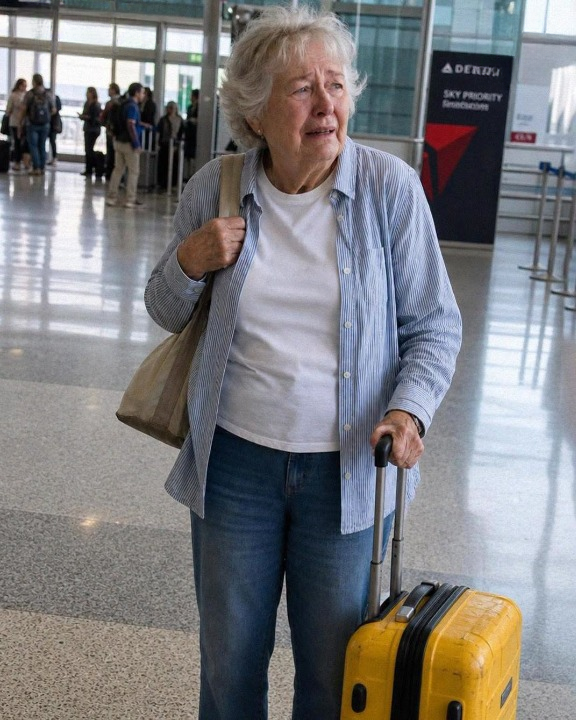
I thought my grandmother was finally getting the long-awaited family trip she had dreamed about for years. She handed my dad $4,800, packed her blue scarf with excitement, and trusted him completely. But at the airport, she called me in tears — and I realized he never intended to take her with them.
My grandmother had called me while I was studying for final exams, her voice breaking as she struggled to speak.
“Drea,” she said, barely audible.
“Grandma? What’s wrong?”
Then she cried harder.
“Your dad said he forgot my ticket. They all went through security… and I’m still here.”
For a moment, I couldn’t even process it.
Then I grabbed my keys.
“Stay where you are. I’m coming.”
She kept apologizing, saying she didn’t want to be a burden. But I was already on my way.
When I reached the airport, I found her sitting alone near the baggage area, holding her suitcase tightly, her blue scarf folded in her lap. She looked like she was trying to disappear into the chair.
She was 68, had never left the country, and had spent most of her life putting everyone else first.
And now she had been left behind.
She told me what happened: my father had pulled her aside at check-in, said there was a mistake with her ticket, and told her he’d fix it later. Then he left with the rest of the family.
When I confronted him later over the phone, he dismissed it like it was nothing.
He insisted she had “given the money to the trip,” and claimed she would’ve struggled anyway. Like her absence was acceptable.
But the truth was simple: she had paid for her seat. She had trusted him. And he had taken advantage of that.
I brought her home that night. She sat quietly in her kitchen in her travel outfit, staring at a suitcase full of new clothes she had bought just for the trip — shoes, earrings, a dress, even a phrasebook she had been so proud of.
“I feel foolish,” she whispered.
“You’re not foolish,” I told her. “You trusted your son.”
The next day, I started asking questions.
My mother and brother were on the trip, posting photos like everything was normal. But when I pressed them, contradictions started to appear — different versions of what happened, shifting explanations, and uncomfortable silence.
It became clear my father had not “forgotten” anything.
He had simply decided she wouldn’t go.
Over the next days, I gathered everything: bank slips, messages, receipts, and every detail that showed what really happened. Not to create drama — but to make sure the truth couldn’t be rewritten.
When he returned home, I was ready.
We confronted him together as a family.
At first, he tried to justify it. Then he tried to dismiss it. But as the evidence was laid out — the payments, the messages, the airport call — there was nowhere left to hide.
My grandmother finally spoke for herself.
She didn’t yell. She just asked one question:
“Where was my ticket?”
And the room went silent.
In the end, he was forced to take responsibility and repay what he had taken. No excuses were left standing.
Months later, I took my grandmother on a smaller trip of her own. Nothing extravagant — just enough to make sure she finally got what she had been promised.
At the airport, she held her blue scarf again, this time with a quiet smile.
“I’m really going this time,” she said.
“Yes,” I told her. “And I’m not letting anyone forget it again.”
And this time, she boarded the plane with her name on the ticket — exactly where it should have been from the start.