
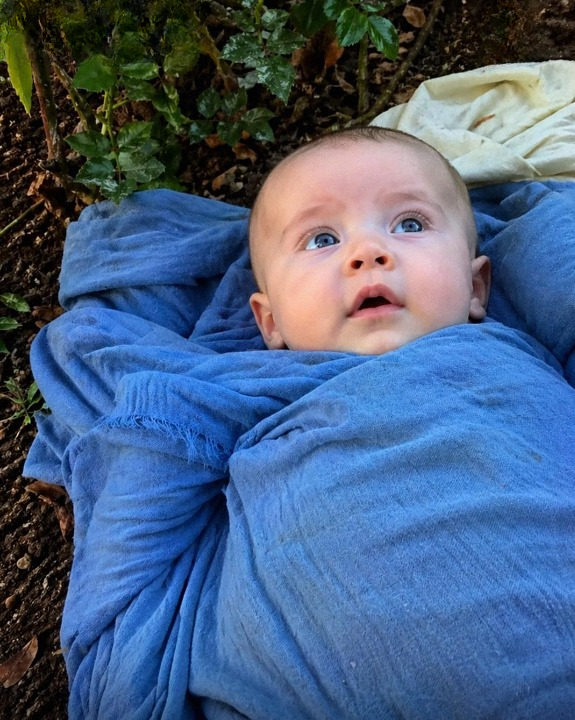
I discovered a baby boy beside my rose bushes, wrapped in blue blankets with a note asking me to give him a better life. I believed someone had entrusted me with their child—but the next day, my security footage revealed the shocking truth about who had left him there.
I always thought roses were simpler than people. When a rose needs water, it droops. When a stem is diseased, it shows spots. And when something rotten is damaging the roots, you cut it away before it destroys the whole plant.
People were different.
People could be starving for love and still smile across the breakfast table.
That thought was in my mind the morning I found the baby.
Just before seven, I was outside in Mark’s old gray robe, gardening clogs on my feet, pruning shears in one hand and coffee in the other.
The spring air still carried a chill, and my yellow roses were beginning to bloom. I’d nicknamed that bush Sunny, because at forty-nine I had no shame and far too much affection for my plants.
“Looking dramatic today, aren’t we?” I muttered as I clipped a dead leaf.
That’s when I noticed the blue bundle.
It sat beside the rose bed, near the porch light—not hidden in the thorns or tossed by the curb, but carefully placed, as if someone wanted it found.
At first, I assumed it was just a blanket. People left odd things in yards all the time—flyers, gloves, even hoses.
Then it moved.
My coffee hit the porch.
“Oh my God!”
I ran so fast one clog flew off behind me. Two faded blue blankets were wrapped around something tiny. A knit cap peeked out at the top, and when I pulled the blanket back with trembling hands, I saw his face.
A baby boy.
He couldn’t have been older than six months. His cheeks were flushed from crying, his tiny fists tucked beneath his chin. His weak cry pierced straight through me.
“Oh, sweetheart,” I whispered, dropping to my knees. “You’re okay now. I’ve got you.”
Pinned to the blanket was a torn piece of notebook paper.
Please, give him a good life.
I can’t.
I love you, baby boy.
For a moment, I could only stare.
Then he whimpered again, and instinct took over. He was strapped into a clean infant carrier, with a bottle and spare hat tucked near his feet. Whoever left him wanted him found.
“Okay,” I said, lifting the carrier carefully. “Let’s get you warm, fed, and checked.”
I carried him inside.
“Mark!” I shouted. “Get downstairs!”
The baby fussed, and I rested my hand on his chest.
“It’s alright,” I murmured. “You’re safe now.”
My husband came downstairs tying his robe, hair flattened on one side.
“Lynn, what happened? Why are you yelling?”
Then he saw the baby—and all the color drained from his face.
Mark and I had been married twenty years, through funerals, layoffs, and hospital visits. He was always calm—sometimes too calm.
But that morning, he looked terrified.
“Where did you get that baby?” he asked.
“I found him beside the roses. Call 911, Mark.”
“No.”
I froze. “What?”
“No, Lynn. We need to hand him over and stay out of this.”
“He was left in our yard. We’re already in it.”
“Then don’t get attached.”
“He’s a baby, Mark. Attachment is the least he deserves.”
The child cried harder.
“Get a towel,” I said. “And warm the bottle.”
Mark didn’t move.
“This isn’t our problem,” he muttered.
I stared at him.
“You haven’t even asked if he’s okay.”
His mouth opened, then shut.
That was the first crack.
I called 911 myself.
The paramedics arrived quickly, along with Officer Hayes, who had kind eyes and a steady voice.
“He’s cold and hungry, but stable,” one paramedic said. “We’ll take him in for a full exam.”
Relief nearly buckled my knees.
Officer Hayes looked at us. “Any idea who left him here?”
“No,” Mark said too quickly. “We know nothing. We have no connection to this child.”
No connection.
Far too specific.
Then Hayes asked, “Any cameras facing the yard?”
“No,” Mark said.
“Yes,” I said at the same time.
He glared at me.
“We installed one last month after someone stole Mrs. Palmer’s planters,” I said.
“Please save last night’s footage,” Officer Hayes replied.
“I will.”
The baby reached up and wrapped his tiny fingers around mine.
“We don’t even know his name,” I whispered.
At the hospital, they confirmed he was healthy. A nurse smiled at me.
“Someone wanted him found,” she said. “He’s loved, even if this is how he arrived.”
My phone buzzed with a text from Mark.
Come home. Don’t make this personal.
I replied immediately.
A baby was abandoned in our yard. It already is personal.
When I got home, Mark was fully dressed in the kitchen.
“You lied about the camera,” I said.
“I forgot for a second. Relax.”
“You forgot the camera you check every time a raccoon touches the trash cans?”
“I was stressed, Lynn!”
“So was the baby.”
He looked away.
That was the second crack.
That night, I barely slept. Mark lay beside me pretending to, his breathing too even, too controlled. Around four, I heard the floor creak and his office door click shut.
The next morning, he was gone before sunrise, leaving only a note.
Meeting. Back late.
No coffee. No kiss. No concern.
I tossed the note in the trash.
“Not today, Mark.”
Then I opened the security camera app.
At 6:08 a.m., the yard was empty.
At 6:11, a car rolled to the curb.
At 6:14, a young woman crossed the lawn carrying the blue bundle.
She wore a dark hoodie, cradling the carrier carefully. When she stepped into the porch light, I saw her face. I didn’t know her—but something about the shape of her mouth unsettled me.
She placed the carrier beside the roses and crouched low.
“Okay, Ollie,” she whispered. “Just a little longer. She’s kind. I’ve watched her from my car. She loves her roses, and she waves at all the kids.”
She kissed his forehead and glanced up at my bedroom window.
“Please,” she whispered.
Then one clear word came through the audio.
“Dad.”
Ice ran through me.
The front door opened.
Mark stepped outside—not shocked, not confused, but furious.
The woman stumbled back. “I didn’t know where else to go.”
“Gabrielle,” he hissed. “I told you not to come here.”
Gabrielle. Dad.
She held out a folded paper. “Please, give this to Lynette. She deserves to know.”
“No.”
“He’s your grandson.”
My hand flew to my mouth.
Mark snatched the paper. “Leave.”
“You told me she’d hate me,” Gabrielle cried. “Maybe you lied about that too.”
“She knows nothing,” Mark snapped. “And it’s staying that way.”
He went back inside with the note.
Gabrielle touched the blanket once. “I’m sorry, baby.”
Then she ran.
At 6:27, I appeared on the porch in Mark’s robe, holding coffee and pruning shears.
The baby had been beside my roses for thirteen minutes.
I saved the footage, emailed it to myself, Officer Hayes, and my sister Denise. Subject line: Please don’t delete this.
Then I entered Mark’s office.
For twenty years, I’d never searched his things. I thought trust meant leaving drawers closed.
That morning, I opened every one.
Hidden beneath folders were bank statements from an account I’d never seen.
Susan: Rent
Gabrielle: Tuition
Gabrielle: Phone
Susan & Gabrielle: Insurance
Oliver: Medical and Supplies
Oliver.
So that was the baby’s name.
Behind the statements was a printed email:
I’m not asking you to love me, Mark. That ended years ago. I’m asking you to help our daughter. Help our grandson.
His reply read:
Don’t come to my house. My wife knows nothing, Susan, and I intend to keep it that way.
When Mark came home, I was waiting at the kitchen table with the laptop open.
“Why is it so dark in here?” he asked.
“I was busy watching the footage.”
His briefcase slipped from his hand.
“Sit down.”
He stayed standing, so I pressed play.
Gabrielle’s voice filled the room.
Please, Dad.
Mark watched himself storm onto the porch. Watched himself take the note. Watched himself leave the baby outside.
When it ended, he looked ten years older.
“I was going back,” he whispered.
“You went upstairs.”
“I panicked.”
“No. Gabrielle panicked. You were cold.”
“It was before you.”
“Your affair with Susan may have been before me. Gabrielle existed during our marriage. You lied every day for twenty years.”
“I sent money. More than most men would.”
“You did less than any father should.”
I called Gabrielle.
She answered on the fourth ring. “If you’re calling to say I ruined his life, don’t bother.”
“This is Lynette.”
Silence.
Then softly: “Is he okay?”
“Oliver is safe.”
Her voice broke.
I found Gabrielle later at a bus station diner, clutching cold coffee.
“He said you’d never want me,” she whispered.
“Then he never knew me at all.”
She cried into her sleeve.
“I never stopped watching Oliver,” she said. “I stayed nearby until you came outside.”
“I believe you,” I told her. “But you should have been able to knock. You don’t want to lose your son—you’re scared. I’ll help you keep him safe.”
The next Sunday, Mark gathered the family to “explain.” I let him speak for five minutes.
Then I opened the front door.
Gabrielle walked in carrying Oliver.
Mark went pale. “Lynn, don’t.”
“Too late.”
His sister stared. “Who is she?”
“Mark’s daughter,” I said. “And this is his grandson.”
When Mark called Gabrielle unstable, I played the footage.
His mother covered her mouth. His sister stepped back from him.
“Twenty years?” she whispered. “You let us sit at Christmas dinners talking about family while your daughter was alone?”
Mark looked around the room for someone to defend him.
No one moved.
Officer Hayes helped Gabrielle secure support, and Oliver stayed safely with his mother. I filed for separation.
At the door, Mark muttered, “I kept this family together.”
“No,” I said. “You kept your image together. The family was waiting outside.”
Months later, Oliver reached for my yellow roses, and I gently moved his hand away from the thorns.
Mark believed the truth destroyed our family.
But the truth only destroys what was already rotten.