
The first time my four-year-old clung to my leg and begged, “Mommy… please don’t make me go there,” I felt a chill run through me.
I just didn’t want to accept what it might mean.
She had always been happy going to her grandmother’s house. That’s what made it so unsettling.
For years, the routine had been simple—drop-off in the morning, pickup in the afternoon, stories about snacks, cartoons, and laughter. My mother-in-law seemed to adore her, at least from everything I could see.
So when my daughter suddenly started crying one morning, holding on to me like she was afraid of being torn away, I convinced myself it was just a passing phase.
“What’s wrong, sweetheart?” I asked, crouching beside her.
“I don’t want to go,” she cried, shaking her head frantically. “Please don’t make me.”
My chest tightened, but I forced a reassuring smile and brushed her hair back.
“Grandma loves you. You’ll be fine.”
And I still took her.
That was the first mistake.
The next day was the same. And then the next—only worse.
Each morning, her distress came quicker and more intense. It wasn’t hesitation anymore; it was panic. She clung to my clothes so tightly I had to gently unhook her fingers.
At night, I asked my husband, trying to understand what was going on.
“How was she today?”
“Fine,” he said. “Mom says she played, ate, and was happy.”
But that didn’t line up with what I was seeing every morning.
Something wasn’t right.
On the fourth morning, the truth shifted from confusing to frightening.
She wasn’t just upset anymore—she was terrified.
I pulled her close.
“You can tell me anything,” I whispered. “Is Grandma being mean to you?”
She shook her head quickly.
“No… but—” She stopped, hesitating.
Then she looked straight at me with an intensity that didn’t belong on a child’s face.
“Mommy… you pick me up today. Not Daddy.”
I frowned. “What do you mean?”
She tightened her grip on my shirt.
“You come. Then you’ll see.”
And then she said nothing else.
No explanation. No details.
Just that.
Something about her tone stayed with me all morning. It didn’t feel like a preference.
It felt like a warning.
That afternoon, I left work early. I didn’t tell my husband. I didn’t call ahead.
I just drove.
My mind ran through every possibility I didn’t want to consider.
When I arrived, everything looked completely normal. Almost too normal.
But as I stepped out of the car, I heard a voice—sharp, angry.
I froze.
It was my mother-in-law.
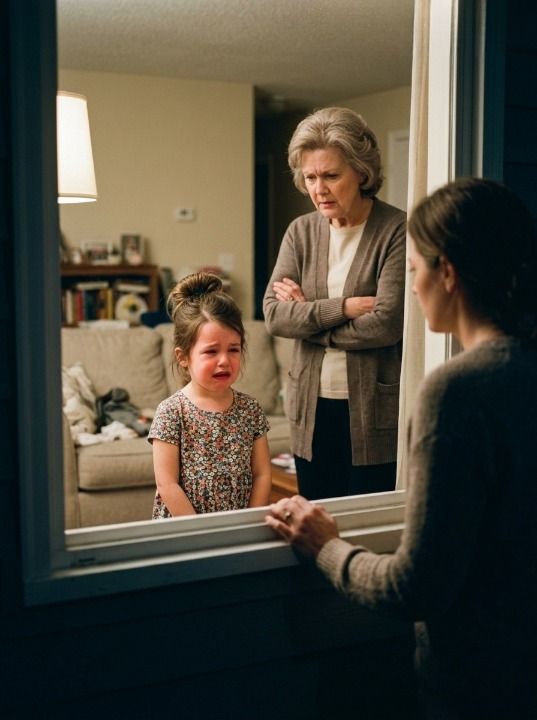
The sound was coming from a partially open window.
I moved closer, my heart pounding.
“Stop crying, Monica! This is ridiculous!”
My stomach dropped.
I carefully looked inside.
My daughter stood near the couch, crying hard, her face red and tear-streaked.
My mother-in-law stood over her with crossed arms and a frustrated expression.
“You act like your mother is abandoning you,” she snapped. “You need to be stronger!”
“I just want Mommy…” my daughter sobbed.
And then the final blow came.
“If you keep this up, no treats. No cartoons.”
My daughter’s small shoulders shook even harder.
That was the moment everything became clear.
This wasn’t about separation anxiety.
It was fear of what she endured while she stayed.
I didn’t think twice.
I walked to the door and pushed it open.
It shut loudly behind me.
Both of them turned.
“What are you doing here?” my mother-in-law demanded.
“I’m here to get my daughter,” I said firmly.
“Mommy!” my daughter cried, running straight into me.
I dropped to my knees and held her tightly.
“I’ve got you,” I whispered.
Behind me, my mother-in-law scoffed.
“You’re overreacting. She’s just dramatic.”
I stood up slowly, still holding my daughter.
“Dramatic?” I repeated.
“Yes,” she said. “She cries every morning. She needs discipline.”
“She’s four,” I said flatly.
“That’s exactly why she needs structure,” she replied.
I took a steady breath.
“No,” I said. “She needs safety, not pressure.”
She huffed. “I raised children just fine.”
“And we don’t raise them that way anymore,” I said quietly. “We don’t break them to make them behave.”
Silence followed.
Then my daughter whispered, “Mommy… can we go home?”
That was all I needed.
“We’re leaving.”
That night, my husband and I finally talked.
At first, he looked stunned.
“My mom said everything was fine,” he admitted.
“Because she knew you wouldn’t question her,” I said gently.
I told him everything I had heard and seen.
The panic in our daughter’s voice.
The fear in her eyes.
The moment I realized what had been happening.
Slowly, his expression changed—from confusion to shock, then guilt.
“I had no idea,” he said quietly.
“I know,” I replied.
We sat in silence for a moment.
Then he finally said, “We need to fix this.”
And he was right.
The next morning, I told my daughter softly, “You’re not going to Grandma’s today.”
Her eyes widened. “Really?”
“Really,” I said, smiling.
She threw her arms around me, completely relieved.
And in that moment, I understood something I should have seen earlier:
Children don’t always have the words to explain what hurts them.
But they always show us—if we’re willing to see it in time.