
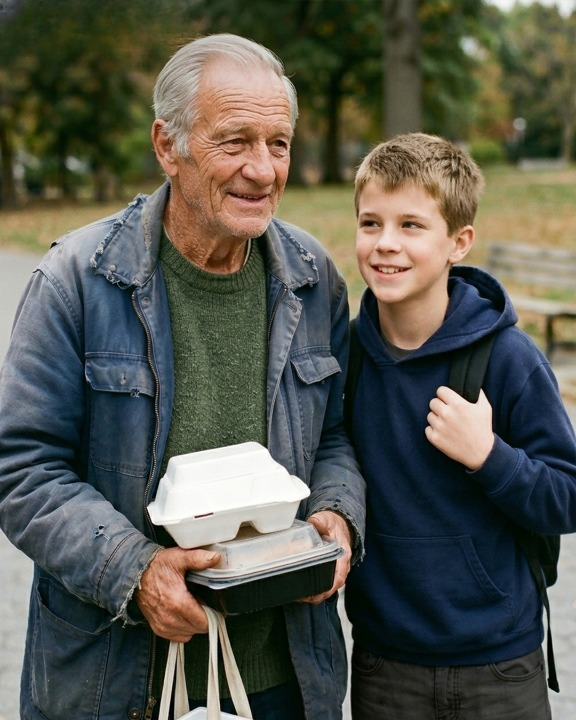
I thought my son was simply feeding a lonely elderly man outside our church. Then police arrived at our home and told us he wasn’t who he claimed to be. What they revealed shook me deeply—and changed how our entire community saw him.
The morning officers came to my door, my thirteen-year-old was at the stove making chicken soup for the man we knew as Mr. Bennett.
One of the officers showed me a photograph.
“Ma’am,” he asked, “how do you know this man?”
I glanced at my son, then back at the image.
“My son feeds him,” I said.
The younger officer exchanged a look with his partner.
The older officer opened his file, studied it, then looked at me carefully.
“Ma’am,” he said, “the man you know as Mr. Bennett is not who he says he is.”
My grip tightened on the door.
“Then who is he?”
He took a breath.
“His name is Walter.”
The soup kept simmering behind me, my son still holding the spoon, while the entire morning suddenly felt heavier.
Three months earlier
That winter Sunday at Saint Luke’s was bitterly cold. My son Noah noticed him first.
As usual, we were at church—me half-singing, Noah mouthing lyrics, and afterward planning our usual donut stop. But that day, something made him pause.
He tugged my sleeve and pointed.
An elderly man sat alone on a bench near the fence, hunched in a thin coat, hands clasped tightly.
“He looks freezing,” Noah said.
I nodded. “I see him.”
But Noah didn’t just see him—he acted. Before I could stop him, he walked straight over.
“Sir, do you need help?” he asked.
The man looked up slowly. Weathered face, white beard, straight posture despite the cold.
“I’m alright,” he said.
Noah frowned. “You don’t look alright.”
The man’s mouth twitched slightly. “Fair enough.”
That was how “Mr. Bennett” entered our lives.
A routine forms
On the ride home, Noah insisted we bring him food. I hesitated, but eventually agreed.
That evening, he cooked like it was something important—checking ingredients, correcting me about “sad peas,” and insisting we do it properly.
From then on, it became routine.
Every day, Noah planned meals for him, adjusted grocery lists, and treated it like responsibility, not charity. The man never asked for anything—he simply accepted it with quiet gratitude.
He stood when Noah approached. He spoke politely. He never begged.
And yet something about him felt… structured. Controlled. Like a man holding himself together through habit alone.
Then he vanished
One Thursday, Noah came home with untouched food.
“He wasn’t there,” he said.
The next day, still gone.
Then the bench stayed empty.
By Sunday, Noah was standing by the fence holding a sandwich, staring at the empty spot like it had betrayed him.
Something felt wrong.
The truth arrives
On Monday morning, police came.
They told us the man had collapsed behind a pharmacy and was now in the hospital. When they ran his prints, the name “Mr. Bennett” didn’t match anything.
His real identity was Walter—a decorated retired Army veteran who had disappeared from official systems after his wife died and he stopped using his benefits.
“He asked for this address,” the officer said. “He said there was a boy named Noah who brought him food every day.”
My son froze.
“He asked for me?”
At the hospital
We went immediately.
Walter looked smaller in the hospital bed than he ever had on that bench.
But when he saw Noah, his expression changed.
“You came,” he said softly.
Noah placed the thermos beside him. “You disappeared.”
Walter gave a tired, almost embarrassed smile. “Not my best decision.”
Noah asked the question we both had.
“Why didn’t you tell us who you were?”
Walter looked down.
“After my wife died, I didn’t want to be that man anymore—the one people remembered, the one people pitied. But you never asked me to be anything except hungry,” he said. “You just brought food.”
Noah whispered, “You made it feel like I mattered.”
Walter nodded. “Because you did.”
What changed everything
He had isolated himself—not because he had nothing left, but because grief made him disappear from his own life. And yet every day, my son unknowingly pulled him back into it with something as simple as a meal.
When we told the church later, Walter refused recognition.
But Noah spoke anyway.
“They keep talking about medals,” he said. “But he mattered before anyone knew who he was.”
And somehow, that was the truth everyone needed to hear.
Afterward
Walter moved into veteran housing and began receiving help.
But he still visits the church sometimes.
And Noah still brings him food.
Because some people don’t need saving in dramatic ways.
Sometimes they just need someone who refuses to stop seeing them.