
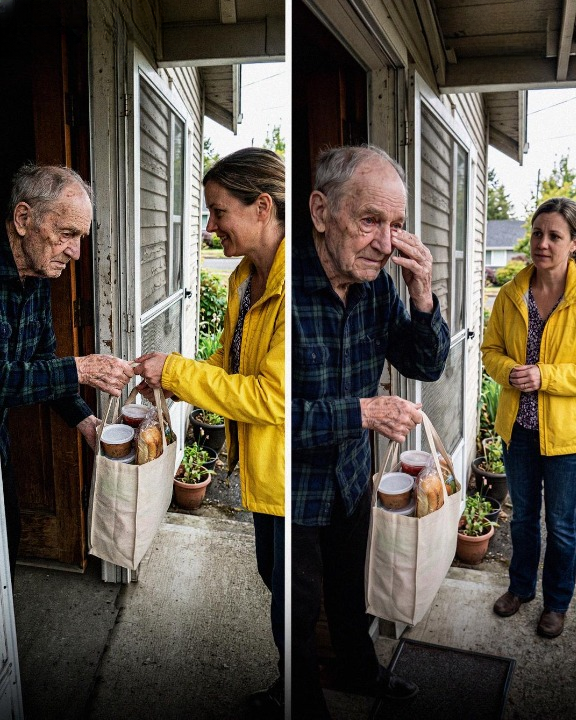
I kept showing up for someone who never asked for help and hardly ever thanked me. I never imagined those small acts of kindness would one day change my life completely.
I’m 45 years old, raising seven children on my own, and for the last seven years I cooked dinner for the grumpiest old man on my street.
His name was Arthur. He lived three houses away in an aging white house with chipped paint and a neglected porch. Newspapers often piled up by the door for days.
Most people stayed away from him.
Honestly, I understood why.
Arthur had a gift for making people feel unwelcome. If my kids rode their bikes too close to his fence, he’d yell from the porch, calling them “wild animals” and saying I was raising troublemakers.
If I waved, he’d turn around and slam the door.
That was Arthur.
And no one had ever stepped inside his house.
So when I began bringing him meals, everyone thought I’d gone crazy.
But they didn’t know what I knew.
It started one bitter winter morning. I was late for my diner shift when I saw Arthur sprawled on the icy sidewalk. He wasn’t moving or calling for help.
I dropped my bag and ran to him. “Arthur? Can you hear me?”
He slowly opened his eyes.
“Don’t make a fuss,” he muttered.
I helped him sit up. His hands shook—not from the cold, but from weakness.
When I got him to his front door, he paused and looked at me differently than ever before.
“Why would you help me?” he asked quietly. “I don’t deserve it.”
I rested a hand on his shoulder.
“No one deserves to be alone.”
He said nothing more, only stepped inside. But in that moment, I realized all that bitterness was covering a man who had forgotten what kindness felt like.
My own life was far from easy. My ex-husband Darren had disappeared years earlier, leaving debts, excuses, and children who still asked when he was coming home.
I worked mornings at a diner, cleaned offices in the afternoons, and did laundry at a roadside motel late into the night.
Some evenings I watered down soup and added crackers just to make enough for everyone. I counted portions so each child had something.
Still, I always made one extra plate.
The first time I brought it to Arthur’s door, he barely opened it.
“I didn’t ask for charity,” he growled.
“Good,” I replied. “Because I didn’t ask whether you wanted it.”
He took the plate anyway. The next morning, it was empty.
That became our routine. Arthur never exactly became warm or friendly. But five years in, something shifted.
I knocked one evening, and instead of shutting the door, he called out, “Are you coming in or not?”
I stepped inside cautiously.
The house was spotless. But what stunned me were the walls—covered in photographs. Birthday parties, school portraits, holidays, smiling children frozen in happier years.
“Your family?” I asked.
Arthur stared out the window.
“I have three kids,” he said quietly. “They stopped coming.”
That was all he offered, but it explained plenty.
After that, I understood him a little more. And I never stopped bringing food. If anything, I became more consistent.
Seven years passed that way. Neighbors called me foolish. Maybe they were right.
Then last Tuesday came.
Arthur’s porch light wasn’t on, which I noticed immediately. When he didn’t answer my knock, I tried the handle. It was unlocked.
I stepped inside.
“Arthur?”
No answer.
I walked to his bedroom and found him lying peacefully in bed, as if asleep. He was 80 years old.
His funeral was small. A lawyer had mailed me an invitation. That was where I first met his children—Daniel, Claire, and Mark.
They wore expensive clothes and stood together whispering about inheritance. None of them asked who I was.
After the service, a man approached me.
“Are you Kylie?”
“Yes.”
“I’m Thomas, Arthur’s attorney. He requested that you attend the reading of his will this afternoon at three.”
Confused, I went anyway.
We sat around a long table in Thomas’s office. Arthur’s children sat across from me. Claire leaned toward Daniel and whispered, “Who is she?”
“No idea,” he muttered.
Thomas placed a recorder on the table.
“Arthur left specific instructions,” he said. “Let’s hear them.”
Arthur’s voice filled the room.
“This is Arthur. I want to make something clear—I didn’t choose Kylie because she was kind.”
Everyone stiffened.
“Years ago, before she ever brought me dinner, I saw her sitting alone on her front steps after her husband left her for another woman. Middle of the night. Seven children asleep inside. She sat there trying to figure out how she would survive.”
I remembered that night.
“I didn’t see weakness,” Arthur continued. “I saw someone who refused to quit. And I knew if I ever had to trust someone, it would be her.”
I stared in disbelief.
“But I needed proof,” he went on. “So I acted difficult on purpose. I wanted to see if she’d give up. She didn’t.”
No one spoke.
“My children planned to sell my house. Months ago, I legally transferred ownership to Kylie. But there is a condition: she chooses what becomes of it. She may sell it and split the money with my children—or keep it and turn it into something that serves the neighborhood.”
The recording stopped.
Arthur’s children turned toward me in shock.
“This is absurd,” Daniel snapped. “You’re telling me some stranger gets the house?”
Thomas remained calm. “I’m telling you Arthur made a legal decision.”
“I didn’t ask for this,” I said quietly.
“No,” Daniel replied sharply. “But you’re not refusing it either.”
Thomas gave me three days to decide.
That night, I sat at my kitchen table staring at unpaid bills. Arthur’s house could solve everything.
But his words echoed in my head: Serve the neighborhood.
The next morning Daniel came by carrying expensive toys for my children.
“We should talk,” he said. “Sell the house. Split the money. Everyone wins.”
“And if I don’t?”
“Then you’re choosing hardship for no reason.”
Claire came later with groceries—fresh meat, fruit, things I hadn’t bought in months. She called selling “practical.”
The next day Mark arrived with no gifts and no charm.
“You’re not seriously keeping it,” he said.
“I haven’t decided.”
“You’re taking what belongs to us.”
“Your father gave me a choice,” I answered.
He glared and left.
The following morning, I asked Thomas if I could walk through Arthur’s house one last time. I brought all seven of my children.
As they ran laughing through the rooms, I froze. I had never heard laughter in that house before.
It filled every corner.
Arthur had lived there alone for years. But now it didn’t feel empty. It felt as if it had been waiting.
Three days later, we returned to the lawyer’s office.
“Kylie,” Thomas said, “have you made your decision?”
“Yes. I’m keeping the house.”
Silence. Then outrage erupted.
“You can’t do this!” Daniel shouted.
Thomas raised a hand. “There is one final instruction.”
He pressed play.
Arthur’s voice returned.
“If you’re hearing this, Kylie kept the house. Good. I knew she would. That tells me everything I needed to know.”
Claire frowned.
“I wasn’t always the man you knew. There was a time I built a company, sold it, and became a billionaire. I gave most of it away to charity over the years. But I kept some.”
Everyone stared.
“Kylie—if you chose to keep that house, then you understood what mattered. Because of that, the rest of my fortune is now yours. My children—I waited years for you to truly see me. But I couldn’t wait forever. She did.”
No one moved.
“That’s impossible,” Claire whispered.
“It’s already arranged,” Thomas said. “Accounts, transfers, all of it.”
“We’ll fight this!” Daniel shouted.
“You can try,” Thomas replied calmly. “But your father prepared for that.”
One by one, they left the room.
I signed the papers that afternoon. It still didn’t feel real.
Weeks later, the money came through. I paid every debt. Repaired what needed repairing. Moved my children into a larger home nearby.
For the first time in years, I could breathe.
And I honored Arthur’s wishes.
I turned his house into a neighborhood meal center. A long table, a working kitchen, doors open every evening to anyone who needed dinner.
At first, only a few people came. Then many more. Soon it became something the neighborhood depended on.
No one ate alone anymore.
Months later, Mark showed up at the door.
“Is it okay if I come in?” he asked.
I nodded.
The next week Claire came. Then Daniel.
Eventually, they stayed longer, talked more, and started helping—not because they had to, but because they wanted to.
One night, we all sat around that long table: my children, Arthur’s children, neighbors, laughter, plates being passed hand to hand.
I looked around and realized something simple.
Arthur hadn’t just left me a house.
He had given me a future.
And somehow, in the end, he brought his own family home too.