
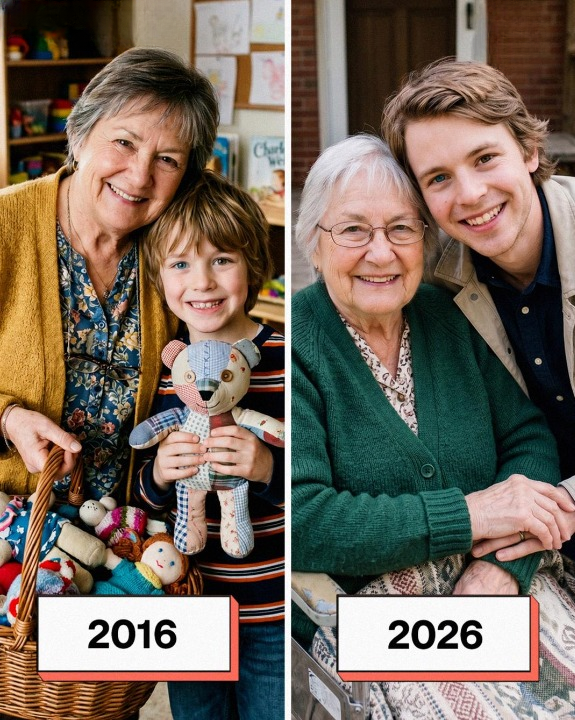
Ten years ago, my grandmother stitched a teddy bear from my missing aunt’s old sweater and gave it to a shy boy at an orphanage. Yesterday, that same boy returned as a young man, carrying the bear, a hidden locket, and a letter proving he was never a stranger at all—he was family.
I was raised by my grandmother, and one thing defines her more than anything else: she notices what others lack. Food. Warmth. Companionship. Hope. She never talks about kindness as an idea—she simply lives it.
After my parents died, she raised me, and most of the good in me came from watching her. She was the kind of woman who mended a neighbor’s coat without being asked and delivered soup to anyone who was sick.
Years ago, while I was in college, one of her closest friends who worked at a local orphanage stopped by for tea. I overheard her saying they were short on almost everything, especially toys for the children.
My grandmother looked up and asked, “Not enough for all of them?”
When her friend admitted there weren’t nearly enough, that was all the motivation she needed.
Within days, our dining table disappeared beneath piles of old clothes—jeans, sweaters, shirts. My grandmother sat there with thread and scissors, turning scraps into bears, rabbits, dolls, and little animals only she could imagine.
When I came home that Friday, I stopped in the doorway.
A basket on the table overflowed with forty handmade toys.
The next morning, we delivered them to the orphanage. I asked if she had really made all of them herself. Without looking up, she said, “Children don’t care whether something came from a store.”
I picked up a faded blue-gray teddy bear and asked what it used to be.
“An old sweater,” she said quietly.
The orphanage itself was clean but worn down—pale walls, long hallways, the smell of detergent and boiled vegetables. When the children saw the basket, they stared at it like they didn’t quite trust themselves to hope.
That’s when I noticed him.
He stood slightly apart from the others. Thin, quiet, about nine years old. One eye darker than the other. The kind of face you don’t forget.
My grandmother looked at him carefully.
“What’s your name, son?”
“George,” he answered softly.
She picked up the blue-gray bear and smiled. “Would you like this one?”
He hesitated, then accepted it with both hands. He didn’t smile right away. He only stared at it before hugging it tightly to his chest.
“It’s yours,” she told him. “Made by someone special to me.”
On the drive home, I mentioned how much the boy seemed to love the bear.
She gazed out the window and said, “Some children understand what it means when something is made just for them.”
Life moved on. I graduated, found work, and stayed nearby to help as my grandmother aged. Her legs worsened, and eventually she needed a wheelchair. But her heart never changed. Even on difficult days, she worried whether others had enough to eat.
Ten years passed.
Yesterday, someone knocked on our front door.
I opened it and froze. A young man stood there—nineteen or twenty, taller and broader now, but I recognized him instantly.
The eyes. One darker than the other.
He looked at me and asked, “Is she here?”
From behind me, my grandmother called out, “Who is it?”
He glanced past me and said, “I think she’ll remember me.”
I stepped aside.
She wheeled closer, impatient that I was blocking the doorway. Then she saw him—and went still.
He nodded. “Hello.”
Her voice trembled. “Those eyes.”
“You remember,” he said.
Then he reached into a canvas bag and pulled out an old teddy bear.
The same faded blue-gray bear.
My grandmother covered her mouth. “You kept it.”
“Always,” he replied.
I brought him into the living room. She couldn’t stop staring at the bear.
“You came all this way for that?” she asked.
“For more than that,” he said.
He removed a small worn wooden box from his bag and handed it to her with shaking hands.
“I’ve been trying to find you for years,” he said. “I found your address last week. I was afraid if I waited longer, I’d lose the chance.”
“The chance to do what?” she whispered.
“To tell you the truth.”
Inside the box was an old photograph of Clara—my missing aunt—holding a baby. There was also a tiny silver locket and a folded letter.
The moment my grandmother saw the locket, she gasped.
“It belonged to Clara,” she whispered.
George looked down at the bear in his lap.
“I found it inside the bear,” he said.
My grandmother began to cry.
“The sweater,” she said. “Clara made that bear. She stitched the name onto it too. You reminded me so much of her that day, so I gave it to you.”
George explained that a seam had split months after he received it, and the locket had fallen from the stuffing. He kept it safe, sensing it mattered. Later, when he was older, a caregiver at the orphanage gave him the letter that had been kept with his belongings.
My grandmother’s hands shook too badly to unfold it, so I helped her open it.
The first line read:
“Mama, his name is George.”
It was Clara’s handwriting.
The short letter said she was sorry. Things had gone wrong faster than she could fix them. If anything happened to her, she wanted her son to know where he came from. She wanted him to know the woman who had taught her kindness.
My grandmother whispered through tears, “Her son.”
George nodded. “I’m Clara’s son.”
For a moment, no one moved. Then my grandmother broke down sobbing.
George dropped to his knees in front of her. “I’m sorry. I didn’t come to hurt you.”
She cupped his face in both hands. “Hurt me? No. Oh no.”
I asked why the orphanage had never contacted us. George explained the letter only mentioned first names—no surname, no address, no town. There was nothing official to trace.
“So how did you find us?” I asked.
He opened the locket. Inside were engraved initials.
“That was my first real clue,” he said. “Later, someone helped me search old records. I found Clara’s birth record, which led me to this town. Eventually, I found your family name. Then your address.”
I asked what had happened to Clara.
He lowered his eyes. “Only bits and pieces. She died not long before I was taken to the orphanage. I was too young to understand much. But I remember she still spoke about her mother.”
My grandmother covered her mouth.
Then George looked at her and said softly, “I didn’t know who you were when you gave me the bear. I just remembered your kindness. You treated me like I mattered.”
She hugged the teddy bear to her chest.
“You gave me this when I had no family,” he said, voice shaking. “But it turns out you were my family all along.”
My grandmother held his hand. “You should have been with us. You should have been home.”
“I’m here now,” he answered.
The room filled with tears, silence, and the strange feeling of life rearranging itself in front of us. She held Clara’s locket in one hand and George’s hand in the other, gripping both tightly as if afraid to lose them.
After a while, she studied his face and said, “You have Clara’s chin.”
He laughed shakily. “Do I?”
“You do.”
Then he admitted quietly, “I don’t know what happens next.”
My grandmother answered immediately. “You come back tomorrow.”
He blinked. “Tomorrow?”
“Yes. And the day after, if you’d like. We’ve already lost enough time.”
That was the first time he smiled.
“Okay,” he said. “Tomorrow.”
After he left, my grandmother sat silently with the bear in her lap. She looked exhausted, but no longer empty.
I took her hand. She stared at the worn teddy bear and whispered,
“All these years, I thought Clara had gone away from me.”
Then she touched the locket and smiled through tears.
“But she still found a way to send him home.”