
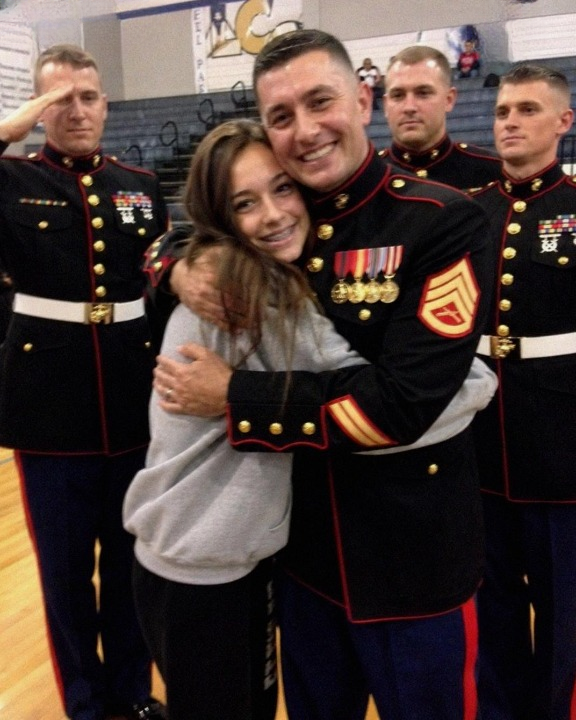
When my 14-year-old daughter got detention for standing up for her late father in class, I assumed I was heading into yet another battle with the school. I never imagined that by the next morning, the entire town would be reminded of the man she refused to let be mocked.
Last week, the school called me in for a meeting.
Grace sat beside me, hands tightly clasped in her lap, eyes fixed on the floor.
I asked, “What happened exactly?”
Her teacher sighed. “Another student made an insensitive remark, and Grace responded by yelling and knocking over her chair.”
Grace looked up, her cheeks blotched from crying.
The vice principal cleared his throat. “The other student is being disciplined separately. Grace received detention for disrupting class.”
“That’s not all she said,” Grace snapped.
The teacher gave her a warning look. “Grace.”
I turned to her. “Tell me.”
She swallowed hard. “She said maybe Dad just didn’t want to come back.”
No one corrected her. That told me everything.
For a moment, the room fell silent.
Then I asked, “And she laughed?”
Grace nodded.
I looked at the adults across from me. “So my daughter had to sit there while someone mocked her dead father, and your solution was detention?”
“We’re handling both students,” the vice principal said.
“Not the same way,” Grace muttered.
When she looked at me, her face crumbled.
No one argued.
That night, I found her sitting on her bedroom floor wearing her father’s old sweatshirt, his dog tags clutched in one hand.
She looked up at me, devastated.
“I’m sorry I got in trouble,” she whispered. “I just couldn’t let her say that about him.”
I sat beside her.
“You never need to apologize for loving your dad.”
“I lost it.”
That earned the faintest smile.
“Yeah,” I said. “You did.”
She stared at the tags. “What if I embarrassed him?”
I let out a broken laugh.
“Grace, your father once got written up for arguing with a superior officer because he thought the man was disrespecting a younger Marine. Embarrassing authority was one of his favorite hobbies.”
That brought another tiny smile.
The next morning, the school announced an emergency assembly.
I stood so fast I knocked over my coffee.
At 8:17, Grace texted me.
Mom are you awake
I replied, Yes. What happened?
Then she called.
Her voice trembled. “Mom… you need to come.”
My heart raced. “What’s wrong? Are you okay?”
There was a pause. I could hear voices behind her.
Then she said, “Four Marines just walked into the auditorium.”
My throat tightened. “What do you mean Marines? Is something wrong?”
She let out a stunned laugh. “No, not like that. They brought a flag. Everyone had to stand. The principal said they were already planning to contact us this week, and then someone from school told them what happened yesterday.”
I grabbed my keys. “Tell me everything.”
The drive felt endless.
When I arrived, the auditorium was packed. Students filled every seat. Teachers lined the walls. A banner for the school’s upcoming service recognition week still hung above the stage.
Grace sat in the front row.
Onstage stood the principal and four Marines in dress blues.
She noticed me near the back and gave me a strained expression that admitted how badly the school had mishandled everything.
Then she stepped to the microphone.
“Yesterday, one of our students was hurt in a way that should never have happened here,” she said. “Today, we have a chance to correct part of that failure and honor a service member whose family should have received this recognition years ago.”
One of the Marines stepped forward. He was older now, silver at the temples, carrying himself with practiced composure.
He looked first at Grace.
“Your father was Staff Sergeant Daniel,” he said. “I served with him.”
Grace covered her mouth.
He opened a velvet box.
Inside was a Bronze Star medal.
A ripple moved through the room.
Another Marine stepped forward carrying a folded flag.
“This commendation was approved years ago,” he said, “but was never formally presented because of an administrative error during a post-operation review. I was assigned to help correct that. After hearing what happened here yesterday, we asked if we could present it today.”
That changed everything.
This had not appeared from nowhere. It had been waiting for us all along.
Then another Marine addressed me.
“This is a ceremonial replacement display flag. Your family should have received a proper one at the time of notification. That failure is being corrected as well.”
My knees nearly gave out.
Then Captain Ruiz continued.
“Your husband was brave. But bravery alone is too small a word. He was steady. He made people laugh when times were hard. He wrote home whenever he could. He was proud to be a Marine, and proud to be Grace’s father.”
Grace broke then—not loudly, just tears she couldn’t stop.
Ruiz stepped off the stage, knelt before her, and said softly, “He talked about you all the time. He would be very proud of you.”
The entire auditorium fell silent.
Then the principal said, “There is one more thing. Her classmate asked to speak.”
The girl stepped into the aisle, face flushed, hands shaking.
She stopped in front of Grace.
“I was cruel,” she said. “I didn’t understand what I was saying, and I said something awful. I’m sorry.”
Grace stared at her for a long moment.
Then she nodded once.
When the assembly ended, Grace ran into my arms.
Into my shoulder, she whispered, “They remembered him, Mom.”
I kissed her hair.
“No, baby. They never forgot.”
That should have been the end of it.
But it wasn’t.
That night, the medal sat on our kitchen table beside the folded flag. Grace kept passing by it, as if checking whether it was real.
Then she stopped.
“Mom?”
“Yeah?”
“If this was approved years ago… why didn’t we get it?”
I opened my mouth with the easiest answer.
“Paperwork. Delays.”
But even as I said it, something tightened inside me.
Because if I was honest, there had always been something strange about the records after Daniel died. Too polished. Too thin. Too quickly closed.
The next afternoon, Captain Ruiz called.
“I hope I’m not intruding,” he said. “There are some next-of-kin documents tied to the reopened review that I think should be delivered in person.”
An hour later, he sat at my kitchen table with a sealed envelope.
Grace hovered in the doorway until Ruiz looked at her and said, “You can stay. This concerns your father too.”
Inside were records, citations, witness statements, and a handwritten letter Daniel had mailed to his unit chaplain after a difficult week.
Ruiz spoke carefully.
“The medal delay was real. But reopening the commendation file also reopened questions about the mission itself.”
I looked at him. “What kind of questions?”
“The kind your family should have been told existed.”
I opened the mission reports.
By page three, I understood.
The mission where Daniel died had been flagged in advance. There were concerns about faulty intelligence. Concerns about timing. Warnings from men on the ground.
Daniel had gone anyway because it was his duty.
Then everything went wrong.
He pulled others out. Covered them. Died doing it.
For years, I had carried grief.
Now anger joined it.
Grace asked quietly, “Did they lie about Dad?”
I looked at her. “Not about him.”
“Then about what?”
Ruiz answered. “About how complete the story was.”
Grace looked sick. “So he died because someone messed up?”
Ruiz’s silence answered her.
I spent the next several months asking questions.
Most responses were redacted. Some offices contradicted themselves. I pieced together the truth from fragments, follow-up calls, and details no one had fully erased.
By the end, one thing was clear:
Daniel and at least one other Marine had raised concerns before that mission. Those warnings were documented and dismissed. Afterward, the official version emphasized sacrifice and heroism—which was true—but buried the failures above them.
Later that spring, during the school’s service recognition event, the principal asked if I wanted to say a few words.
I almost refused.
Then I saw Grace in the front row, her father’s dog tags hidden beneath her blouse, and I folded my prepared remarks in half.
I stepped to the microphone.
“My husband was a hero. I’m grateful people are finally saying that in front of my daughter. But I’ve learned something in the months since Captain Ruiz brought us his file. Heroism and failure can exist in the same story. People on the ground can do everything right and still be failed by the people above them.”
The room went still.
I continued.
“For years, I was given a version of my husband’s death that was honorable, but incomplete. He deserves the full truth. So do the families of everyone we ask to serve. Respect does not mean sanding grief down until it becomes easier for institutions to live with.”
My voice shook, and I let it.
“He was brave. He was funny. He loved his daughter more than anything. If we remember him, then we remember all of him—not just the parts that make everyone else comfortable.”
When I stepped back, silence hung for one long second.
Then Ruiz stood and saluted.
Another Marine beside him did the same.
Then a veteran near the bleachers rose too.
After that, a local paper called. Then another family from Daniel’s unit reached out. Then the school quietly erased Grace’s detention from her record—which mattered far less than I once thought it would.
What mattered was what happened at home.
I told Grace everything.
And she began asking different questions.
Not how he died.
How he laughed.
What he ordered at restaurants.
Whether he sang in the car.
If he was ever scared.
I told her everything.
That he burned pancakes but kept trying.
That he sang loudly and badly.
That he cried the first time he held her, then denied it while still crying.
That is where we are now.
One night, she pinned the medal beside an old photo of him holding her as a toddler.
She stood there for a long time.
Then she said, “I think I know him better now.”
I stood beside her, looking at the man I loved frozen young in a photograph, our daughter in his arms.
“So do I,” I said.
We are not healed. Not completely. Not neatly.
But we are clearer.
My daughter no longer carries her father’s memory like something she has to defend alone.
And no matter how long it took, he was finally honored in front of the person who needed it most.