
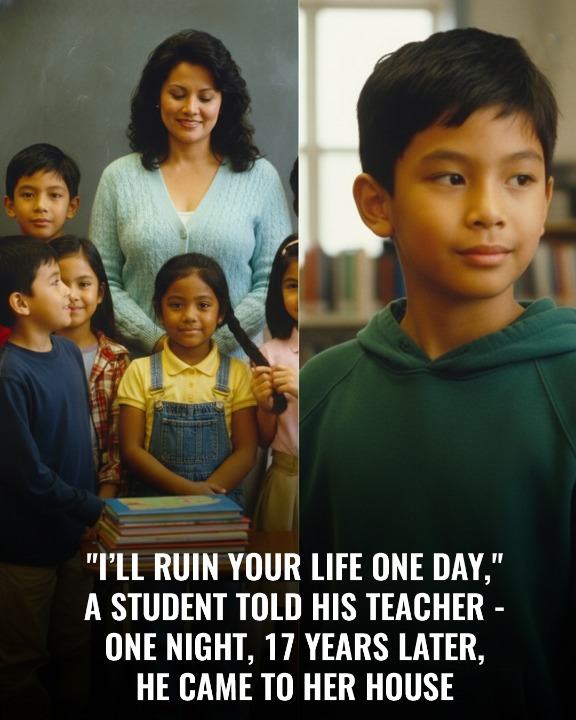
Seventeen years ago, I had a student who stood in my classroom shaking with rage and told me he would ruin my life. I never imagined those words would follow me for decades—until one night, they came back to my doorstep.
“I’ll ruin your life one day!”
I can still hear Daniel’s voice when he said it—cracked with anger, humiliation, and something deeper he couldn’t name. His hands were clenched, his whole body trembling as the class watched in stunned silence.
I tried to calm him. “Daniel, sit down. You’re not thinking clearly.”
But he wouldn’t stop. He accused me of controlling him, of not understanding him, of thinking I knew what was best for his life.
“I don’t need your help!” he shouted.
Then came the words that stayed with me long after he walked out.
“I’ll ruin your life one day. You’ll see!”
I remember the cold finality in my own voice when I sent him out of the room. I told myself it was just another outburst, another difficult student. But something about him lingered in my memory.
Years passed. I retired. Life became quiet—almost empty. But those words never fully left me.
Then, at 68, everything changed.
One night, around 2 a.m., someone knocked urgently on my door. At first, I thought it was a mistake or an emergency nearby. A calm voice on the other side said, “Police.”
My stomach dropped.
When I opened the door, I froze.
At first, I didn’t recognize him. But then I saw his eyes.
Daniel.
Older now. Composed. Standing there in a police uniform.
“You remember me?” he asked.
I could barely speak. “Daniel…?”
“Yes,” he said simply.
My mind raced. Fear came instantly, mixed with disbelief. I asked him why he was there, unable to understand what this meant after so many years.
He didn’t answer right away. Instead, he reached into his bag.
I tensed immediately—but what he pulled out wasn’t dangerous. It was an old, worn notebook.
And then I saw it.
My handwriting inside.
It was his confiscated notebook from years ago—the one I had taken from him in class.
“You still have that?” I asked, stunned.
He nodded. “You took it from me. And then you wrote in it.”
I remembered then. The pages full of anger, confusion, sketches… and the moment I had written a note inside it, trying to reach him beyond discipline.
I opened the notebook again and read my own words:
“You are not what your anger says you are. But if you don’t learn to control it, it will decide your future for you.”
My breath caught.
“Why do you still have this?” I asked.
Daniel’s voice softened. “Because it was the first time someone saw me instead of judging me.”
The air between us changed.
He admitted he had meant his words back then—but not in the way I had always feared. Not as revenge.
It had been pain speaking. Not a plan.
He told me that those words I wrote never left him. He carried them through the worst parts of his life—through mistakes, near breakdowns, moments he almost gave up completely.
“I thought I hated you for it,” he said quietly. “But you were the only person who didn’t give up on me when I made it hard to care about me.”
Tears blurred my vision.
Then he reached into his bag again and handed me an envelope.
Inside was an official recognition letter. My name was there, acknowledging the impact I had on his life as an educator.
“I wouldn’t be here without you,” he said simply.
And in that moment, all the fear I had carried for 17 years dissolved into something else entirely—grief, relief, and a quiet understanding that the words I once feared had never been a promise of harm… but a cry from a boy who didn’t know how else to be heard.