
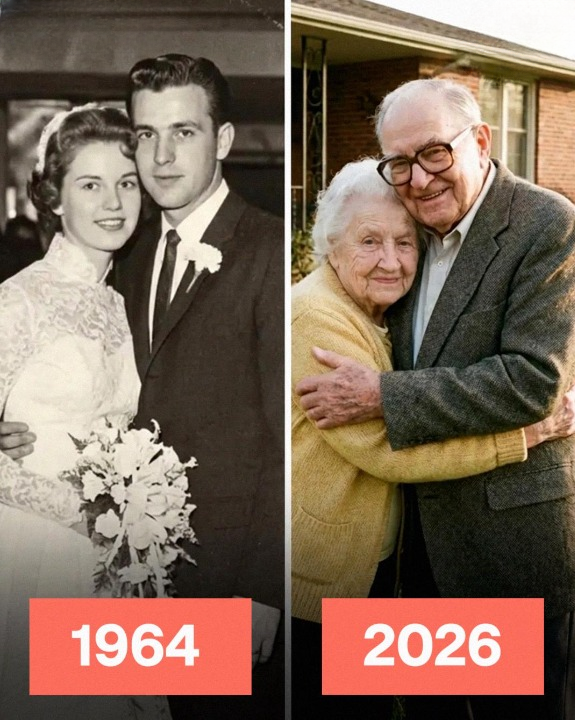
Harold and I spent 62 years together, and I believed I knew every part of the man I married. Then a girl I had never seen before appeared at his funeral, handed me an envelope, and hurried away before I could ask her anything. What was inside that envelope began a story my husband had never found the courage to tell me himself.
I could barely make it through the service that day.
Harold and I had been married for 62 years. We met when I was 18 and married within a year. Our lives had become so deeply intertwined that standing in that church without him didn’t just feel like grief — it felt like trying to breathe with only half my lungs.
My name is Rosa, and for more than six decades Harold had been the most constant part of my life. Our sons stood close beside me, and I held onto their arms just to stay steady.
People were beginning to leave when I noticed her — a girl, maybe 12 or 13 years old, someone I didn’t recognize at all. She moved through the thinning crowd, and the moment her eyes found mine, she walked straight toward me.
“Are you Harold’s wife?” she asked.
“Yes, I am.”
She held out a simple white envelope. “Your husband asked me to give this to you today. At his funeral. He said I had to wait until this exact day.”
Before I could ask her name, how she knew Harold, or why a child was delivering a message from a man who had been ill for months, she turned and ran out of the church.
My son touched my arm. “Mom? Are you okay?”
“I’m fine… really.”
I slipped the envelope into my purse and didn’t mention it again.
That evening, after everyone had gone home and the house had settled into the quiet that follows a funeral, I sat at the kitchen table and opened it.
Inside was a letter in Harold’s familiar handwriting — and a small brass key that clinked softly on the table when it fell from the envelope.
The letter began simply:
“My love. I should have told you this years ago, but I couldn’t. Sixty-five years ago, I believed I had buried this secret forever, but it followed me through my entire life. You deserve the truth. This key opens Garage 122 at the address below. Go there when you’re ready. Everything is inside.”
I read it twice.
Even though I wasn’t ready, I put on my coat, called a taxi, and went.
The garage stood on the edge of the city — a long row of identical metal doors that looked like they hadn’t changed since the 1970s. I found number 122, unlocked the padlock with the key, and lifted the door.
The first thing that struck me was the smell — old paper, cedar, and the stale air of a space that had been closed for years.
In the middle of the concrete floor stood a huge wooden chest, almost as tall as I was, covered with dust and thick cobwebs.
I wiped the front clean, found the latch, and slowly opened it.
Inside were children’s drawings tied together with faded ribbons, birthday cards addressed to Harold, school certificates, and dozens of carefully preserved letters.
Every one of them was signed with the same name:
Virginia.
At the bottom of the chest was a worn folder. When I opened it, I found documents from 65 years ago explaining that Harold had quietly supported a young woman and her infant daughter after the child’s father disappeared. He had paid their rent, later covered school costs, and sent them a modest monthly allowance for years.
He had saved every letter the woman ever wrote to him.
One thought immediately filled my mind.
Harold had another family — a hidden life he had kept secret for six decades.
I sank down onto the cold garage floor and covered my mouth with my hands.
“Oh, Harold,” I whispered. “What did you do?”
Just then, I heard tires crunching on the gravel outside.
A bicycle skidded to a stop.
When I looked toward the open door, the same girl from the funeral was standing there, breathing heavily.
“I thought you might come here,” she said.
“You followed me?”
She nodded. “I rode behind the taxi. When I felt the key in the envelope earlier, I couldn’t stop wondering what it opened. When Harold asked me to deliver it, he told me it would be the most important thing I’d ever do.”
I stared at her.
“Who are you? How do you know my husband? What’s your mother’s name?”
She stepped closer and looked curiously at the chest.
“My mom’s name is Virginia,” she said. “And I’m Gini.”
I felt the air leave my lungs.
“Did your mother ever say who Harold was to her?”
Gini shook her head. “She always called him the man who made sure we were okay. She said he’d been very close to my grandma. But she never said he was her father.”
If Harold wasn’t Virginia’s father, why had he supported her for so many years?
“Can you take me to your mother?” I asked.
Gini looked down at her shoes.
“My dad left when I was little,” she said quietly. “My mom is in the hospital right now. I stay with a neighbor most of the time. That’s how I found out Harold died — she showed me the obituary.”
“What’s wrong with your mother?”
“She needs heart surgery,” Gini said calmly. “But it costs too much.”
“I want to see her.”
We put Gini’s bicycle into the taxi and drove to the hospital.
Her mother lay in a narrow bed, pale and thin, with tubes running from her arm. She looked younger than her illness allowed.
“She’s been here for two months,” Gini whispered. “Harold used to visit sometimes. The last time I saw him, he gave me the envelope and made me promise to deliver it to you.”
Later, I spoke to the doctor in the hallway.
“The surgery is urgent,” he said. “Without it, her chances are very poor. The problem is the cost.”
Standing there, I suddenly understood what Harold had done.
He had known what I would find. He had known what needed to happen next.
Two days later, I returned with the money for the surgery.
Harold and I had spent our whole lives saving carefully, and using that money didn’t feel like a sacrifice. It felt like finishing the work he had started.
The operation lasted six hours.
It was successful.
When Virginia was strong enough to sit up, I introduced myself as Harold’s wife.
She looked at me for a long time before whispering, “Your husband saved us. My mother and I would never have survived without him.”
But one question still troubled me.
Why had Harold kept this secret for so many years?
A few days later, Virginia invited me to her home and showed me an old photo album.
As I turned the pages, I watched her life unfold in photographs.
Then I reached one picture that made my breath stop.
It showed a young Harold standing beside a teenage girl holding a newborn baby.
And I knew that girl.
She was my older sister, Iris — the one who had run away when I was 15 and never returned.
“My mother,” Virginia said softly. “She passed away 12 years ago.”
I could barely speak.
Later that night, I returned home and opened Harold’s old diary.
Entry by entry, the truth came together.
Sixty-five years ago, Harold had found my sister alone with a newborn after the man who promised to marry her disappeared. At first he hadn’t realized who she was. Only later, when he saw a locket with our childhood photo inside, did he understand that the girl he was helping was my sister.
By then, he had already begun courting me.
He knew how deeply my parents had been hurt by Iris leaving. He knew revealing her situation might reopen wounds that had never healed.
So he did what he always did.
He helped quietly.
For decades he supported my sister and her daughter without telling anyone — not even me.
The next day I went back to Virginia and Gini and told them everything.
“You are my sister’s daughter,” I told Virginia gently.
Then I looked at Gini.
“And that makes you my great-niece.”
For a moment the kitchen was completely silent.
Then Gini climbed down from her chair, walked over to me, and wrapped her arms around me.
I held her tightly and thought about Harold — about the weight he had carried alone for 65 years.
My husband hadn’t been hiding a betrayal.
He had been protecting a family.
Two families.
And in the end, the secret he kept didn’t tear us apart.
It brought us all back together.