
My daughter kept talking about a teacher who humiliated her in class. I didn’t think much of it until I saw the same name listed as the organizer of her school’s charity fair. The very same woman who tormented me years ago had returned—and this time, she picked on my daughter.
School had been the hardest time of my life. One teacher made sure I never left her class without feeling small. Even now, I can’t understand what she gained from publicly shaming me.
Her name was Mrs. Mercer. She mocked my clothes, called me “cheap” in front of everyone, and once told me, “Girls like you grow up broke, bitter, and embarrassing!” I was only 13. That night I went home and didn’t eat dinner. I didn’t tell my parents—I was terrified she’d fail me in English—and my classmates were already teasing me for my braces.
When I graduated, I left that town with one bag, determined to never think of Mrs. Mercer again. I built a new life elsewhere, one I could finally call my own.
Then she reappeared in my world. My 14-year-old daughter, Ava, came home quiet, pushing her dinner around. She told me about a teacher who’d been belittling her in front of everyone, calling her “not very bright.” She begged me not to get involved, fearing more embarrassment. But I couldn’t ignore the pattern.
Before I could confront the teacher, I fell ill and was bedridden for two weeks. My mother took over everything—school drop-offs, lunches, home care. I watched helplessly as Ava faced the classroom alone.
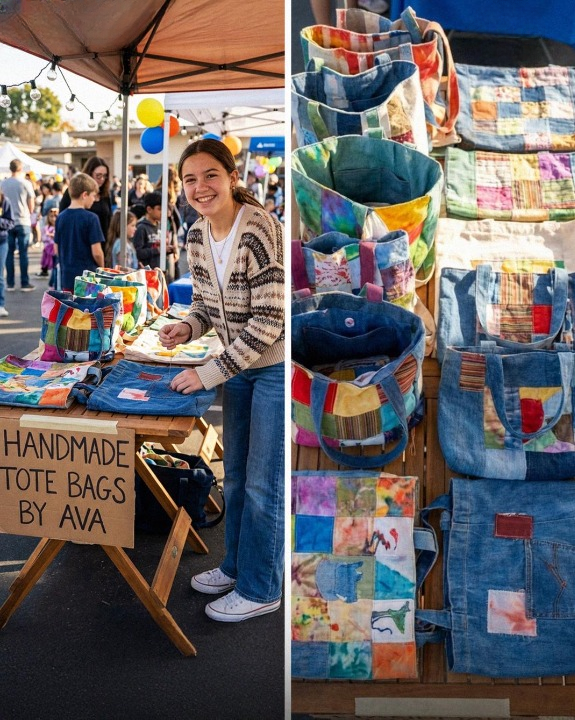
Then the school announced a charity fair. Ava dove into it headfirst, sewing tote bags from donated fabric to raise money for winter clothes. I watched her work late into the night, proud yet anxious, wondering who was behind her torment at school.
A flyer arrived: the fair’s faculty coordinator was listed—Mrs. Mercer. My stomach dropped. She had not only returned but was now in my daughter’s classroom, repeating the same cruel behavior I endured.
At the fair, the gym smelled of popcorn and cinnamon. Ava’s table displayed twenty-one neatly arranged tote bags with a note: “All proceeds go to families in need!” Parents admired her work, but I kept my eyes on the crowd for Mrs. Mercer.
She appeared, older and grayer but unmistakably her old self. Her gaze met mine, recognition flashing. She sneered at Ava’s work, muttering about “cheap fabric” and “cheap standards,” dismissing the effort entirely.
Something inside me that I’d carried for decades snapped. I grabbed the microphone. “I think everyone should hear this,” I said, and the room quieted.
“When I was 13,” I continued, “this same teacher told me girls like me would grow up ‘broke, bitter, and embarrassing.’ Today, she said the same to my daughter.”
I held up one of Ava’s tote bags. “This was made by a 14-year-old who stayed up for two weeks sewing with donated fabric—her work is not for praise, not for a grade, but to help people she’ll never meet.”
Parents and students started speaking up, one by one, sharing their own experiences with Mrs. Mercer’s cruelty. The room realized together that her behavior was unacceptable.
I looked her in the eye. “You don’t get to stand in front of children and decide who they become. You told me what I’d become—you were wrong. I’m not rich, but I raised my daughter with love, hard work, and generosity. I don’t tear others down to feel better about myself.”
The room fell silent. Then applause began. Ava stood taller than she had in weeks, proud and relieved. The principal stepped in, and Mrs. Mercer was confronted officially, leaving without the authority she once wielded.
By the end of the fair, every one of Ava’s tote bags had sold. That evening, Ava leaned against me and said softly, “Mom, I was so scared.”
I held her close. “I know, baby. But you weren’t scared anymore.”
Mrs. Mercer once tried to define me. She will never define my daughter.