
Daniel Whitmore gripped the letter as if it were a lifeline, his fingers trembling slightly even though the sleek glass office in Manhattan remained silent and pristine.
Outside, New York sparkled with its usual relentless energy—towering skyscrapers, yellow cabs zipping by, and people rushing as though time obeyed their every command. For decades, Daniel had been one of them. But at sixty-five, the billionaire founder of Whitmore Industries felt a sensation he hadn’t known in years: doubt.
The envelope had no return address. Just a name written in careful script: Emily Whitmore, his ex-wife. A name he hadn’t allowed himself to think of in nine years. Beneath it, an address in a remote Kentucky town so isolated that his GPS hesitated to recognize it.
Daniel had spent his life running from that place, from that past—the day he yelled, humiliated, and expelled her from his mansion, slamming the door as if closing a chapter forever.
Yet the letter carried no anger. No accusations. Only a location, almost as if the past had finally found its way back to him.
“Are you sure about this, Mr. Whitmore?” asked Marcus, his longtime driver.
“This time… I’ll go alone,” Daniel replied quietly.
He rented a modest van, left his tailored suits behind, and drove for hours. The city faded, replaced by fields and quiet roads. Sirens vanished, the air felt heavier, older. As he drove, he rehearsed apologies in his mind, but nothing could prepare him for what awaited.
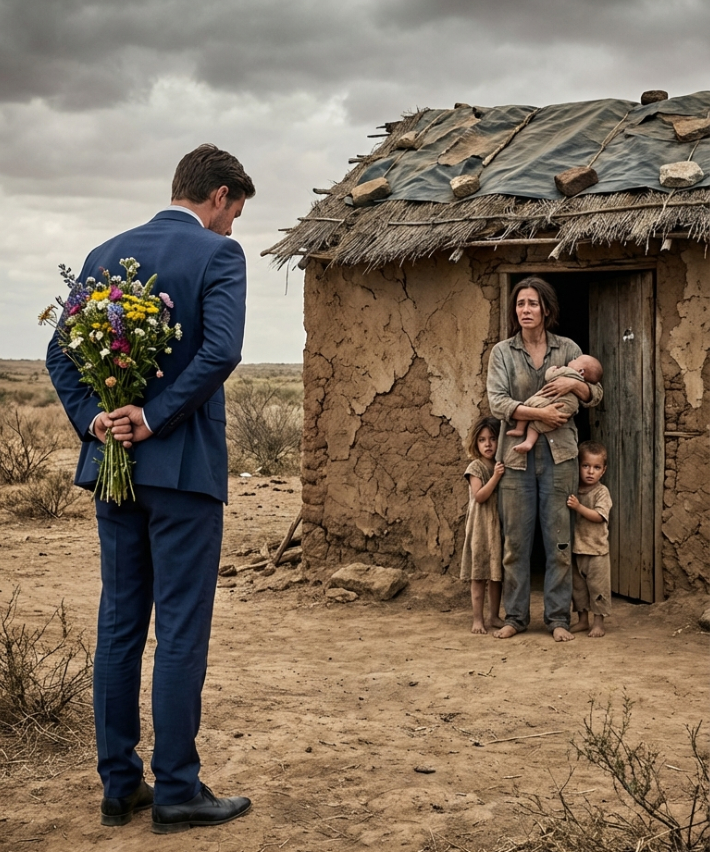
When the GPS finally announced his arrival, Daniel slammed the brakes. Before him was not a house but a wound—a small wooden structure leaning to one side, peeling paint, a sagging roof, cracked porch steps. Wealth had never touched this place.
Emily emerged, carrying a small bouquet of wildflowers from a roadside stand. After nine years, he felt ridiculous—flowers? A gust of wind stole a petal and sent it skimming across the dusty yard.
He knocked.
“Emily?” he called.
The door creaked open, revealing a woman changed. Gray streaked through her once-golden hair, hands marked by years of work, eyes the same soft blue but colder, calm where warmth had been.
“What are you doing here, Daniel?” she asked, her voice guarded.
“I needed to see you,” he admitted. “We need to talk.”
Emily crossed her arms.
“After everything you did?”
“I didn’t come to fight,” he said, holding out the flowers. “I… I’m losing everything.”
She eyed the bouquet like it was a joke.
“Did you come to buy forgiveness?” he asked, ashamed.
“How did you used to buy everything else?” she countered.
An old neighbor appeared briefly, exchanging greetings with Emily before Daniel stepped inside. The home was small, tidy, humble—far from the wealth he had known.
Emily recounted her story: the eviction, the women’s shelter, the hard labor, the tiny house her grandmother left behind—the only thing he couldn’t take. Daniel listened, stunned.
“I didn’t know,” he murmured.
“You didn’t want to know,” she corrected.
He confessed that the company was near collapse. Emily reminded him that her strategies had been the heart of their past successes. Slowly, he realized the depth of what he had lost.
Emily handed him a folder containing their old project plans—innovative strategies for transforming the company sustainably. Together, they began to rebuild, but Daniel’s perspective changed too. He experienced honest labor, helping neighbors, carrying water, mending roofs. For the first time, hard work felt meaningful.
Weeks later, under a star-filled sky, Emily revealed a devastating truth: she had been pregnant when he kicked her out—and she lost the baby from stress and hunger. Daniel broke down, crying for the first time in decades.
Over time, Whitmore Industries recovered, stronger and more purposeful. Daniel rejected a $1 billion buyout, saying he had finally discovered something more valuable than money: purpose. He and Emily worked side by side—not as lovers yet, but as equals, perhaps friends.
Six months later, they gave their relationship a second chance. Their remarriage was simple, without luxury, surrounded by family and laughter, in a community they had rebuilt together.
Walking home beneath the Kentucky stars, Daniel whispered:
“I had to lose almost everything to understand what truly matters.”
Emily squeezed his hand.
“Sometimes life takes away what you have too much of… so you can finally see what you were missing.”
Daniel finally understood: true wealth was not in money or power, but in creating something meaningful—with your hands, your heart, and the people you love.