
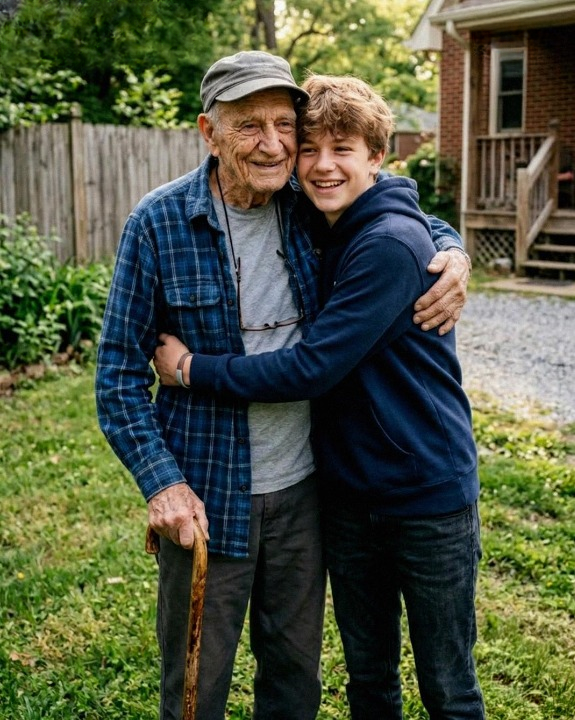
For weeks, the teenage boy across the street had been signaling S.O.S. in Morse code from his bedroom window. I’m Harold, a former Marine, and at first, I thought he was joking. But when one night his message changed to WE NEED YOUR HELP, I realized he had been trying to reach out for help all along.
I’d lived a quiet life for years in my small house, but everything shifted when new neighbors moved in: David and Sarah, a couple in their 40s, with their teenage son Leo and young daughter Mia. They looked like a perfect family, but appearances can be deceiving.
The next day, they introduced themselves. David extended his hand, Sarah offered a cherry pie, and their kids followed behind. Leo, the teenager, kept his chin down and hands in his pockets, while Mia smiled brightly.
A week later, I watched from my porch as David trained Leo on throwing a ball. At first, it looked like play, but David’s intensity revealed it was serious coaching. Leo’s throws were sloppy, and when his father left, his shoulders slumped. I offered him advice across the street, and he seemed unsure but tried again, nodding a quiet thanks after a cleaner throw.
Then the strange signals began. Three short, three long, three short—S.O.S. My pulse spiked, joints creaking, as I peered out at the quiet street. At first, I thought it was a prank. But the signals continued night after night. On the fourth night, I flicked my lamp in warning, and Leo’s light went out instantly.
A couple of days later, I caught him at the mailbox. I told him the signal was serious and shouldn’t be used as a joke. He replied calmly, “I never joke, sir. Watch your window carefully.” Then he walked away. For a few nights, the flashing stopped.
Then it returned, and the message was no longer S.O.S.: WE NEED YOUR HELP. COME INTO THE HOUSE. A chill ran down my spine. Years in Vietnam had taught me to trust that gut feeling. I grabbed my cane and went out into the cool night air.
Their front door stood wide open. Inside, a heavy thud sounded, followed by shouting. I stepped in and saw an overturned side table and David and Leo in a heated argument. David was frustrated, insisting he had built a path for his son and sacrificed for him, while Leo insisted he wanted to choose a different life.
When they noticed me, David demanded to know why I was in the house. I explained I had seen the lights and was concerned. David tried to dismiss it as a family disagreement, but I told him Leo had been signaling for days.
Leo explained calmly that his father never listened when he tried to talk. He needed someone to see him, to acknowledge his presence. He wanted to be an EMT, to help people in need. David argued that he could achieve more and have a “stable” career, but Leo insisted that meaningful work mattered more than safety or comfort.
I stepped in, drawing on my experience: “Pressure can build strength, David, but if you don’t know when to let off the gas, it just makes dust. You’ve got a good man standing right in front of you. Don’t break him.”
The room shifted. David finally saw his son without the lens of his expectations. “I’m not trying to crush you, Leo,” he said, voice softening. “I just wanted to shield you from struggle.”
“I’d rather struggle for something that matters,” Leo said.
A week later, Leo knocked on my door, calmer, shoulders squared. He wanted to learn first aid and practical skills from me. We didn’t talk about heroics; we focused on keeping steady under pressure and staying calm in chaos.
I still saw David across the street sometimes, waving from his yard—not disapproving anymore, just learning to listen.
One night, I noticed Leo’s room flicker again. The message was clear: THANK YOU. I responded with a flick of my lamp. Message received. I climbed into bed with a smile, feeling the satisfaction of making a difference once again.