
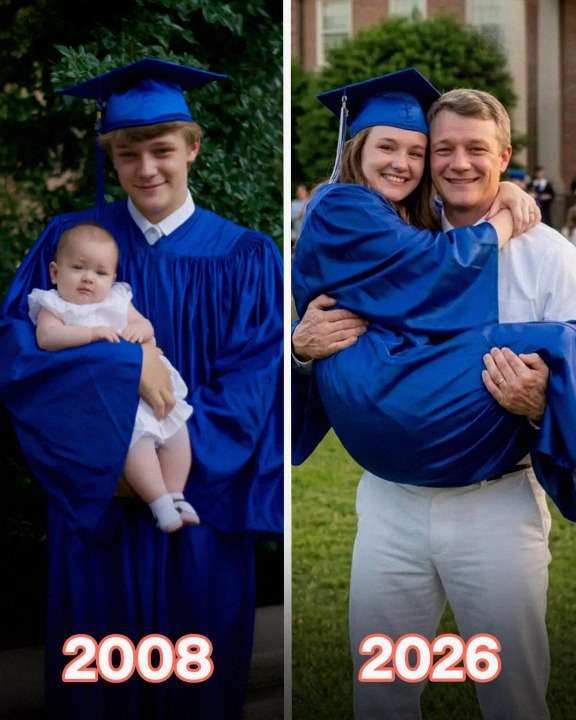
My dad raised me on his own after my birth mother abandoned me. On my graduation day, she suddenly appeared in the crowd, pointed at him, and said, “There’s something you need to know about the man you call ‘father.’” That moment made me question everything I thought I knew about the man who had raised me.
The most important photo in our house hangs above the couch. The glass is cracked in one corner from when I hit it with a foam soccer ball at eight.
In the picture, a thin teenage boy stands on a football field wearing a crooked graduation cap, holding a baby wrapped in a blanket. That baby was me.
I used to tease him, saying, “You look like I’d break if you even breathed too hard.” He’d laugh and shrug, saying he was nervous he’d hurt me, but clearly, he did more than okay—he did everything.
That night, my dad was 17. He came home exhausted from delivering pizzas and noticed a bundle in his bike basket. At first, he thought it was trash. Then it moved. Inside was a baby girl with a note: She’s yours. I can’t do this.
He had no one to call—his parents were gone, and he was living with an uncle who barely spoke to him. Still, he picked me up and never put me down again. The next morning was his graduation. Instead of panicking, he wrapped me tighter, grabbed his cap and gown, and walked into the ceremony with both of us. That’s when the photo was taken.
He skipped college to raise me, working construction in the mornings and delivering pizzas at night. He learned to braid my hair from YouTube tutorials, burned countless grilled cheese sandwiches, and somehow made sure I never felt abandoned.
So when my graduation finally came, I brought no date—I brought him. We walked across the same football field where the photo had been taken. He tried not to cry, his jaw tight, and I teased him about it. For a brief moment, everything felt right.
Then she appeared.
A woman stood up from the crowd, walking directly toward us. Her gaze made the hair on the back of my neck stand up. She stopped a few feet away and whispered, trembling, “Before you celebrate today, there’s something you need to know about the man you call ‘father.’”
The field went silent.
“She’s not your father,” the woman said. “He stole you from me.”
Dad’s face turned to terror. “That’s not true… at least not all of it.”
“I’m your mother, and he’s lied to you your entire life!” she shouted. My mind spun. My mother, here at my graduation, claiming me.
Instinctively, I pulled back. Dad put his arm between us. “You’re not taking her anywhere,” he said.
“She left you with me,” he explained. “Her boyfriend didn’t want the baby, and she asked me to watch you for one night. She never returned, and I assumed they had left.”
Then a teacher came down the steps. “You graduated here 18 years ago with a baby in your arms. And you, Liza, lived next door and disappeared that summer with your boyfriend.”
The truth shifted. My dad had raised me because no one else would.
When Liza revealed she was dying and needed a bone marrow match, my dad supported me completely. “You don’t owe her anything,” he said, placing a hand on my shoulder.
I chose to help—not for her, but because he had raised me to do the right thing, even when it’s hard.
The principal later said, “After everything we’ve witnessed, there’s only one person who should walk this graduate across the stage.”
Eighteen years ago, my dad carried me across this field. Today, we walked it together, proving that being a parent isn’t about biology—it’s about showing up when it matters most.