
THE FRAGILE LANDSCAPE OF MEMORY
Dementia didn’t strike suddenly—it crept in, slowly eroding the essence of who my mother was. By the time I could no longer manage her care alone, she had become a ghost in her own body. Some mornings, her gaze would pierce through the fog with an almost painful clarity, her eyes bright with a fragile joy that left my heart aching. But more often, she was adrift—mistaking me for her long-dead sister, or looking at me with polite confusion, as if I were a kindly stranger who had wandered into her home.
Placing her in the Willow Creek Nursing Suite was the hardest choice I’ve ever made, a burden I still carry like a stone in my pocket. I recited my justifications silently: I was exhausted. I was failing her. She wandered streets at night. She almost burned the house down forgetting the stove. But logic offered little comfort against the gnawing guilt. On that first night, as I kissed her forehead and turned to leave, she gripped my hand with the desperation of a child drowning.
“Don’t leave me,” she whispered.
I left anyway. Outside, in the chill of the night, I cried in the parking lot, already mourning her even while she still breathed.
THE SILENCE BETWEEN VISITS
Months passed and life slowly pulled me back. Work demands and the miles between us made visits stressful, and “when I can” became increasingly infrequent. Each trip down those antiseptic, lemon-scented hallways was a reminder of my guilt.
She would cry when I left, her frail fingers clutching my coat, voice trembling with a fear she could no longer name. I offered hollow assurances—“I’ll come back sooner next time, Mom, I promise.” But life swallowed my promises whole. One week became two, then three. I was living; she was fading.
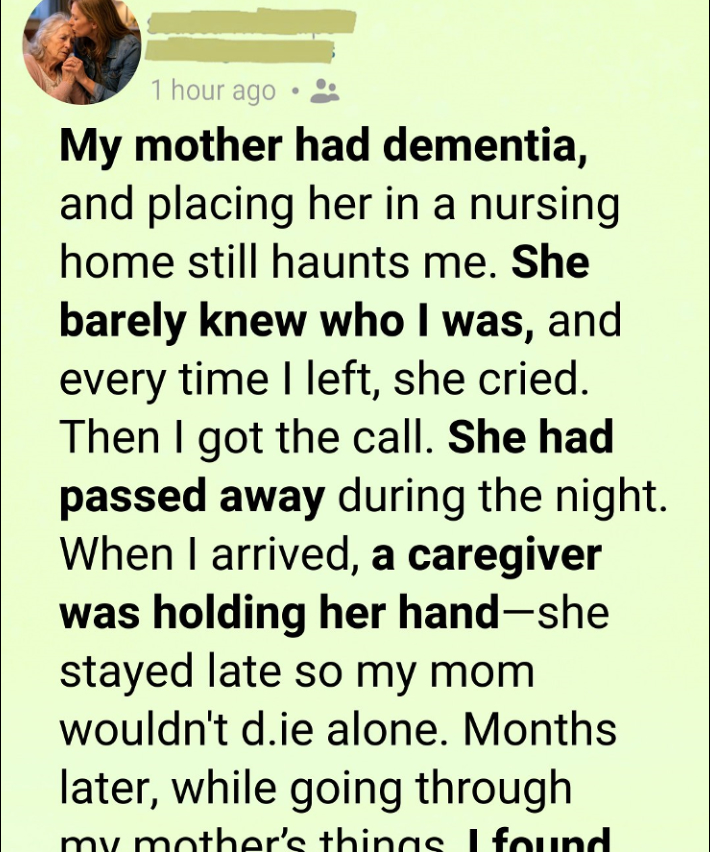
Then the call came, before sunrise on a Tuesday. The nurse’s voice was calm, professional, and terrifying. My mother had passed during the night. “Peacefully,” they said. I stared at the wall, the word feeling like a cruel joke.
A SACRED VIGIL
I barely remember the drive to the facility. I only remember bracing myself for the paperwork, the sterile air, the hollow emptiness of Room 402. But when I opened the door, the room was not empty.
A young caregiver, Sarah, sat on the edge of my mother’s bed, still holding her hand. Her head was bowed, shoulders slumped, eyes red from exhaustion. She hadn’t slept. I froze, feeling like an intruder on a sacred moment.
Startled, Sarah looked up and apologized, as if she had failed. “I stayed after my shift,” she whispered, voice cracking. “I didn’t want her to be alone.”
My knees gave way, and I sank into a chair. Sarah told me about the night: six hours by her side, reading Tennyson, brushing my mother’s hair, talking about the birds at the feeder and the changing leaves—treating her as fully herself until her final breath.
THE NOTEBOOK IN THE DRAWER
Months later, as I sorted through the remnants of my mother’s life, I found a thin, spiral notebook hidden in her nightstand. The handwriting wasn’t my mother’s—it was Sarah’s.
It was a detailed, loving record of the moments I had missed:
“October 14th: She hummed along to ‘Blue Moon.’”
“November 2nd: Restless in the morning, but calmed by the brook poem.”
“December 10th: Brushed her hair for twenty minutes. She smiled at her reflection.”
Page after page chronicled the quiet triumphs of a woman the world had forgotten. On the final page, dated the afternoon before she died, was a single sentence that changed me:
“She talked about her daughter today. She said she loved her very much.”
I pressed the notebook to my chest, crying harder than I did at the cemetery. That book became my most precious possession. It didn’t erase my guilt, but it gave me grace I didn’t deserve. Even in her darkest, loneliest hours, my mother was seen, known, and loved—by a stranger who chose to stay when I could not.