
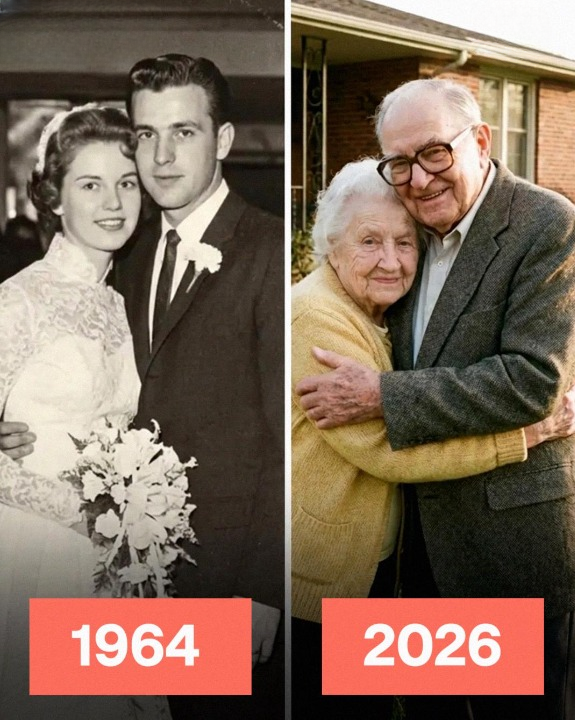
Harold and I spent 62 years together, and I believed I understood every part of the man I married. But at his funeral, a young girl I had never seen before walked up to me, handed me an envelope, and ran away before I could ask her anything. Inside that envelope was the beginning of a secret Harold had carried for decades but never found the courage to tell me himself.
I barely managed to get through the funeral service.
Harold and I had met when I was only 18, and within a year we were married. Over time, our lives became so connected that standing in that church without him felt almost unreal, like trying to live with half of myself missing.
My name is Rosa. For more than sixty years, Harold had been the most constant presence in my life. Our two sons stood beside me during the service, helping me stay steady as we said goodbye.
As people slowly began leaving the church, I noticed a young girl in the crowd. She looked about twelve or thirteen, and I didn’t recognize her from any of the families or friends present.
She walked directly toward me.
“Are you Harold’s wife?” she asked.
“Yes,” I replied.
She held out a simple white envelope.
“Your husband asked me to give this to you today… at his funeral. He told me I had to wait until this exact day.”
Before I could ask who she was or how she knew Harold, she turned and hurried out of the church.
One of my sons touched my shoulder.
“Mom, are you okay?”
“I’m fine,” I told him quietly.
I slipped the envelope into my purse and didn’t mention it again until later that evening.
That night, after everyone had gone home and the house had fallen silent, I finally opened it at the kitchen table.
Inside was a letter written in Harold’s familiar handwriting—and a small brass key.
The letter began:
“My love, I should have told you this long ago, but I never had the courage. Sixty-five years ago, I thought I had buried this secret forever, yet it followed me throughout my life. You deserve to know the truth. This key opens Garage 122 at the address below. Go when you’re ready. Everything is there.”
I read it twice, trying to understand.
Eventually I grabbed my coat, called a taxi, and went to the address.
The garage stood at the edge of the city, part of a long row of old metal units that looked as if they hadn’t changed since the 1970s. I found number 122, unlocked the padlock, and lifted the door.
The air smelled of cedar and old paper.
In the center of the garage stood a large wooden chest covered with dust and cobwebs.
When I opened it, I found bundles of children’s drawings tied with faded ribbons, birthday cards addressed to Harold, school certificates, and dozens of letters carefully preserved over the years.
Every letter ended with the same name: Virginia.
At the bottom of the box was a worn folder containing documents from 65 years earlier. They revealed that Harold had quietly supported a young woman and her infant daughter after the child’s father abandoned them. He paid their rent, covered school expenses later on, and sent money regularly for years.
He had saved every letter the woman ever sent him.
The thought that immediately struck me was heartbreaking: had Harold secretly had another family?
Overwhelmed, I sat down on the cold garage floor.
Just then I heard gravel crunch outside.
A bicycle stopped near the open door.
When I turned, the same girl from the funeral was standing there.
“I thought you might come here,” she said.
“You followed me?” I asked.
She nodded.
“My mom’s name is Virginia,” she explained. “I’m Gini.”
She told me that her mother was currently in the hospital and needed heart surgery, but they couldn’t afford it.
Something about Harold’s letter suddenly made sense.
I took Gini with me to the hospital, where I met her mother, Virginia. She was pale and weak, lying in a narrow bed surrounded by medical equipment.
Later, a doctor confirmed that the surgery she needed was urgent—but the hospital couldn’t perform it without payment.
Standing in that hallway, I realized Harold had known exactly what I would discover.
Two days later, I returned with the money for the surgery. It came from the savings Harold and I had built together over our lifetime.
The operation lasted six hours.
Thankfully, it was successful.
When Virginia was strong enough to talk, she told me how much Harold had helped them throughout the years. Without him, she and her mother might not have survived.
Still, one question remained in my mind.
Why had Harold kept this secret from me for so long?
A few days later, Virginia invited me to her home and showed me an old photo album.
As I flipped through the pages, I saw pictures of her childhood—school photos, holidays, and family moments.
Then I reached one photo that made my breath stop.
It showed a young Harold standing beside a teenage girl holding a newborn baby.
I knew that girl.
She was my older sister, Iris—the one who had run away from home when I was fifteen and never returned.
Virginia was her daughter.
Suddenly everything made sense.
That night, I went home and searched Harold’s study. Inside his diary, written decades earlier, I finally learned the full story.
He had once found my sister struggling alone with her baby. At the time he didn’t realize who she was. By the time he did, he was already courting me.
Knowing how deeply my family had been hurt by my sister’s disappearance, he chose to help her quietly instead of revealing the truth and reopening old wounds.
For the rest of his life, Harold secretly supported my sister and her daughter—without telling anyone.
He hadn’t been hiding betrayal.
He had been hiding compassion.
The next day, I returned to Virginia and Gini and explained everything.
“Virginia,” I said gently, “you are my sister’s daughter… which means you’re my niece.”
Then I looked at Gini.
“And that makes you my great-niece.”
For a moment the room was silent.
Then Gini came over and hugged me tightly.
As I held her, I realized that Harold hadn’t just kept a secret all those years.
He had quietly protected a family—two families—at the same time.
And in the end, the truth he left behind brought us all together again.