
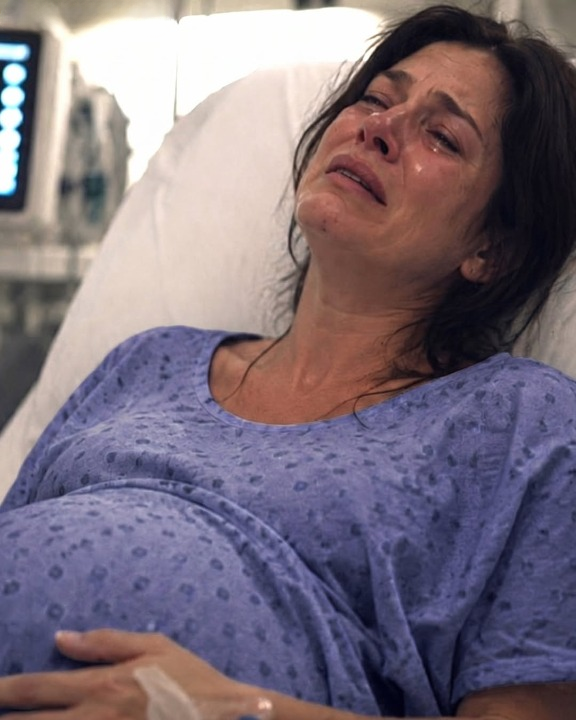
After enduring the heartbreak of seven lost pregnancies and watching her husband abandon her during what might be her final chance at motherhood, Emilia found herself alone in a hospital bed—fighting for her unborn child while facing a dangerous medical crisis. Then, during a sudden emergency, doctors uncovered something that should have been identified months earlier.
The steady beep of the monitor filled the quiet room at St. Carmel Medical Center, its rhythm cutting through the stillness. Outside, the grey Ohio sky made the afternoon feel like night was already approaching. Emilia had been in the same room for two weeks, the silence growing heavier each day.
She lay back against the pillow and rested a hand on her swollen belly.
“We’re still here,” she whispered.
At 40, Emilia had spent years trying to become a mother. On her property stood a small gravestone in the backyard garden—an unusual sight for most, but a painful constant in her life. It bore the name Noah, her sixth child, who had survived only a few hours after birth before passing away in her arms.
Her nurse, Rosa, entered with a chart and water, cutting through the quiet with practiced firmness.
“Blood pressure check. And then you’re eating,” she said.
Emilia gave a tired refusal, but Rosa didn’t argue—she simply continued with her routine, as she always did.
Rosa also mentioned that David, Emilia’s husband, had called again. Emilia barely reacted. He had been distant for months, watching each loss pull him further away until, eventually, he stopped trying to stay.
Two months earlier, he had left for good, telling her they were “fighting nature” and that perhaps they were never meant to have children. Emilia had said nothing as he walked out.
Since then, she had faced everything alone.
Her diagnosis—a rare genetic condition with immune rejection complications—had taken months to fully understand, even with multiple hospitals involved. Now she was being treated at St. Carmel under Dr. Harmon, who studied every case with relentless precision.
At night, Emilia spoke to her unborn child, refusing to give up hope.
But everything shifted when she finally listened to a voicemail from David. His voice was cold and final—he had moved out and was done trying.
Moments later, Rosa arrived and quietly stayed beside her as Emilia absorbed the news. No comfort was forced, only presence.
An hour later, Dr. Harmon arrived, his expression unusually tense. He explained that Emilia’s condition was worsening. Her body was showing signs of rejection, and both she and the baby were now at serious risk.
Then came something unexpected: inconsistencies in earlier ultrasound scans from the previous clinic. The files were being re-examined.
Emilia was left unsettled, sensing something important had been missed.
Soon after, David returned briefly, urging her to end the pregnancy, insisting she was endangering herself. But Emilia refused. His concern had turned into control, and she finally told him to leave.
Not long after, chaos erupted.
Her condition suddenly collapsed. Monitors blared. Staff rushed in. The situation turned critical as doctors prepared for an impossible decision—save the mother or attempt to save the baby.
Then, in the middle of the emergency, Dr. Harmon studied the newly corrected scans and realized the truth.
It wasn’t one baby.
It was two.
Twins had been missed entirely due to a misread diagnosis from the earlier hospital.
The crisis was not rejection of a single pregnancy—but severe strain caused by undetected twin complications.
Everything changed instantly.
Emergency surgery was ordered. The team shifted from choosing between lives to fighting for all three.
Emilia, overwhelmed and in pain, could only whisper one request:
“Save them both.”
Later, through anesthesia and exhaustion, she awoke to the sound of crying—two distinct voices.
Both babies had survived.
Weeks afterward, Emilia sat beside two NICU bassinets, watching her son and daughter grow stronger day by day. After years of loss, grief, and fear, she finally allowed herself to believe what she had almost stopped hoping for:
This time, they all made it.