
For six months, the same thing happened every single day.
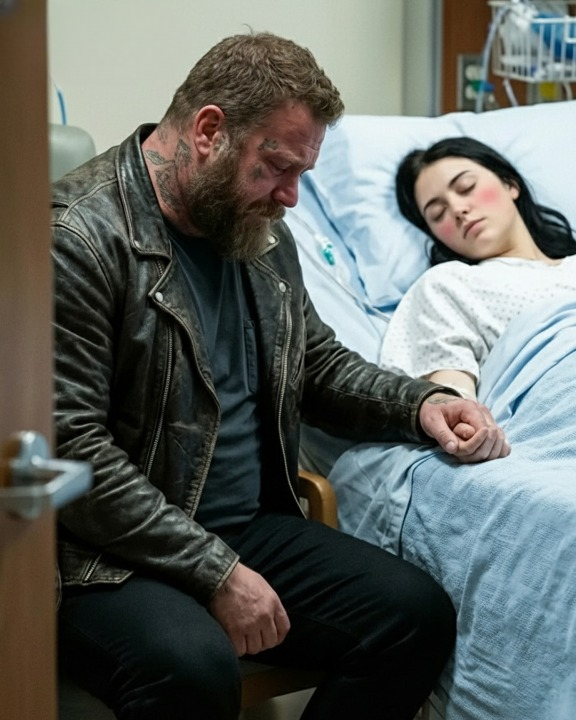
At exactly 3:00 p.m., a large biker with a gray beard would walk into my 17-year-old daughter’s hospital room, gently hold her hand for an hour, and then quietly leave.
My daughter was in a coma.
And I had no idea who this man was or why he kept coming.
My name is Sarah, I’m 42, and my daughter Hannah’s life changed forever six months ago when a drunk driver ran a red light and slammed into the driver’s side of her car.
She had just finished her shift at the local bookstore.
The crash happened only five minutes from our house.
Now she lies in Room 223, surrounded by machines, unconscious.
I practically live at the hospital. I sleep in a recliner, survive on vending machine snacks, and know exactly which nurse gives the warmest blankets.
In a hospital, time feels strange. The only things that feel real are the beeping monitors and the clock on the wall.
And every day, right at 3:00 p.m., the door opens.
In walks the same man.
He’s huge — gray beard, leather vest, heavy boots, tattoos covering his arms.
But he’s quiet. Respectful.
He nods politely to me, then walks to my daughter’s bedside.
“Hey, Hannah,” he says softly. “It’s Mike.”
Sometimes he reads fantasy books to her.
Sometimes he just talks in a low voice about his day.
Then, exactly at 4:00 p.m., he gently places her hand back on the blanket, nods to me again, and leaves.
Every single day.
For months.
At first, I let it go.
When your child is in a coma, you accept any kindness you can get.
But eventually, the questions started to eat at me.
He wasn’t family.
None of Hannah’s friends knew him.
Even her father had never heard his name.
Yet the nurses treated him like he belonged there.
Finally, one afternoon after he left, I followed him into the hallway.
“Excuse me… Mike?” I called.
Up close he looked even bigger — broad shoulders, scarred hands, tired eyes.
But there was something else in his face too.
Pain.
“I’m Hannah’s mom,” I told him. “You’ve been coming here every day. Holding her hand. Talking to her. I need to know who you are.”
He looked toward her hospital room, then back at me.
“My name’s Mike,” he said quietly.
Then he swallowed and added the words that made the world spin around me.
“I’m the one who hit your daughter.”
My heart stopped.
He was the drunk driver who caused the accident.
He told me he had already served his sentence — ninety days in jail, lost his license, court-ordered rehab, and Alcoholics Anonymous meetings.
He said he hadn’t touched alcohol since the night of the crash.
But none of that changed the fact that my daughter was still lying in a hospital bed.
So every day at 3:00 p.m., the exact time the accident happened, he came to sit with her.
He apologized to her.
He read her books.
He told her about his sobriety.
It didn’t erase what he had done, he said.
But it was the only way he knew how to face it instead of running away.
At first, I told him to stay away.
And he did.
But when three o’clock came and the door didn’t open, the room felt strangely emptier.
Days later, I went to one of his AA meetings and listened as he stood up and admitted, in front of strangers, that he was the reason a teenage girl was in a coma.
Eventually, I told him he could come back.
Not because I forgave him.
But because Hannah deserved every voice fighting for her.
Weeks passed.
Then one afternoon, while Mike was reading another chapter from a fantasy novel…
Hannah squeezed my hand.
For the first time in six months.
Doctors rushed into the room.
Her eyes fluttered open.
“Mom?” she whispered.
I broke down crying.
In the corner, Mike covered his mouth with his hand and sobbed.
Later, when Hannah was strong enough, we told her the truth about the accident.
She looked at Mike for a long time.
“I don’t forgive you,” she said.
He nodded.
“I understand.”
“But… don’t disappear either,” she added quietly. “I don’t know what this means yet.”
Recovery was long and painful.
Physical therapy. Frustration. Tears.
But almost a year later, Hannah finally walked out of the hospital, slowly, leaning on a cane.
I held one arm.
And after a moment’s hesitation…
She took Mike’s arm with the other.
Outside the hospital doors she looked at him and said something I’ll never forget.
“You ruined my life.”
Mike looked down.
“I know,” he said.
“And you also helped me not give up on it,” she replied.
“Both things can be true.”
Now Hannah works part-time again and will start community college soon.
Mike is still sober.
Every year, on the anniversary of the crash, the three of us meet at a small coffee shop at 3:00 p.m.
We don’t make speeches.
We don’t pretend everything is okay.
We just sit together and drink coffee.
It’s not forgiveness.
And it’s not forgetting.
But somehow… it’s a way forward.