
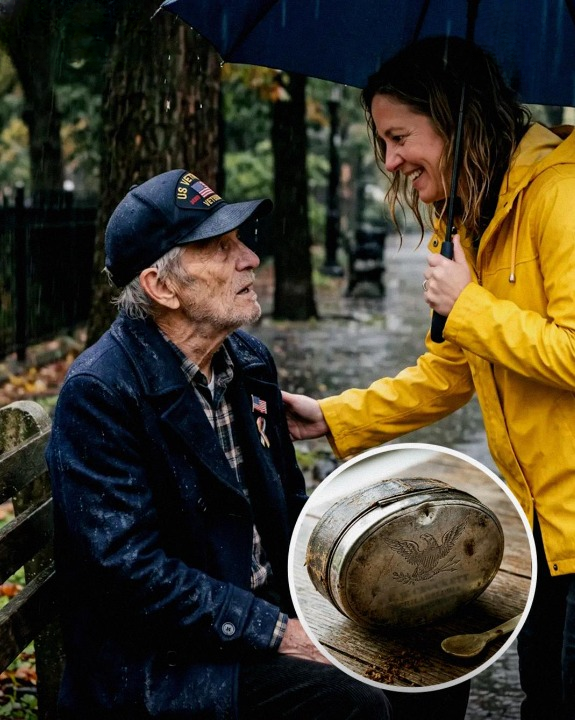
I took in an elderly veteran I found sitting alone on a rain-soaked park bench because he had nowhere else to go. Days after he passed away, I opened the snuff box he had guarded like something precious—and discovered he had known exactly who I was from the very beginning.
The first thing I noticed after Walter died was the silence where he used to be. His plate, always waiting for me after my shifts, sat untouched on the table. No warm casserole under foil. No reminder to wash my hands before eating. Just emptiness.
Even his chair seemed to change the room, like his absence had hollowed it out. He hadn’t just lived in our house—he had become part of its rhythm.
I’m 41, a single mother of two who understands loss too well. My parents died when I was nineteen. Later, my husband left, saying I was “too closed off.” After that, it was just me, two kids, long shifts at a diner, pizza deliveries at night, and a car that barely held together.
Then one rainy evening—on my son Tom’s birthday—I saw him.
Walter.
An elderly man, soaked through, sitting alone on a park bench, clutching a snuff box carefully like it was the only thing keeping him anchored. The shelter had turned him away. He had nowhere to go.
I didn’t hesitate. I brought him home.
He barely spoke that first night, only quietly thanking me as he dried himself and held that small box like treasure. At dinner, he insisted he shouldn’t stay, but I told him plainly: it wasn’t a board meeting—it was a birthday.
And just like that, he stayed for the meal… then for longer.
He told me, without dramatics, that his own family had turned him away. Just facts, no self-pity. A man who had served his country for decades and ended up with nothing but a bench and a box of memories.
That night, I already knew one day wouldn’t be enough.
And I was right.
Walter became part of our home in quiet ways. Helping my kids with homework, fixing small things that broke, telling stories that made them laugh until they forgot their worries. Soup on Tuesdays. Jokes about peas being “ammunition for growing boys.” A steady presence that made life feel less like survival and more like living.
Mrs. Carter, my neighbor, even started dropping by more often just to be around him, pretending it was for borrowed dishes.
But Walter wasn’t just kindness and warmth. One night, he told me he had once had a daughter—gone after a bike accident. He never lingered on it, but I never forgot the way his voice changed when he said it.
Then, one day, everything changed.
I found him collapsed in the laundry room, still holding his snuff box. His face had gone pale in a way I’ll never forget. I called for help, but I already knew.
At the hospital, the doctor said it likely wasn’t his first episode. Walter had been hiding his pain for a long time.
Before I left his side, he pressed the snuff box into my hands.
“Promise me,” he whispered. “Open it after I’m gone.”
I refused to believe he wouldn’t come home, but I promised anyway.
That night, Walter passed away.
The house changed again—this time into something too quiet, too still. My children grieved in their own ways. Tom asked if heaven had gardens because Walter would be upset if they didn’t. Mrs. Carter cried like she had lost family.
Days later, alone after everyone was asleep, I finally opened the box.
Inside was a folded note. My breath caught the moment I saw it—it was handwriting I recognized immediately.
It was mine.
A delivery note I had written years ago, left with a pizza order for an elderly man who couldn’t afford both boxes. I remembered slipping both pizzas inside anyway, along with a small message: “You deserve kindness today.”
I had never known his name. I had never seen his face clearly.
Until now.
Inside the box, beneath the note, was an envelope of money—and a letter from Walter.
He wrote that he had been the man on that porch that rainy night. That he had recognized me the moment I found him on the bench. That after his family cast him out, he carried my note and the memory of that small act of kindness everywhere he went.
“I wanted to see if kindness like yours was real,” he wrote, “even when you didn’t know who I was.”
He had kept everything—my note, the money from selling his wife’s ring—waiting for the day life brought us together again. Not as repayment. Never as repayment.
What broke me most was his final line:
“This money will not last long, but your kindness will.”
That money changed everything for us—rent, school needs, small breathing room—but it wasn’t the money that made me cry.
It was the truth that he had carried my kindness with him as something sacred until the very end.
We buried Walter with honors. My children stood beside me. And I felt something I hadn’t felt in years—not just grief, but gratitude tangled through it.
Now his snuff box and my note sit together in a shadow box on a shelf, where he used to leave my plate waiting.
A reminder that small kindnesses don’t disappear.
Sometimes, they come back carrying the weight of an entire life.