
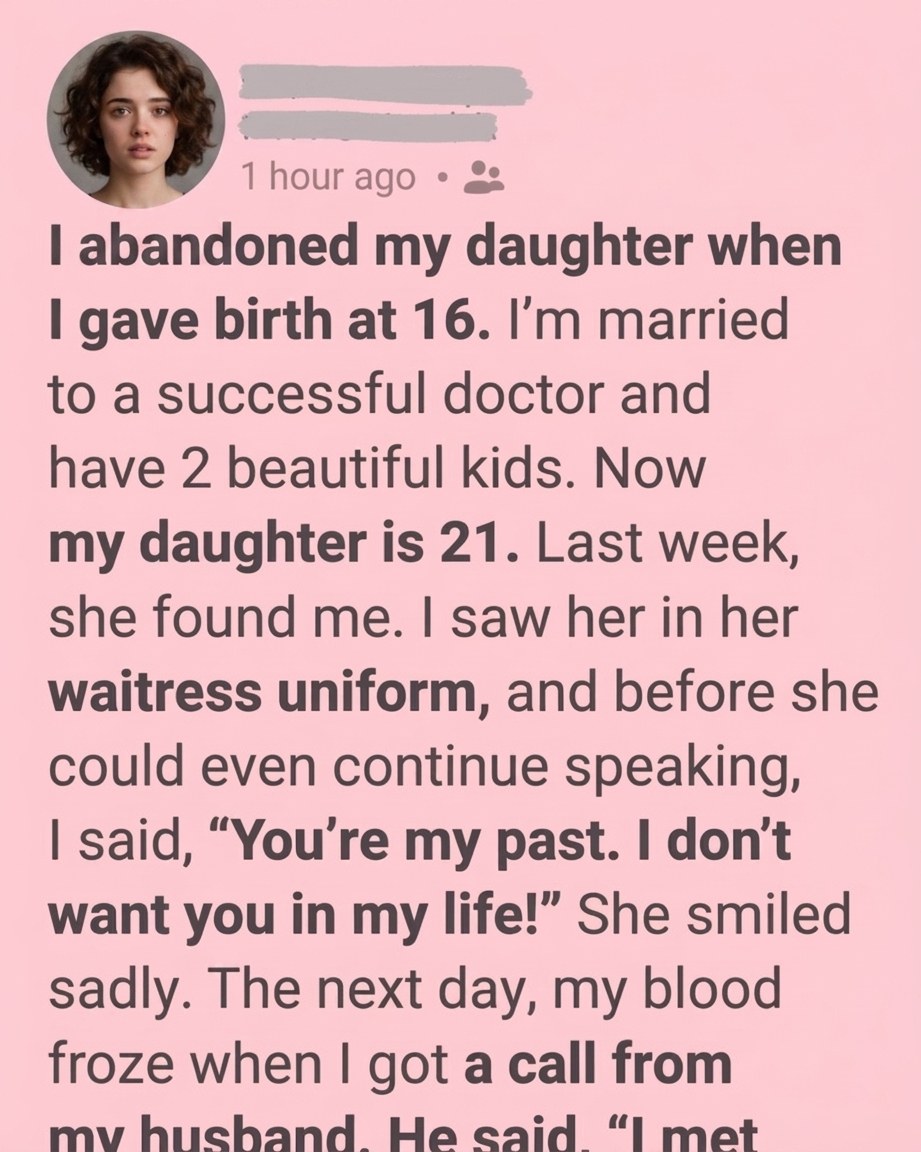
I LEFT MY DAUGHTER AT 16… YEARS LATER, SHE CAME BACK INTO MY LIFE
“I was sixteen.”
I don’t say it as an excuse anymore—just as what it was. I was a terrified teenager, overwhelmed and convinced I had nothing to offer a child. My parents made the decisions, signed the papers, guided me through everything, and I let it happen. I told myself she would be better off without me. When I left the hospital alone after giving birth, something inside me broke in a way I never fully recovered from.
After that, I rebuilt my life piece by piece. I went to college, found work, met Daniel, and when he asked about my past, I always kept it vague. “It’s complicated,” I would say, and he never pressed further. Eventually, we married and had two children—Ethan and Lily. Our home became full of the life I thought I had earned: routines, laughter, drawings on the fridge, and the comforting illusion that the past stayed where I left it.
My daughter turned twenty-one this year.
I hadn’t seen her since the day she was born.
Then, last week, she found me.
It happened at a quiet café near the hospital. I noticed the waitress looking at me longer than necessary—young, maybe twenty-one, hands slightly unsteady as she took our order. Before she even spoke, something in my chest tightened.
“Mrs. Collins?” she asked.
“Yes?” I answered, already uneasy.
“My name is—”
I cut her off. “You’re my past. I don’t want this in my life. I’m busy.”
It came out sharper than I intended, like something rehearsed for years. She didn’t argue or react. She just looked at me for a long moment, smiled faintly, and said, “I understand,” before walking away.
I sat there afterward, shaking, convincing myself I had protected my family—that Daniel, Ethan, and Lily didn’t need the disruption of what I had left behind.
The next morning, Daniel called.
“Where are you?” he asked.
“At home. Why?”
“I met her,” he said quietly. “Your daughter.”
My stomach dropped.
“You need to come home,” he added. “Now.”
The drive felt unreal, my thoughts spiraling the entire way. When I stepped into the kitchen, she was already there—sitting at the table in her waitress uniform, hands folded carefully in her lap. Daniel stood nearby, and his expression told me everything had already changed.
“What is going on?” I asked, barely steady.
“She didn’t come to hurt you,” Daniel said. “She came to help.”
Then he added, “She’s a match for Lily.”
The room went still.
Our daughter, Lily, had been fighting illness for months—hospital visits, treatments, and hope that kept slipping through our fingers. And now the answer stood in front of me.
I looked at the girl I had left behind.
“She’s my sister,” she said softly. “I wasn’t going to let her suffer alone.”
My knees nearly gave out.
“I was cruel to you,” I whispered. “Yesterday I—”
“You were scared,” she interrupted gently. “You were a teenager. And you still are, in some ways.”
There was no anger in her voice. Only calm understanding.
That broke something in me.
Two weeks later, the transplant took place. She never asked for recognition, forgiveness, or even a place in our lives. She simply showed up—day after day—sitting by Lily’s bedside, reading to her, holding her hand as if she had always belonged there.
Slowly, Lily began to heal. Ethan grew attached to her instantly. And Daniel, though shaken, began to understand what was unfolding.
One night, he told me quietly, “You can’t bury your past and expect it to stay buried. You face it—or it shapes everything you become.”
I thought I had escaped who I used to be.
But I hadn’t.
My past didn’t return to punish me.
It returned to save me.
Because even though I abandoned my daughter at sixteen…
she didn’t abandon us.
She chose compassion over anger.
She chose to stay.
And in doing so, she didn’t just save Lily.
She saved me.