
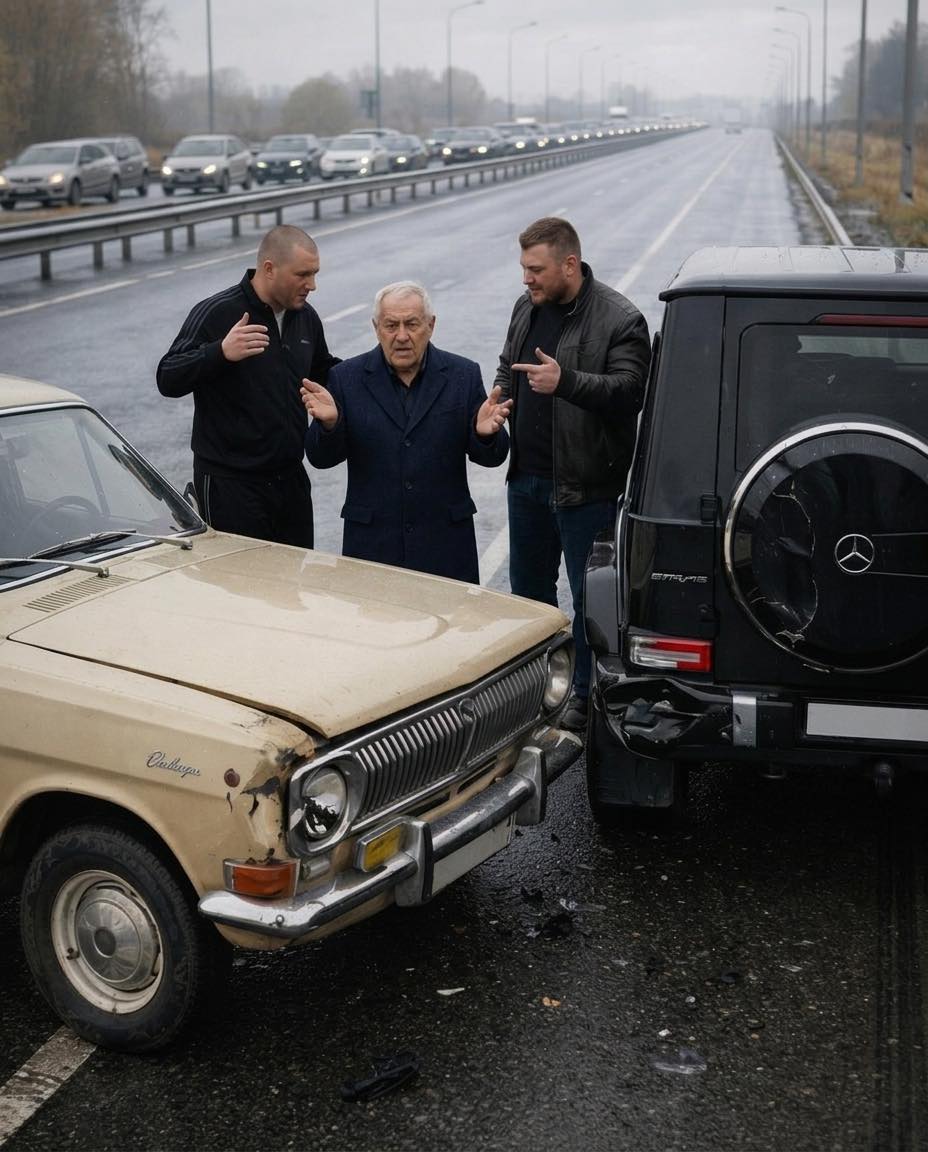
Thugs on a highway deliberately forced an elderly driver into an accident and then tried to extort money for supposed “damage”—completely unaware of who he was or how quickly the situation would turn against them.
It was a busy Saturday morning, traffic flowing steadily as people left the city. An older man drove carefully in the right lane, staying within the speed limit and avoiding any sudden moves. He was experienced and cautious, the type of driver who preferred patience over risk.
In his rearview mirror, he noticed a black SUV approaching fast—large, aggressive, and impatient. It hovered behind him, shifted lanes without warning, and then suddenly cut in too close, pushing him toward the edge of the road.
To his right was a guardrail. To his left, heavy traffic. He was boxed in.
He gripped the wheel calmly. “I’m following the rules,” he muttered. “No need to bow to recklessness.”
Without warning, the SUV swerved across a solid line, overtook him illegally, and cut directly in front of his car. Then it slammed its brakes.
There was no time to react. The older man braked hard, tires skidding on wet asphalt, but the collision was unavoidable. Metal struck metal with a heavy impact.
He sat back for a moment, steadying his breath, hands trembling slightly—but his expression remained composed.
Two men jumped out of the SUV immediately. One shaved-headed and aggressive, the other larger, wearing a leather jacket. They stormed toward him, shouting.
“What are you doing, old man?!” one yelled, striking the hood.
“You ruined our car!” the other added. “Do you even know what this costs?”
They pointed at the damage, raising their voices and trying to intimidate him.
“Pay up, and we’ll forget this happened. No need for police.”
The elderly man slowly lowered his window.
“You cut me off and braked on purpose,” he said calmly. “This wasn’t an accident I caused.”
One of them sneered. “Are you going to lecture us? Do you know who you’re dealing with?”
It was clear now—the crash had been staged to pressure him into paying.
“Let’s settle this here. Cash. Now.”
The man studied them quietly, unbothered.
“Fine,” he said. “We’ll settle it.”
He took out his phone and made a single call.
The men laughed, assuming he was helpless.
But within minutes, flashing lights appeared on the road. A traffic police vehicle pulled up.
An officer stepped out, quickly assessed the scene, and approached the older man first.
“Are you injured?” he asked.
“I’m fine,” the man replied.
One of the attackers immediately tried to spin the story—but the officer raised a hand, stopping him.
“The cameras recorded everything,” he said firmly. “Illegal lane crossing, intentional braking, staged behavior.”
The men went silent.
Then the officer added, coldly:
“And this man is my father.”
The mood shifted instantly.
The realization hit them too late—their “easy target” wasn’t unprotected at all. The entire incident had already been captured, reviewed, and confirmed.
Within minutes, more patrol units arrived, statements were taken, and evidence from road cameras sealed their fate.
The same men who had been shouting moments earlier now stood quiet, avoiding eye contact as the situation collapsed around them.
One of them tried to speak again, but the officer cut him off.
“Save it for the report.”
They were no longer in control.
The elderly man simply stood aside, calm and steady, watching as the consequences unfolded.
When it was over, his son approached him.
“You didn’t need to handle it alone,” he said quietly.
The old man gave a small shrug.
“I was driving by the rules. I had nothing to fear.”
And with that, the lesson was clear—what looked like an easy target on the road turned out to be the worst possible choice they could have made.