
I used to think the hardest part was already behind us—that everything my son had worked for was finally within reach. I had no idea that a single moment on the track would end up testing him far more than any race ever could.
I still remember the sound of the suitcase zipper more than anything else.
Not the door. Not the words. Just that final, ordinary sound as my husband Edward packed like he was leaving for a weekend trip instead of walking away from his newborn son.
I was sitting on the bed, holding Brennan—just a week old—when he said it.
“I didn’t sign up for this.”
“This” was our son, born with a leg difference.
And then he was gone.
The years that followed weren’t easy.
Doctors, therapy, braces, setbacks—none of it came gently. But Brennan never stopped trying. He fell often, but he always got back up. And somewhere along the way, “careful” stopped being enough for him.
“I don’t want to be careful,” he told me once. “I want to be fast.”
And he meant it.
By sixteen, he wasn’t just running—he was winning. Local meets became regional wins, then state-level competition. People started noticing him. Scholarships, scouts, opportunities I never could have created for him started opening up.
Running became his way forward.
Then came the state finals.
The biggest race of his life.
The stadium was packed. I sat in the stands next to Dana, whose son Caleb—Brennan’s closest friend—had once been a runner himself before an accident left him unable to walk.
When the race began, Brennan took the lead immediately. Everything was going exactly as it should.
Until, suddenly, he slowed.
Then stopped.
Then stepped off the track entirely.
The stadium went silent.
And then I saw him move toward Caleb.
What happened next didn’t feel real.
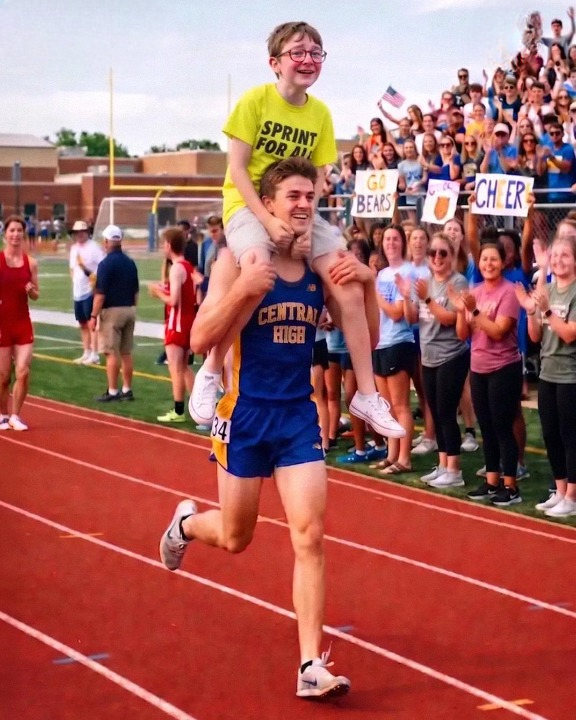
Brennan helped Caleb up, lifted him onto his shoulders, and carried him onto the track.
“We finish this together,” he told him.
And they did.
He wasn’t the fastest anymore—but he was steady. Every step was harder than the last, but he kept going. And one by one, the other runners slowed, then stepped aside, as if they understood this moment was bigger than competition.
When they crossed the finish line together, the crowd erupted—not in celebration of a winner, but of something else entirely.
The officials eventually stepped in and awarded Brennan a special first-place recognition. Without hesitation, he placed the medal around Caleb’s neck instead.
“That’s the real champion,” he said.
And for a moment, everything felt like it made sense.
But the next morning, the call came.
We were summoned to the principal’s office.
The atmosphere wasn’t celebratory. It was cold.
“Do you understand what this reckless act will cost your son?” the principal asked.
Then he slid a folder across the desk.
Inside was the decision: Brennan had been disqualified.
“Violation of race protocol. Interference with competitive outcome.”
Just like that, everything he had worked for—every early morning, every injury, every sacrifice—was reduced to a single ruling.
No scholarship.
No official recognition.
Just consequences.
I expected Brennan to be crushed.
Instead, he was calm.
He said he knew there might be consequences. He just didn’t care enough about them to stop.
And that’s when I realized something: he had made a choice I hadn’t fully understood until that moment.
At home, I couldn’t stop thinking about it.
So I posted the video.
Not for attention—but because I needed people to see what I had seen.
And they did.
The story spread quickly. Parents, coaches, strangers—all reacting, all sharing, all weighing in on what they thought it meant.
A local paper reached out next. They wanted to cover the story properly.
A second meeting at the school followed soon after.
This time, everything changed.
A donor had seen the video.
Someone who funded a private foundation—someone who looked for something they called “character under pressure.”
And what they saw was a boy willing to give up everything he’d worked for to help someone else finish what he couldn’t do alone.
They offered full college tuition and medical support—for both Brennan and Caleb.
The original scholarship was still gone.
But something else had appeared in its place.
When I told Brennan, he didn’t hesitate.
“I’d do it again,” he said.
And I believed him.
Later, we drove to Caleb’s house.
When the boys saw each other, they just smiled like none of it had ever been in question. Like this was always the outcome they understood better than anyone else did.
“You lost your scholarship because of me,” Caleb said quietly.
“We gained something else,” Brennan replied.
And he meant it.
Weeks later, the story ran publicly, and people kept talking about it long after.
But Brennan didn’t change.
He kept running. Kept training. Kept showing up.
The only difference was that he wasn’t doing it alone anymore.
Caleb was there too—not as a competitor, but as part of it all in a different way.
And watching them, I understood something I hadn’t before:
Sixteen years ago, someone walked away from my son.
But my son never stopped showing up for the life ahead of him.
And when he crossed that finish line, it was never just about winning.
It was about who he chose to carry with him.