
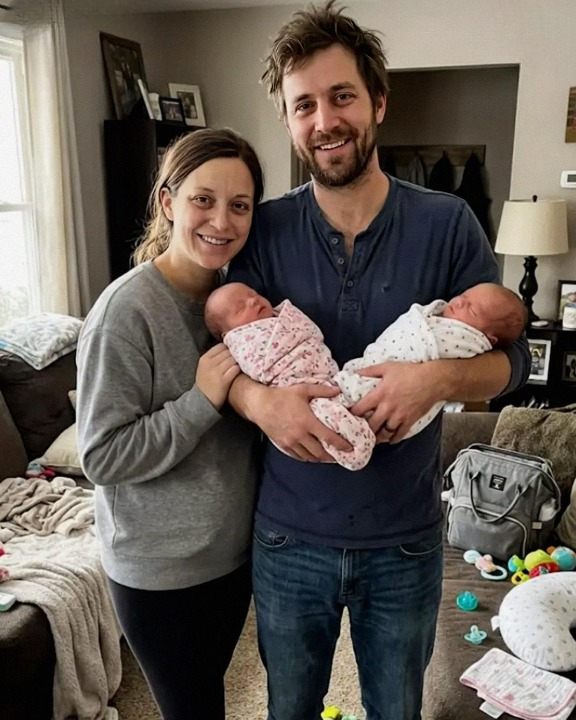
I believed that becoming a mother meant everything in my life had finally come together—until the day my husband was left alone with our newborn twins and said something I could never forget. When I discovered who had influenced him, everything in our home shifted.
I sensed something was wrong even before Brian spoke.
The babies had been crying for too long—one with that strained, exhausted wail, the other letting out sharp, frustrated sobs. A bottle lay untouched, formula scattered across the counter. And Brian sat there, elbows on his knees, staring blankly.
I rushed past him, picking up Jade, her face flushed and blotchy, then reaching for Amber, whose tiny fists were clenched tight.
“Hey, hey,” I murmured. “Mama’s here. You’re okay now.”
When I looked at Brian, he seemed distant, almost unrecognizable.
Then he said, flatly, “I’m sorry… but we have to give them away.”
For a moment, I thought I’d misunderstood.
A month into life with the twins, I was exhausted but deeply in love. That morning had started like any other—juggling babies, running on little sleep—until my mom called to say she’d fallen and might be hurt. I had to leave quickly, trusting Brian to manage for the day.
He hesitated, unsure, but insisted he could handle it.
All day, I checked my phone. His replies were brief—too brief. Something didn’t sit right.
When I finally came home, the crying hit me immediately. Both babies were distressed, overheated, and inconsolable. Brian stood nearby, not just tired—but shaken.
As I pressed him, the truth unraveled.
His mother had been there.
Overwhelmed and frightened, Brian had struggled to calm the babies. Instead of asking for help, he let his mother step in—and worse, let her plant the idea that our daughters were too much, that maybe there were “other options.”
That’s where his words had come from.
He admitted he’d panicked, that for a moment he felt completely out of his depth. But hearing him repeat her suggestion—that maybe the girls would be better off without us—cut deeper than anything.
I told him plainly: one difficult day didn’t justify abandoning our children, and fear didn’t give him the right to let someone else define them as a burden.
“We’re not giving anyone away,” I said. “We’re getting help.”
That night, I took the girls to my mother’s house. Before leaving, I made it clear: he needed to choose whether he was going to be a father to his daughters or remain under his mother’s influence.
When his mother called, I didn’t hold back. I told her she had no place in my children’s lives after suggesting they were disposable.
For the first time that day, everything became clear.
My daughters came first. Always.