
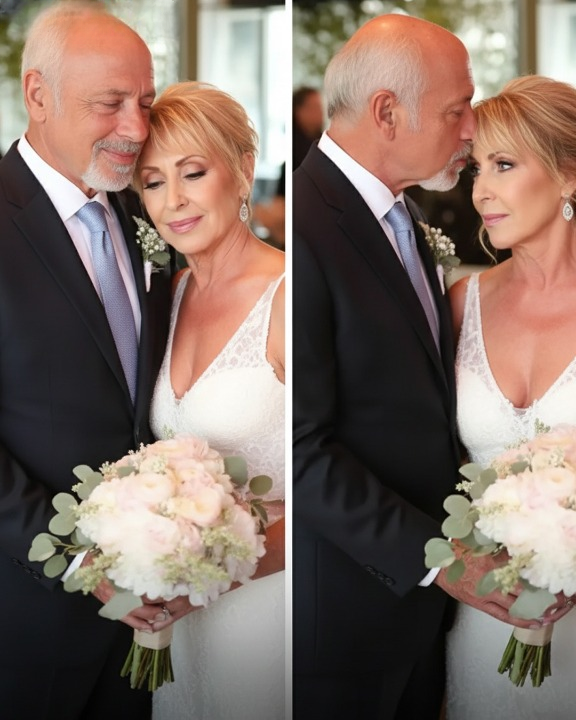
Three months after Mom’s funeral, my dad married her sister. I tried to chalk it up to grief making people act strangely. But at the wedding, my brother arrived late, pulled me aside, and handed me a letter Mom had written—one she never wanted me to see.
I thought nothing could feel worse than losing Mom, watching her fight breast cancer for almost three years, barely able to sit up yet still worrying if I’d eaten, if my brother Robert was paying bills, and if Dad remembered his medications. Even in her final days, she was parenting. I was wrong.
The house still smelled of antiseptic and her lavender lotion when we buried her. People kept saying the same things: “She’s not in pain anymore,” “She was so strong,” “Time will heal you.” Time did nothing except make the silence louder.
Three months later, Dad called Robert and me over. When we arrived, everything was the same—Mom’s coat by the door, her slippers under the couch. The funeral flowers were gone, but the emptiness remained.
Sitting beside my dad was Laura, Mom’s younger sister. She looked nervous, hands folded, eyes red like she’d cried recently. I thought, Why is she here?
Dad spoke first. “I want to be honest with you both. No secrets.”
He took her hand. “I’ve found someone,” he said. “I didn’t plan it. I wasn’t looking.”
Robert frowned. “What do you mean?”
“I’m with Laura,” Dad admitted.
The room spun. “You’re… together?” I asked.
Laura hurried to explain. “Grief just… does things to people. We leaned on each other, understood the same pain. One thing led to another.”
Robert stood. “Three months after Mom died? Three months.”
“It’s grief,” Dad said. “Life is short. Losing your mother taught me that.”
I wanted to scream. She was the one who lost her life, not him. But I stayed frozen as they announced their love and upcoming wedding. My brother left without a word and called me later, saying, “This isn’t right. None of this feels right.” I replied automatically, “It’s grief. People do strange things,” though I wasn’t sure who I was convincing.
Weeks passed. Everything moved quietly—paperwork, appointments, whispered conversations. Laura tried to include me: “Do you want to help pick flowers?” “See the venue?” I always declined, saying, “I’m fine. Do whatever you want.” Dad once asked if I was okay with it; I nodded, and his shoulders relaxed.
The wedding invitation came six weeks later. Small ceremony. Close family. Mom’s name was nowhere on it. Still, I went, telling myself I was being mature, loving—the daughter. I repeated that lie in my head: This is just grief. Two broken people finding comfort.
Then Robert appeared, eyes wild, jacket half-on, grabbing my arm. “Dad isn’t who he pretends to be,” he said.
He explained that Mom had known something I couldn’t imagine. Before she died, she had uncovered the truth: Dad had been living a double life, and the other person wasn’t a stranger—it was her sister. There was even a child everyone assumed belonged to someone else—but it was Dad’s.
Robert handed me the envelope Mom had left. Thick, cream-colored, sealed. She had written it knowing she wouldn’t live long enough to protect us herself. The letter detailed Dad’s deception, the child, and everything Mom had quietly planned to secure justice.
“She rewrote her will,” Robert said. “Everything goes to us. Dad and Laura get nothing.”
The wedding, meant to start a new life, instead exposed the truth. We left without saying goodbye. Months later, Laura left him too. Mom didn’t fight while dying, but in the end, she won quietly.
Even in death, Mom made sure justice was done.