
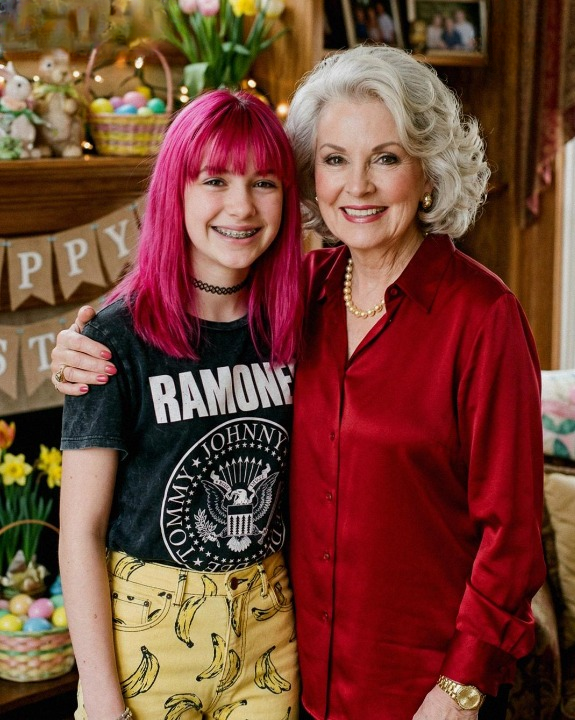
I sent my 14-year-old daughter, Lily, to her grandmother’s house for Easter, expecting her to be safe. But at 2:14 a.m., the sheriff called. He told me she was at the station and demanded I come immediately—he wouldn’t say why. My heart dropped; I felt panic tighten every muscle.
I had imagined a peaceful holiday, with Lily tucked into her grandmother Kathy’s guest room. Instead, I was racing through the dark, my mind spinning with every possible nightmare.
“Is she hurt?” I asked, voice trembling.
“Your daughter is here,” the officer finally said. “She’s safe for now. But you need to come in.”
Those words—“safe for now”—made everything worse. My car flew down empty streets as I replayed every critique Kathy had ever thrown at me: You can’t parent from guilt. She needs discipline. Maybe I had been too soft, I thought, letting her get away with too much.
When I arrived at the station, Lily was in a small interview room, slumped over the metal table, trying to disappear behind her hair. My heart sank. Nothing hurts a mother more than seeing her child sitting in a place designed to intimidate.
The sheriff asked me to sit. He told me she wasn’t in trouble, but her actions could have ended badly. He explained: around 1 a.m., Lily woke to noises downstairs and found her grandmother collapsed, barely conscious. Kathy couldn’t get up. Lily panicked, tried calling 911, but her phone died mid-call.
“She stood there, thinking,” the sheriff said. “Then she made a choice. She helped her grandmother into her shoes, guided her to the car, and drove her to the hospital herself.”
My chest tightened. “She did that alone?”
“Yes,” he said. “She talked to her grandmother the whole way, kept her calm, and got her help before we intercepted her.”
I couldn’t breathe. Fourteen years old. Driving a car. Saving a life.
I stepped into the room, and Lily’s face lit up with relief. “Mom…” she whispered. I wrapped her in my arms.
She explained between sobs, “I didn’t know what else to do. I tried calling, but the phone… I couldn’t wait anymore. Grandma needed me.”
I held her face and whispered, “You scared me half to pieces.”
“I know, Mom. I just remembered what you always tell me: never ignore when something feels really wrong,” she said.
When we got to the hospital, Kathy was stable. Her eyes filled with gratitude when she saw Lily. “You stayed with me,” she whispered.
I realized then: all the lectures about discipline meant nothing compared to what truly mattered. Lily had the courage and love to act when it counted.
“You didn’t raise her wrong,” Kathy told me. “You raised her to be brave.”
And in that moment, I knew every doubt, every second I thought I might’ve been too soft, had been wrong. Love had taught her exactly what she needed to do.