
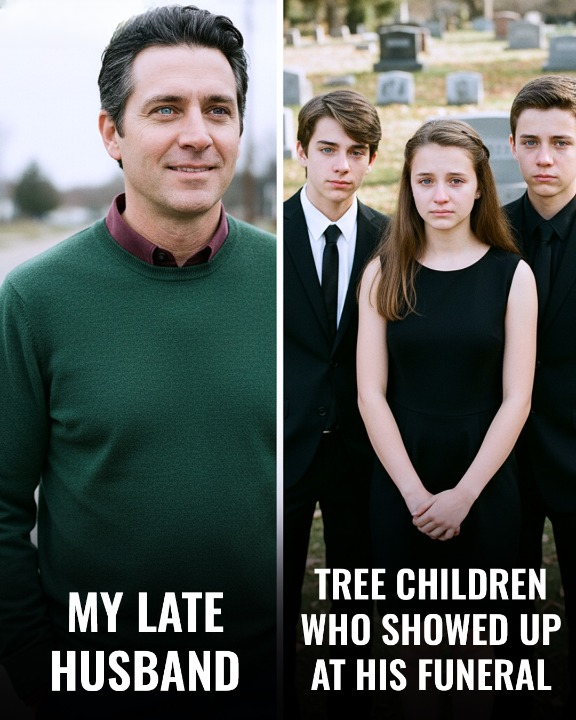
After 37 years of marriage, my husband passed away. This morning, as I opened the obituary draft the funeral home had sent me, my hands nearly dropped my phone. Listed there were three children I had never heard of! When they showed up at the funeral, seeing their faces made me question everything I thought I knew about my life with him.
Mark died yesterday. We had shared 37 years together, and losing him felt like losing a piece of myself. Condolences poured in immediately, all echoing the same sentiment:
“You two had the kind of marriage everyone dreams of.”
“Mark adored you, Carol. That was obvious to anyone.”
“You were so lucky to have each other.”
I felt the same—until this morning.
The funeral director had emailed the obituary for my approval. I opened it at the kitchen table, coffee in hand, still numb from the shock. Then I saw it:
“…Survived by his wife, his parents, and his children—Liam, Noah, and Chloe.”
Children? Mark and I never had any. He was infertile.
I called the funeral home immediately.
“There’s a mistake,” I said, my voice trembling.
“Which part, ma’am?” the director asked carefully.
“The part about him having three children.”
A pause. Then, gently:
“Ma’am, your husband updated the obituary himself. Just days before his aneurysm. Using his account, his login.”
I couldn’t breathe. How could this be possible?
Mark had been open with me about his infertility before we married, and I had accepted it. I’d dreamed of having children, but I wanted him more. We had been happy for years. Then, a heart condition and life-saving surgery had further proven how deeply he cared for me.
Now, this obituary made my entire life feel like a lie.
For the next two days, I tore the house apart. Bank statements, emails, texts, anything. Nothing. No secret accounts, no hidden communications—just the ordinary life we had shared. Yet the mystery of the children from the obituary haunted me.
Then, the children came to me.
At Mark’s funeral, the church doors creaked open. A pale woman entered, looking uncertain, followed by three teenagers—two boys and a girl—bearing an uncanny resemblance to Mark. People whispered. Questions and suspicions spread like wildfire.
I moved toward them after the service, but they were gone. Only a guest book remained, with a single entry: “Anna — He is not who he claimed to be.”
It followed me home.
The truth revealed itself at the bank, while I handled Mark’s accounts. A second checking account existed under his name, and every deposit and withdrawal aligned with my past medical expenses. But the ongoing payments? They were sent to Anna—the woman from the guest book—and her children.
I drove straight to her house. There, she explained everything:
Anna was Mark’s sister. These were her children. Six years ago, after a family conflict, Mark had stepped in as their guardian, their only father figure. He had never hidden them to deceive me; he had protected them.
The obituary, the children at the funeral, everything—it was his way of honoring them, a final Father’s Day gesture. He had planned to tell me, to finally introduce me.
Standing on Anna’s porch, seeing the kids, I understood: Mark hadn’t kept a secret to hurt me. He had just been protecting a family he loved as deeply as he loved me.
Mark had always said he couldn’t be a father. Yet, in his own way, he had been one all along.