
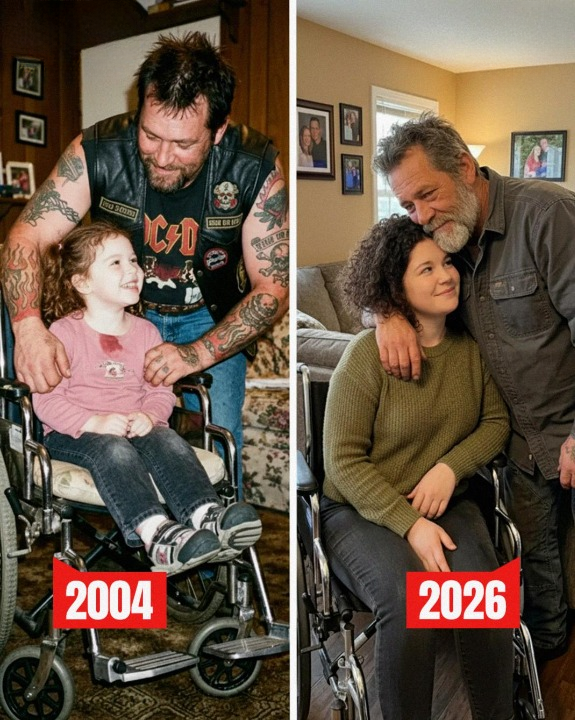
My uncle raised me after my parents passed away. After his funeral, I received a letter written in his handwriting that began with the words, “I’ve been lying to you your whole life.”
I was twenty-six years old, and I hadn’t walked since I was four.
Most people assume my life began in a hospital bed, but that isn’t true. I had memories before everything changed.
I don’t remember the accident itself. What I remember are small pieces of life before it. My mom, Lena, singing loudly in the kitchen. My dad, Mark, smelling like motor oil mixed with peppermint gum. I had light-up sneakers, a purple cup I carried everywhere, and a personality far bigger than my tiny body.
All my life I was told the same story: there had been a car crash. My parents died. I survived, but my spine was badly damaged.
The state began discussing where I should be placed.
Then my mom’s brother showed up.
A social worker named Karen stood beside my hospital bed talking about finding “a loving home” with a family experienced in caring for children with disabilities.
Ray cut her off immediately.
“No,” he said firmly. “I’m taking her. She’s not going to strangers.”
Ray was a big man with rough hands and a permanent scowl. He looked like someone shaped by hard weather and harder work.
He took me home to his small house that smelled like coffee.
He had no children. No partner. And no idea what he was doing.
But he learned.
He watched nurses carefully and copied everything they did. He kept notes in a worn notebook—how to move me without hurting me, how to check for pressure sores, how to lift me gently but securely.
The first night I was home, he set alarms every two hours. Each time he shuffled into my room with messy hair and sleepy eyes.
“Pancake time,” he muttered as he turned me so my body wouldn’t stiffen.
When I whimpered, he whispered, “I got you, kiddo.”
He argued constantly with insurance companies, pacing the kitchen while speaking through the phone’s speaker.
“No, she can’t just manage without a shower chair,” he snapped once. “If you think she can, you come tell her yourself.”
They never did.
He built a simple plywood ramp outside the front door so my wheelchair could get through. It looked rough, but it worked.
Ray also pushed me around the neighborhood and introduced me to every kid like I was the most important person there.
My first real friend was a girl named Zoe. She walked right up and asked why I couldn’t walk.
Before I could panic, Ray crouched beside me and said casually, “Her legs don’t listen to her brain. But she’ll probably beat you at cards.”
Zoe laughed and challenged me immediately.
Ray had a way of stepping into awkward moments and softening them.
When I was ten, I found him secretly practicing braiding yarn on the back of a chair in the garage.
That night he tried braiding my hair. His hands shook, and the result looked awful—but it meant everything to me.
When puberty arrived, he awkwardly brought a plastic bag to my room with pads, deodorant, and cheap mascara.
“I watched some YouTube videos,” he admitted, embarrassed. “Those girls talk really fast.”
We never had much money, but he never made me feel like a burden.
He washed my hair carefully in the kitchen sink, one hand supporting my neck.
“It’s okay,” he would say softly. “I got you.”
Whenever I cried about the things I’d never do—like dancing or standing in a crowd—he’d sit beside me and say firmly, “You’re not less. Do you hear me? You’re not less.”
As I got older, it became clear there would be no miracle recovery.
Most of my life happened inside my room.
But Ray turned that room into an entire world. He installed shelves where I could reach them and built a makeshift tablet stand in his garage.
For my twenty-first birthday, he made a planter box by the window and filled it with herbs.
“So you can grow that basil you’re always yelling about on those cooking shows,” he said.
I cried because it was perfect.
Then Ray began getting tired.
At first he just moved slower. He forgot his keys more often and had to sit halfway up the stairs to catch his breath.
He insisted he was fine.
But eventually Mrs. Patel from next door and I convinced him to see a doctor.
After the tests, he sat quietly at the kitchen table.
“Stage four,” he finally said. “It’s everywhere.”
Hospice nurses soon started visiting.
The night before he died, he asked everyone to leave except me.
He came into my room and sat beside my bed.
“You know you’re the best thing that ever happened to me, right?” he said.
I tried to joke about how sad that sounded, but I was already crying.
“You’re going to live,” he told me. “Promise me that.”
Before leaving, he whispered, “I’m sorry… for things I should’ve told you.”
He died the next morning.
After the funeral, the house felt painfully quiet.
That afternoon, Mrs. Patel came in holding an envelope.
“Your uncle wanted you to have this,” she said. “And he asked me to say he’s sorry.”
Inside were several pages written in Ray’s handwriting.
The first line said:
“Hannah, I’ve been lying to you your whole life.”
In the letter, he described the night of the crash—not the version I had always been told.
My parents had come to his house that evening planning to move away and start over somewhere else.
They intended to leave me with him.
Ray had exploded in anger, accusing them of abandoning their child.
He admitted something else too: my father had been drinking.
Ray realized later he could have stopped them from driving. He could have taken the keys or forced them to stay.
But he didn’t.
He let them leave in anger.
Twenty minutes later, police called.
Their car had wrapped around a pole.
They died.
I survived.
Ray wrote that at first he looked at me and saw the consequences of his own anger.
But taking me home was the only way he knew how to live with what had happened.
He also revealed something else.
The life-insurance money from my parents had been placed into a trust in my name, along with years of overtime he had worked as a lineman.
He had secretly saved everything so I could eventually afford real rehabilitation and better care.
He had even sold the house to make sure I’d have enough.
At the end of the letter he wrote:
“If you can forgive me, do it for your own peace. If you can’t, I understand. I will love you either way.”
I cried until my head hurt.
Part of me was furious. His anger had helped set the tragedy in motion.
But he had also spent twenty-two years caring for me with unwavering love.
A month later, after meeting with lawyers and handling paperwork, I entered a rehabilitation center.
For the first time in decades, therapists began helping me try to stand again.
It was painful and exhausting.
But I kept going.
Last week, for the first time since I was four years old, I stood on my own legs for a few seconds.
It wasn’t graceful. I shook and cried.
But I was upright.
In my mind, I heard Ray’s voice: “You’re going to live, kiddo.”
Do I forgive him?
Some days I’m not sure.
Other days I realize I may have been forgiving him little by little for years.
He couldn’t undo the crash.
But he gave me love, stability, and the chance to move forward.
He carried me as far as he could.
The rest of the journey is mine.