
When our parents died, I became everything my little sister had left. I gave up my own life to make sure she was safe. When kids at school ruined the one thing I had worked for weeks to buy her, I thought that was the worst of it—but I was wrong. What I saw after the principal called me in stopped me in my tracks.
My day starts at 5:30 a.m., and before I’m even fully awake, I check the fridge—not out of hunger, but to figure out how to stretch what we have. What Robin gets for breakfast, what goes in her lunch, and what’s left for dinner.
Robin is twelve. She doesn’t know I skip meals most days, and I plan to keep it that way. I’m not just her older brother—I’m all she’s got.
I work late shifts at a hardware store and take whatever extra jobs I can on weekends. While I’m gone, she stays with our elderly neighbor. I’m 21—I should be in college, figuring out my future—but Robin comes first.
For a while, she seemed okay. But then I started noticing small things—hesitation, quiet moments, like she was holding something back.
One night at dinner, she casually mentioned that girls at school were wearing these trendy denim jackets. She didn’t ask for one, but she didn’t have to. I could hear it in the way she said it.
That night, I said nothing—but I made a plan.
I picked up extra shifts, cut back on food, and saved every dollar I could. Three weeks later, I finally had enough.
I bought the jacket and left it on the kitchen table for her.
When she saw it, she froze.
“Is that…?” she whispered.
“It’s yours,” I told her.
She held it like it wasn’t real, then hugged me so tight I almost lost my balance. She wore it every day after that—until the day she came home in tears.
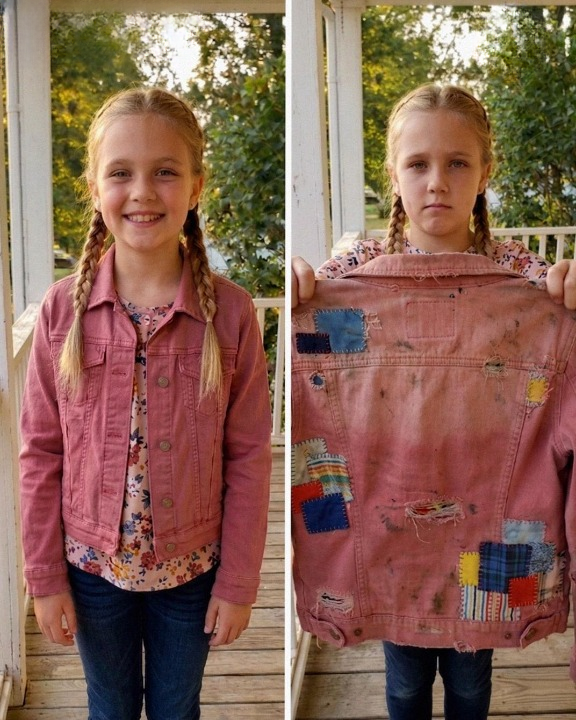
The jacket was torn.
Some kids had grabbed it at school, yanked on it, even cut it with scissors while laughing.
But instead of being angry, Robin kept apologizing—to me.
That hurt more than anything.
That night, we sat together and fixed it. We stitched it up, added patches, made it whole again.
“It doesn’t matter what they think,” she said. “You gave it to me.”
The next morning, she wore it again.
I hoped that would be the end of it.
It wasn’t.
Later that day, I got a call from her school. The principal told me to come in immediately.
When I arrived, the hallway was eerily quiet.
Then I saw it.
Her jacket—cut into pieces—stuffed in a trash can.
Not torn this time.
Destroyed.
I just stood there, staring.
Then I heard Robin crying.
I found her being comforted by a teacher, repeating over and over that she wanted to go home.
“They ruined it again,” she said when she saw me.
The principal explained that a group of students had cornered her before class and destroyed it.
I walked over to the trash can and carefully gathered every piece.
Then I made a decision.
I asked to speak to the students responsible—right then, in their classroom.
Inside, I stood at the front and held up the remains of the jacket.
I didn’t yell.
I told them the truth.
How I worked extra shifts to afford it. How my sister never even asked for it. How we fixed it together after it was damaged the first time—and how she wore it proudly anyway.
“What you destroyed,” I said, “wasn’t just a jacket. It was something she cared about—something she was proud of.”
The room went silent.
That was all I needed to say.
The principal stepped in after that and made it clear there would be consequences.
I didn’t stay.
I just took my sister home.
That night, we sat at the table again—needle and thread between us.
But this time felt different.
We didn’t just repair the jacket—we rebuilt it. Stronger. With new patches, new stitching, new meaning.
Robin even started smiling again, talking about school, about her life.
When she finished, the jacket didn’t look new.
It looked stronger.
“I’m wearing it tomorrow,” she said.
“I know,” I replied.
She looked at me and said, “Thanks for not letting them win.”
I squeezed her hand.
“No one gets to treat you like that,” I told her.
Some things come back stronger after they’re broken.
That jacket did.
And so did my sister.