
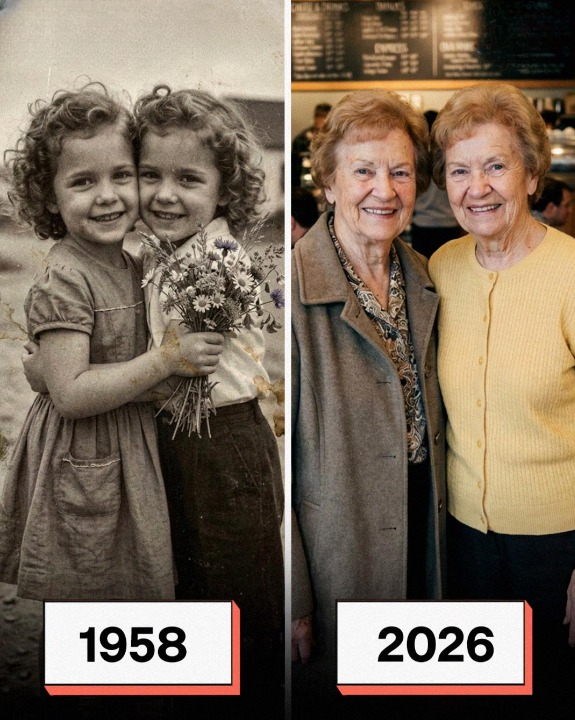
When I was five, my twin sister wandered into the woods behind our house and never returned. The police later told my parents they had found her body—but I never saw a funeral, a grave, or any real proof. Just years of silence, and a feeling that the story was never truly finished.
My name is Dorothy, I’m 73, and I’ve lived my whole life with a missing piece shaped like a little girl named Ella.
Ella was my twin. We were inseparable—more than just “same birthday” twins. We shared everything: thoughts, feelings, even a bed. If one of us cried, the other did too. She was the bold one; I followed her lead.
The day she disappeared, we were staying with our grandmother while our parents were at work.
I was sick—burning with fever—lying in bed while Grandma sat beside me with a cool cloth. Ella was nearby, playing quietly with her red ball, humming as she bounced it against the wall. I remember the soft thumping sound… and the rain beginning outside.
Then I fell asleep.
When I woke up, something felt wrong.
The house was too quiet.
No humming. No ball.
I called out for Grandma. She rushed in, looking shaken.
“Where’s Ella?” I asked.
“She’s probably outside,” she said, though her voice trembled.
I heard the back door open. Then her voice, louder now, calling Ella’s name.
Soon after, the police arrived—asking questions I couldn’t answer.
They searched the woods behind our house. Flashlights cut through the darkness as people called her name in the rain.
All they ever told me was that they found her ball.
The search went on for days, then weeks. Time blurred. Adults whispered, but no one explained anything to me.
Eventually, my parents sat me down.
“The police found Ella,” my mother said quietly.
“Where?” I asked.
“In the woods… she’s gone.”
My father cut in: “She died. That’s all you need to know.”
But I never saw a body. Never attended a funeral. It was as if she simply vanished from existence.
One day I had a twin.
The next, I didn’t.
Her things disappeared. Her name was never spoken again.
Whenever I asked questions, my mother would shut down. “Stop, Dorothy. You’re hurting me.”
So I stopped asking—at least out loud.
But inside, the questions never went away.
As a teenager, I tried to find answers. I went to the police station and asked to see her case file—but they turned me away, saying my parents would have to request it.
They never did.
In my twenties, I asked my mother one last time. She refused again, saying it was too painful.
So I buried it.
I grew up, built a life, had children, became a grandmother. On the outside, everything was full—but inside, there was always that empty space where Ella should have been.
Sometimes I’d imagine what she might look like now.
Sometimes I’d feel like I heard her.
My parents died, taking their silence with them.
I thought I would never know the truth.
Years later, my granddaughter invited me to visit her at college in another state.
One morning, she suggested I explore a nearby café.
So I went.
Inside, as I stood in line, I heard a woman’s voice—something about it felt familiar.
Then I looked up.
And saw her.
A woman standing at the counter—same height, same posture.
Then she turned.
We locked eyes.
It felt like looking into a mirror.
I walked toward her, my heart racing.
“Oh my God,” she whispered.
“Ella?” I said before I could stop myself.
She shook her head. “My name is Margaret.”
But she looked just like me.
We sat down together, stunned by the resemblance—same features, even similar mannerisms.
Then she said something that changed everything:
“I was adopted.”
My heart tightened.
She told me she’d always been told very little about her origins. When she asked questions, she was shut down.
We compared timelines.
She was born five years before me.
Not my twin—but still…
Something connected us.
We exchanged numbers, both unsure but unable to walk away.
Back home, I went through a box of my parents’ old documents.
At the bottom, I found something that made my knees buckle.
An adoption record.
A baby girl.
Born five years before me.
Same mother.
My mother.
Behind it was a handwritten note.
She wrote about being young, unmarried, and forced by her parents to give up her baby. She wasn’t even allowed to hold her. She was told to forget—and never speak of it again.
But she never forgot.
She called that baby her first daughter.
I broke down.
All those years of silence suddenly made sense.
I sent the documents to Margaret.
She called immediately, her voice shaking.
We took a DNA test.
The results confirmed it:
We are full sisters.
People ask if it felt like a joyful reunion.
It didn’t.
It felt like uncovering the truth buried beneath decades of pain.
We talk now. We share stories, compare our lives, notice the small similarities.
But we also face the reality:
Our mother had three daughters.
One she was forced to give away.
One she lost.
And one she raised—but in silence.
It wasn’t fair.
But I’ve come to understand how deeply broken she must have been.
Pain doesn’t justify secrets— but sometimes, it explains them.