
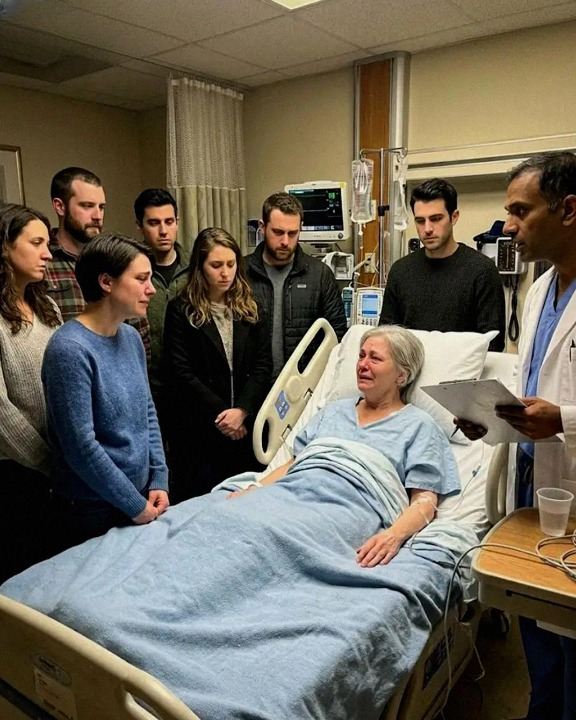
When the doctor told us our mother could no longer safely live alone, my six siblings immediately came prepared with excuses. I was the one they least expected to speak up—so what I said next completely changed the direction of everything.
At the hospital, the doctor warned us that our mother’s balance was worsening and that she had already suffered multiple serious falls. She needed full-time care.
We all stood there in silence.
Our mother, Margaret, looked at each of us with quiet hope—the kind of look a parent gives when they still believe their children will step up for them.
Then one by one, my siblings began to refuse.
Each had a reason. Each had a problem. Each one made it clear they wouldn’t be taking her in. My brothers and sisters spoke as if responsibility belonged to someone else entirely.
And with every excuse, I watched my mother’s expression slowly collapse.
She had raised all of us—mostly on her own—working tirelessly after our father left. She had sacrificed everything. And now, when she needed us, no one wanted to take responsibility.
I was the youngest. The one who always felt a little separate. Not the favorite. Not the first choice. So when I finally spoke, no one expected it.
I told them I would take her in.
But I had one condition: the house needed to be sold.
That changed everything.
Suddenly, the refusal turned into outrage. The house mattered more than they admitted—it was the only real asset left. Their concern wasn’t care for our mother, but ownership and inheritance.
My mother finally spoke up, embarrassed by the argument, and told us to stop fighting. I set a time for a proper meeting the next day.
That night, I realized something uncomfortable: this was never just about care. It was about control and money.
The next day, I went to the house early. I cooked for my mother, and for the first time in years, we talked honestly.
I asked her why she always kept me at a distance.
What she told me surprised me.
She admitted that after our father left and everything fell apart, she emotionally pulled away from me—not because she didn’t love me, but because I reminded her of the hardest period of her life. She thought distance would hurt less than attachment.
It wasn’t rejection.
It was survival.
That shifted something in me. I realized I hadn’t been unloved—I had been loved cautiously, imperfectly, from afar.
When my siblings arrived for the meeting, the tension was immediate. They resisted the idea of selling the house, but I laid out the reality clearly: the home wasn’t safe, no one was stepping up, and pretending otherwise wasn’t helping anyone.
To my surprise, my mother supported me.
That cracked the room open. One by one, my siblings began admitting the truth—not just about logistics, but about their inability to care for her properly. Some were afraid, others overwhelmed, all of them unprepared.
It became clear that no one had been fully honest—not even with themselves.
So we sold the house.
I arranged for a real estate agent, handled the process, and at the same time brought my mother to a specialist for a proper evaluation.
After the sale, my mother moved in with me while her medical care was reassessed. Eventually, we learned that much of her decline had been worsened by medication mismanagement rather than her condition alone. With corrected treatment and monitoring, her condition improved noticeably.
As time passed, my siblings began to reappear—not to argue, but to help in small ways. Groceries, repairs, visits.
And slowly, something shifted in our family dynamic.
One evening, my mother admitted she never expected me to be the one who would take care of her.
Neither did I.
But in the end, we found a kind of understanding between us—imperfect, late, but real.
And for the first time in my life, I didn’t feel like the forgotten child anymore.