
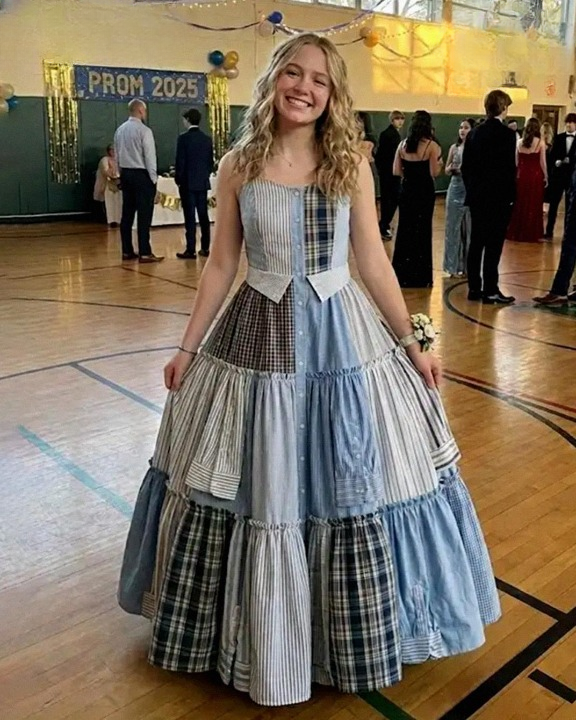
My dad was the school janitor, and for years, classmates mocked him—and me by extension. When he passed away before my prom, I sewed my dress from his work shirts so I could carry him with me. At first, everyone laughed. By the time the principal spoke, the room fell completely silent.
It had always been just the two of us. My mom died giving birth to me, and my dad, Johnny, handled everything. He packed my lunches, made pancakes every Sunday, and even learned to braid hair from YouTube videos.
Because he worked at my school, I endured years of cruel whispers: “That’s the janitor’s daughter… her dad scrubs our toilets.” I never cried at school. At home, Dad would reassure me, saying, “You know what I think about people who make themselves big by making others feel small? Not much, sweetie… not much.” His words always helped.
Dad believed honest work was honorable, and I promised myself I’d make him proud enough to drown out every nasty comment.
When he was diagnosed with cancer, he kept working as long as possible. He often looked exhausted, leaning against the supply closet, but he’d straighten when he saw me. “Don’t give me that look, honey. I’m fine,” he’d say. But we both knew he wasn’t.
Before prom, Dad told me, “I just need to make it to prom… then your graduation. I want to see you walk out like you own the world, princess.” But he lost his battle months before prom.
Left with only memories, I sat with the box of his things—the wallet, the cracked watch, and his folded work shirts. And then an idea struck: if Dad couldn’t be at prom, I could bring him.
With my aunt’s help, I cut and stitched his shirts into a dress. Each piece carried a memory: the blue shirt from my first day of high school, the faded green one from a long bike ride, the gray one from a hug on a rough junior year day. Every stitch held him.
The night before prom, I tried the dress on. It wasn’t designer—just a patchwork of Dad—but it fit perfectly. For the first time since the hospital call, I didn’t feel something missing.
Prom night arrived. As soon as I stepped in, whispers started: “Is that dress made from the janitor’s rags?” Laughter rippled through the room. My face burned. I told them it was made from my dad’s shirts to honor him. Some mocked further, but I refused to break.
Then the DJ cut the music, and the principal, Mr. Bradley, took the mic. Silence fell. He recounted Dad’s years of quiet service—fixing lockers, sewing torn backpacks, laundering uniforms—things most of us had never noticed.
He explained the dress wasn’t rags—it was a tribute to the man who cared for everyone in that school for more than a decade. Teachers and students began standing one by one, showing respect. Within minutes, over half the room was on their feet.
Someone started clapping, spreading like wildfire. Former classmates approached to apologize. Others quietly carried their shame.
When handed the microphone, I spoke briefly: “I made a promise a long time ago to make my dad proud. I hope I did. And if he’s watching from somewhere tonight, I want him to know that everything I’ve ever done right is because of him.”
Later, my aunt and I visited Dad’s grave. I placed my hands on the headstone, whispering, “I did it, Dad. I made sure you were with me the whole day.”
Dad never saw me walk into that prom hall—but through every stitch of that dress, he was there