
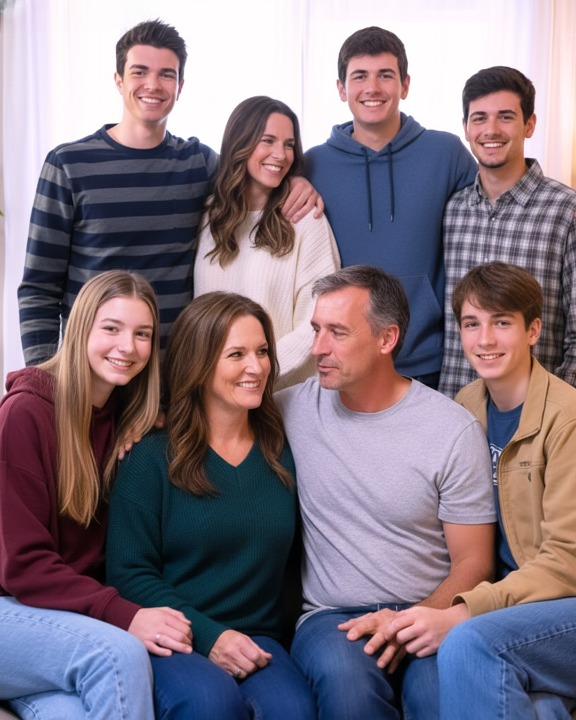
I spent decades building a family and a future, until a single sentence from a doctor made me realize my marriage had been run like a construction project—and I was the only one never allowed to see the plans.
After paying the final semester of my youngest child’s college tuition, I sat staring at the confirmation email as if it were a finish line.
“That’s it,” I told Sarah. “We did it.”
She smiled proudly, but there was something uneasy in her eyes—like she had already practiced what she would say if everything suddenly collapsed.
Two weeks later, I sat in a plain exam room, expecting to hear about a possible prostate issue. The doctor glanced between my chart and the lab results before looking up.
“Benjamin,” he said carefully, “do you have biological children?”
I chuckled. “Six of them. Four boys, two girls. My bank account can prove it.”
But he didn’t laugh. “You were born with a rare chromosomal condition. You’ve never produced viable sperm. It’s congenital. Not low count—impossible.”
The room seemed to shrink. My mouth went numb, and I couldn’t even remember how to stand like someone in control of his own life.
I built my construction company the same way I built everything else: if there was a problem, I fixed it; if something was needed, I worked until it was provided.
And now I was being told the one thing that defined me—being a father—had never even been biologically possible.
I’d paid every bill, even when overtime left my hands cracked and raw. When Axl began his final semester, I told Sarah I might finally slow down.
“Maybe I’ll take that fishing trip,” I said. “Maybe it’s time.”
She raised an eyebrow. “You? Slow down? I’ll believe that when I see it.”
I laughed, but the thought lingered. Maybe, for once, I could just be present.
After the doctor’s visit, I came home to find Sarah folding laundry on the couch.
“How’d it go?” she asked.
“Fine,” I answered too quickly.
Her hands paused on Kendal’s sweatshirt. “Really?”
“Doctor wants to run more tests,” I said with a shrug.
She studied my face like she was examining a crack in a wall. “Okay.”
“I’m going to shower,” I muttered.
Under the hot water, panic swirled in my chest. If I wasn’t their biological father, then what exactly was I?
By noon the clinic had called three times—not casual calls, but urgent ones, like they were trying to catch me before something irreversible happened.
The nurse would only say, “The doctor needs to see you in person.”
Sarah asked if she should come.
“No,” I said quickly. “It’s probably nothing.”
But driving there, the doctor’s earlier words echoed like a siren.
Impossible.
That night, once the house was quiet, I sat at the kitchen table with the doctor’s report and a cold cup of coffee.
“Ben? Why are you still up?” Sarah asked, pulling her cardigan tighter.
I slid the report across the table.
“Whose kids are they, Sarah?”
Her face drained of color. Instead of denying it, she walked down the hallway, opened the wall safe, and returned with an old envelope my mother had once insisted we keep.
“It wasn’t my idea,” she whispered. “You need to read this.”
Inside was a fertility clinic invoice, a donor ID, and a letter in my mother’s handwriting.
Sarah,
If Ben ever finds out the truth, tell him it was for his sake. He was meant to be a father. Don’t tell anyone. Protect him. Protect our name.
—F
My hands clenched around the paper.
“How long have you known?”
“After a year of trying to conceive, your mother stepped in,” Sarah said. “She said we needed to make sure I wasn’t the problem. She scheduled an appointment herself.”
“And you never told me?”
“She told me not to. And I wanted a family so badly. The doctor said I was healthy… but your mom insisted on testing you too.”
A memory surfaced: a sterile clinic room, a paper cup, a nurse avoiding eye contact.
“I remember that test,” I said quietly. “Mom told me it was routine. The doctor said the results were inconclusive.”
Sarah shook her head.
“Your mother saw the real report. It said you had no viable sperm.”
The words landed heavy in my chest.
“She said if you ever saw the word sterile, it would break you.”
“And I never followed up,” I murmured. “I was too busy.”
Sarah nodded through tears. “Your mother wasn’t.”
“And Michael?” I asked hoarsely.
She hesitated.
“Your mom wanted someone she trusted. Someone who’d never claim anything.”
I already knew the answer.
“She asked Michael,” Sarah said softly. “He agreed. The clinic handled everything—donor codes, appointments, timing. He never had to touch me.”
I stared at her.
“He said he didn’t want kids of his own,” she added. “If this gave you the life you wanted, he was willing.”
So everyone had decided for me.
Sarah nodded.
“Your mom controlled everything. She made us promise never to tell you. She said the truth would destroy you.”
“And instead it destroyed trust.”
Days passed with that truth hanging over every conversation.
One afternoon Michael walked in like usual, joking about my cheap coffee.
“We need to talk,” I told him.
He looked at my face and sighed. “You found out.”
“How long have you been lying to me?”
“Since the beginning,” he said. “Mom thought the truth would crush you. She said you needed to believe you were a father.”
For a split second I imagined punching my own brother.
“You all thought I was too weak to handle it?”
“No,” he said quietly. “We thought you’d leave. Or hate Sarah. I didn’t want that.”
Sarah stood in the doorway, crying. “I just wanted a family.”
Michael looked at me. “Your kids love you, Ben. That doesn’t change.”
But everything inside me felt uncertain, like I’d lost the story of my own life.
A week later, the whole family gathered for Kendal’s birthday. Laughter filled the house, music thumped, and balloons hung in the dining room.
Michael joked with the kids like nothing had changed.
Then my mother arrived—late, arms full of gifts, sweeping in like always.
I avoided her most of the party, but she cornered me in the hallway.
“You look tired,” she said. “Long week?”
“Why did you do it?” I asked quietly. “Why decide what kind of father I’d be?”
Her expression hardened. “You think I enjoyed it? You think you’d have stayed if you knew?”
“No,” I said, louder than intended. The room fell silent.
“You did what was easiest for you. You made my wife lie. You made my brother lie. You built a whole family on secrets.”
My mother snapped back, “I protected you.”
“You controlled me,” I replied. “And you don’t get to do that anymore.”
She tried to walk past me toward the living room, but Mia stepped in front of her.
“Grandma, stop.”
My mother stared at her, stunned.
“Please leave.”
Mom’s heels clicked down the porch steps, and the door shut behind her.
The room stayed quiet, candles still burning.
“Dad… what just happened?” Liam asked.
“Your grandmother made choices for us years ago,” Sarah said softly.
“About Dad?” Kendal asked.
“Yes.”
Michael stood pale near the door and finally nodded. “About your dad.”
Then Spencer—the quietest of the boys—came over and rested a hand on my shoulder.
“Whatever it is,” he said steadily, “you’re still the man who raised us.”
Something inside my chest cracked open.
The candles kept burning.
Later that night, after everyone had gone to bed, Sarah sat beside me on the porch.
“I know I’ve lost your trust,” she whispered. “I just hope I haven’t lost you.”
I sat in silence for a long moment.
“You haven’t,” I finally said. “But it’ll take time. I love our kids. I don’t regret them. I’m just… heartbroken.”
The screen door creaked open. Kendal stepped outside, eyes red.
“Dad?” she said softly. “I heard enough.”
“Kendal—”
She placed her hand over mine.
“Don’t explain,” she said. “You’re my dad. You always have been. And anyone who tries to take that away will have to get through me first.”
Sarah covered her mouth, crying.
I pulled Kendal into a hug and breathed out for the first time since the doctor’s office.
“It’s okay,” I whispered.
And for the first time, I believed it—because she said it like it was something permanent, not something that could be taken away.
“Because you’re my dad.”