
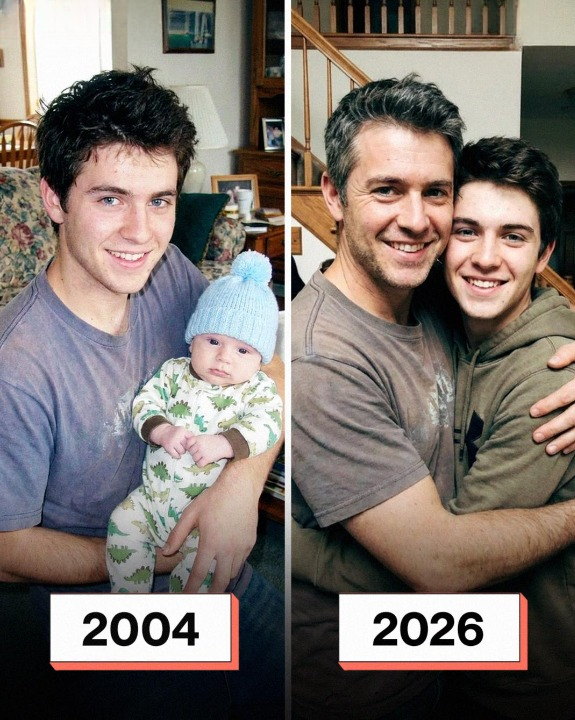
When Dylan’s mother resurfaced after more than 20 years, she didn’t just bring herself—she brought a secret that threatened everything he’d built. What started as a tense encounter quickly became a reckoning, forcing Dylan to choose between the woman who gave him life and the man who raised him.
I’m Dylan, and my life’s been complicated.
My mom, Jessica, had me when she was very young. She and my dad, Greg, were barely adults themselves. I was told they tried to make it work, but it wasn’t enough—especially with a baby in the mix.
The day I was born, my dad arrived at the hospital expecting to meet his son. Instead, my mom handed me to him.
“I’m not ready to be a parent, Greg. You can do it,” she said, then walked out—never to be heard from again. No support, no calls, no birthdays, just silence stretching across years like an unscalable wall.
Greg raised me alone. Every scraped knee, every late-night school project, every fever—he was there. He cooked, cleaned, worked two jobs, and never once complained. And through it all, he never spoke ill of her.
When I was seven, I asked to see a picture of her. He quietly handed me a small photo and said, “She’s your mom, Dyl. You should know what she looks like.” She had brown eyes, auburn hair, carefree and beautiful—the kind of person who seemed untouched by life.
I asked why she left. He told me some people make choices we don’t understand, not because they’re bad, but because they weren’t ready. “I just love you more than I hate what she did,” he said. That idea—that love is about staying even when it’s hard—stuck with me.
Growing up, I learned responsibility early. By 10, I was cooking meals, folding laundry, and helping my dad keep our lives afloat. I worked hard in school not because anyone expected it, but because I wanted to give back to the man who gave me everything.
By 21, I had founded LaunchPad, a startup connecting young creatives with mentors and investors. Within a year, it exploded. People outside my family finally noticed. And for the first time, I wondered: if she saw me now, would she feel anything at all?
I didn’t have to wait long. One Saturday, my dad called from the porch.
“Dyl, someone’s here asking for you.”
I stepped outside and saw her—Jessica. My mother. Older, tired, but unmistakably her.
She didn’t apologize. She didn’t cry. She handed me a manila envelope with a DNA test inside.
“This proves Greg isn’t your biological father,” she said. “I kept it private, but now, with everything you’ve accomplished, you deserve the truth. You’re mine, honey. Now we can start over.”
She also slid a contract toward me, claiming a stake in my company—the one I built with my father’s guidance and support.
I looked at her, then at my dad. “Blood doesn’t make a parent,” I said. “My dad raised me. He loved me more than anyone, and he taught me everything. You’re a stranger.”
She tried to argue, but I refused to sign. I wasn’t giving her the chance to rewrite my life.
The next day, she returned with a lawyer, trying again. But my attorney, Maya, laid out all the proof: my father’s sacrifices, her abandonment, her attempt to claim LaunchPad. The court sided with us—she was ordered to pay retroactive child support, and her claim on my company was denied.
In the end, the public saw the truth too: LaunchPad wasn’t just a business; it was proof of my father’s love and my own resilience. Blood didn’t make him my dad—he did, every day, through every act of love.