
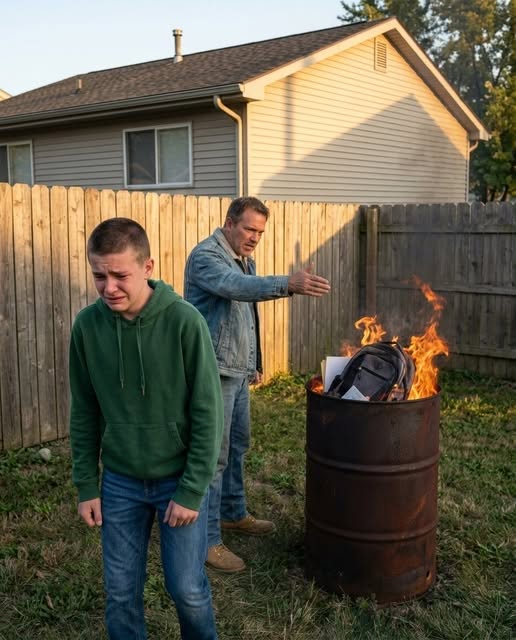
The night my father tried to erase me didn’t begin with chaos or shouting—it was worse than that. It was quiet, deliberate, and disturbingly calm. At nineteen, I stood in the backyard watching him move like a man finishing a task he had already decided on long ago. One by one, he dragged my life out into the grass: my clothes, my notebooks full of plans and thoughts, my worn work boots, the cheap laptop I had worked a whole summer to afford. Then he added the things that meant even more—the coffee mug that had belonged to my mother, and the framed photo from my graduation that I had always kept close.
He piled everything into a rusted metal barrel without hesitation. When he lit the fire, it wasn’t just objects that burned—it was memory, effort, and everything I thought he might have valued about me. The flames swallowed it all while he stood there and told me this was what disobedience cost.
To him, I was never an individual with a future of my own. I was something to control, someone expected to stay and serve his version of life. The fight that led to that moment began when I told him I was leaving for a trade program in Columbus. I had already planned my job, my path, my escape from his control. He responded with anger, insults, and finally destruction when words no longer worked.
But what he didn’t realize was that I had already prepared. Earlier that day, I had moved my documents, my savings, and my acceptance papers into my friend Nate’s car. So when the fire died down and he told me I would never come back if I left, I was already done believing I needed his permission for anything.
That night, I walked away with a single backpack and no intention of returning.
The years that followed were brutal. Survival came first. I took any job I could find, slept wherever there was space, and slowly built myself up through exhaustion and repetition. I learned the trade from the ground up—construction sites, demolition work, freezing mornings, and scorching afternoons. My body hurt constantly, but I kept going. By my mid-twenties, I was running crews, licensed, and stable enough to put my name on a truck: Hayes Restoration and Build.
I didn’t choose that name out of pride in him—I chose it to redefine it completely.
My work focused on fixing what others gave up on: broken buildings, abandoned homes, neglected structures. Over time, I realized I wasn’t just restoring property—I was rebuilding things that had been written off, much like I had rebuilt myself.
Then one day, I saw it. His house.
It was falling apart—overdue taxes, legal issues, visible decay. To most people it was worthless. To me, it felt like a full circle waiting to close. I didn’t rush it. I followed every legal step, and when the auction ended, the result felt less like revenge and more like finality.
When I arrived at the property, it felt smaller than I remembered. The yard was overgrown, the structure tired, almost defeated. I stood where the fire had once been and took a photo of the front of the house. Then I called him.
When he answered, I simply told him to check his mailbox.
Inside was the image of me standing in front of the house he had once ruled over—the same house I now owned legally.
I didn’t act out of anger or force him out through cruelty. I followed the law, every step, because I refused to become what he was. Power didn’t need destruction. It only needed time.
When he finally confronted me, demanding answers, I told him the truth: he had taught me exactly what I never wanted to become. Then the line went silent. Not with apology, but with realization—he no longer had any control over me.
A month later, it was over. No celebration, no spectacle. I renovated the house instead—restoring everything that had been left to rot.
When it was finished, I sold it. The money didn’t go toward luxury or ego. I used it to fund housing repairs for young people aging out of foster care—those starting life without safety nets, just like I once did.
That, to me, was the real ending. Not revenge, but redirection.
For years I thought victory meant making him feel what I felt that night in the firelight. But I learned something better. The real victory was building a life he could never reach, damage, or take away from me.
He tried to erase me.
Instead, he gave me everything I needed to rebuild myself into something stronger.