
When my best friend Mia urged me to go on a blind date with her boyfriend’s friend, I was unsure. I wasn’t really into blind dates, but she promised he was kind, respectful, and reliable. His name was Eric, and from the start, he seemed genuinely attentive—thoughtful in messages, polite, and never overbearing. After a week of chatting, he invited me to dinner at a well-known Italian restaurant downtown.
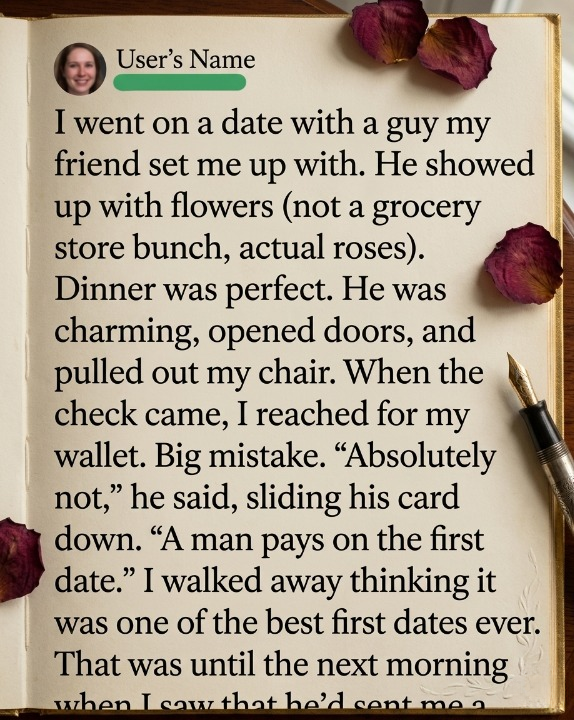
The date itself went smoothly. Eric showed up early with roses, dressed neatly in a slightly old-fashioned but charming way. He pulled out my chair, complimented my outfit, and even gave me a small engraved keychain. The conversation felt easy, flowing naturally between travel, work, and dating stories.
When the bill arrived, he insisted on paying, saying, “A man pays on the first date.” It felt traditional, so I didn’t object. He walked me to my car afterward and waited until I drove off, and overall, the night felt like it had potential.
But the next morning, I woke up to an email titled “Invoice for Last Night.” I thought it was a joke at first—until I saw an itemized breakdown of dinner, flowers, the gift, and even something labeled “emotional labor.” At the bottom, he implied that if I didn’t “settle up,” he might involve Mia’s boyfriend, Chris.
Confused, I showed Mia immediately. Her response was blunt: he was unhinged and I shouldn’t engage.
Mia and Chris ended up responding with a mock “invoice” of their own, calling out his behavior. Eric quickly spiraled from defensive to angry to pitiful in his replies.
I never responded again. They cut him off entirely after that, seeing exactly who he was.
In the end, what looked like the start of a sweet date turned into a lesson I won’t forget: kindness isn’t a transaction, and generosity doesn’t come with a price tag.