
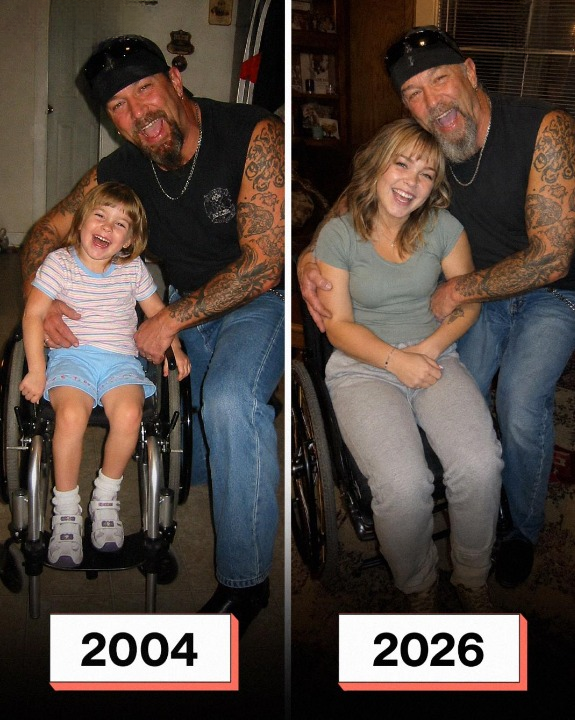
My uncle raised me after my parents died. After his funeral, I received a letter in his handwriting that began: “I’VE BEEN LYING TO YOU YOUR WHOLE LIFE.”
I’m 26 now, and I haven’t walked since I was four.
Most people hear that and assume my life started in a hospital bed—but there was a before.
I don’t remember the crash. I only know what I was told: my parents died, I survived, and my spine didn’t.
My mom, Lena, used to sing loudly in the kitchen. My dad, Mark, always smelled like motor oil and peppermint gum. I had light-up shoes, a purple cup, and far too many opinions.
Then everything changed.
After the accident, the state talked about foster care and “appropriate placements.” That’s when my mother’s brother stepped in.
“I’m taking her,” Ray said. “She’s not going anywhere with strangers.”
Ray wasn’t polished or soft around the edges. He was solid, quiet, and unprepared for caregiving—but he showed up anyway.
He learned by watching nurses, scribbling notes, copying everything: how to move me safely, how to care for my skin, how to lift me without hurting me. He set alarms every night just to check on me.
He built a ramp out of wood so I could leave the house. It wasn’t pretty, but it worked.
He fought insurance companies, arguments echoing through the kitchen while I listened from my room.
“I know,” he’d say when I cried. “I’ve got you.”
He took me everywhere he could—parks, fairs, sidewalks—treating me like I belonged in every space. When people stared, he didn’t let them.
He made sure I had friends. When a girl once asked why I couldn’t walk, he answered simply: “Her legs don’t listen to her brain. But she can beat you at cards.”
That girl became my best friend.
As I grew, Ray kept adapting the world around me—lower shelves, makeshift equipment, small inventions built in the garage just so I could reach more of life.
He even learned things he never should’ve had to: how to do my hair, how to prepare me for puberty, how to make me feel less alone in a body that didn’t work the way I wanted it to.
We didn’t have much money, but I never felt like a burden.
“You’re not less,” he always told me. “You hear me?”
Then, years later, everything shifted again.
He started slowing down. Forgetting things. Getting tired in ways he couldn’t hide.
At first he insisted it was nothing. Then came the doctor visits, the quiet conversations, and finally the word that changed everything: stage four.
He tried to keep things normal for as long as he could—still making meals, still helping me, still pretending he wasn’t falling apart.
But hospice eventually came into the house, bringing machines, charts, and silence that felt heavier than anything before.
The night before he died, he came into my room and sat beside me.
“You know you’re the best thing that ever happened to me,” he said.
“I don’t know what I’m going to do without you,” I replied.
“You’re going to live,” he said firmly. “That’s your job.”
And then he was gone the next morning.
At the funeral, people called him a good man. I nodded because I didn’t know what else to do.
Three days later, our neighbor handed me an envelope.
“He asked me to wait,” she said. “He said you’d understand.”
Inside was his handwriting.
The first line broke me:
“Hannah, I’ve been lying to you your whole life.”
He wrote about the night of the crash—about things I had never been told.
He said my parents hadn’t simply been victims of an accident. They had been arguing about leaving, about moving, about taking me or not taking me. He said anger was in the car that night—his too.
He admitted he had seen warning signs and didn’t stop them. That he could have intervened. That he didn’t.
And then came the truth he carried for years:
He had taken me in not only out of love—but also out of guilt.
He wrote that at first, when he saw me in the hospital, he felt something he hated in himself: blame. Resentment. Responsibility he didn’t know how to hold.
But that feeling didn’t last the way love did.
He worked constantly—overtime shifts, insurance battles, paperwork, everything—to build a life for me. He even secured money from my parents’ insurance and placed it into a trust for my future. He sold the house so I’d have resources he never spoke about.
“I didn’t tell you,” he wrote, “because I couldn’t stand the idea of you looking at me and seeing the man who failed your parents.”
By the end of the letter, there was no justification left—only regret, honesty, and something close to peace.
“If you forgive me,” he wrote, “do it for yourself. If you don’t, I’ll still love you. I always have.”
I sat there for a long time, unable to breathe properly, holding pages that changed everything I thought I knew.
Some part of me wanted to erase it all.
Another part couldn’t deny what I already knew: he had also been the reason I survived the life that came after.
The days that followed were confusing. Nothing felt simple anymore.
Then, slowly, I made a choice—not about him, but about me.
I went to rehab.
It was hard. Brutally hard. My body resisted everything. But I kept going anyway.
Because somewhere in that struggle was the life he kept trying to give me.
And for the first time in years, I stood—really stood—for a few seconds on my own legs.
It wasn’t perfect. It wasn’t complete. But it was real.
And in that moment, I understood something I couldn’t before:
Some truths don’t cancel each other out. They coexist.
He caused pain he could never undo.
And he also spent the rest of his life trying to build something out of what remained.
Now I live with both realities.
Some days I feel anger. Some days I feel gratitude. Most days, both at once.
But I’m still here.
Still trying.
Still moving forward.
And maybe that’s what he meant when he said I was going to live.