
Grandma Ruth had been gone for three weeks, but it still felt like she hadn’t fully left. I hadn’t even unpacked the black dress from the funeral. It stayed zipped in its garment bag on the back of my closet door, like something I wasn’t ready to face yet. Sometimes, when I reached past it for clothes, I caught the faint scent of cedar—her scent—still clinging to the fabric.
She kept showing up in small, ordinary moments. In the way I made tea the way she taught me, using loose leaves instead of bags. In the sight of autumn flowers outside a shop. In the way a dog leaned into its owner on a sidewalk, calm and trusting in a way Ruth always believed people should be.
My mother didn’t ask how I was coping. She went straight to the will.
Ruth had left me the house in Stillwater, her savings, and her investments, aside from a donation to the animal shelter she supported for years. My parents immediately decided it should be split with my older sister Olivia. “That’s fair,” my mother said.
But fairness in my family was never really about balance. It was a rule already decided, where Olivia’s needs always mattered more and mine were expected to bend around them.
When I pointed out that Ruth had clearly made her choice, my mother shifted tactics. Not anger—something worse. Hurt. The kind that implied I was selfish for not complying.
Olivia had children. Another on the way. Expenses. Responsibilities. I was single, independent, and therefore “free,” as they saw it. According to them, I didn’t need it.
That familiar pattern surfaced again. Olivia received support, funding, attention. I received expectations and praise for being low-maintenance. Over time, I learned my role: the one who manages, who doesn’t ask for much, who makes things easy.
It took years—and therapy—to understand that “easy” often just means overlooked.
After the call, Olivia texted too. At first it was polite, then it turned into a list of expenses: childcare, clothes, bills. No mention of Ruth. Just need disguised as urgency.
I opened the attorney’s email again. The estate was significant. The house alone was worth hundreds of thousands. Ruth had made these decisions deliberately.
Unlike the rest of my family, she never measured people against each other. She remembered my work. Sent me books and postcards. Told me there was more than one way to build a life.
That night, I decided. I booked a flight to Minnesota and arranged a meeting with Ruth’s attorney.
The pressure started immediately. My mother talked about duty. Olivia called crying about the kids. My father left an angry voicemail. Then came the message that made everything clear: transfer it to Olivia, or don’t come home.
So I locked everything down—accounts, passwords, credit. I instructed the attorney to speak only to me.
By midnight, I had dozens of missed calls. My father’s voicemail stood out most. Not the anger, but the contempt: that I must have been manipulated into receiving the inheritance, as if I couldn’t simply have been chosen.
On the flight, Olivia sent photos of her children, trying to guilt me into responding. I didn’t.
I stayed at a hotel instead of my parents’ house, which only made things worse. More messages. More accusations. More entitlement.
By Saturday morning, I was in the attorney’s office.
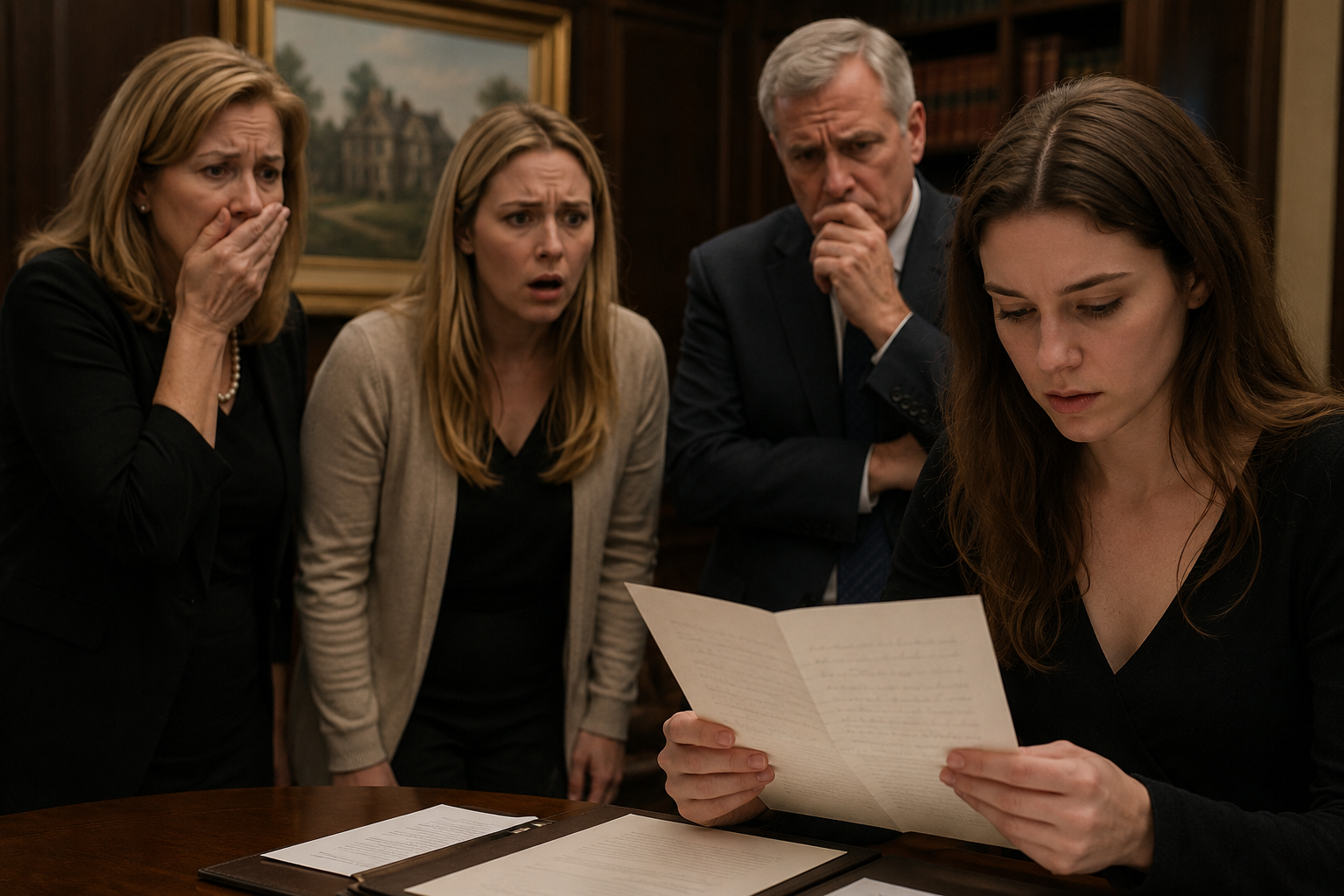
Before the meeting could continue, my family arrived uninvited—my mother, Olivia, and my father all insisting on being heard. The situation escalated fast, each of them claiming the inheritance should belong to the “family.”
Then the attorney revealed something unexpected: Ruth had left a sealed letter, to be opened only if anyone tried to pressure or intimidate me.
The envelope was placed on the table.
Before it could be opened, my father accused Ruth of being confused and me of manipulation. That was the moment everything shifted.
The attorney broke the seal anyway.
Inside was confirmation from Ruth’s doctor that she had been fully competent when writing her will. Alongside it was something far more revealing: a detailed record of financial support Ruth had already given my family over the years.
Tuition. Wedding costs. Housing help. Car payments. Emergency bailouts. Hundreds of thousands in total—almost entirely benefiting Olivia and my parents.
Then Ruth’s letter explained the rest.
She had already supported Olivia for years, repeatedly and quietly. Meanwhile, I had never asked for anything—not even when I was struggling. I asked for time, stories, recipes, advice. Not money.
She wrote that she was tired of a pattern where one child was endlessly supported while the other was expected to simply cope. She would not let her final decision reinforce that imbalance.
She also addressed the claim that I had been manipulated: if people believed that was more likely than her simply seeing things clearly, that said more about them than about me.
That was when my father snapped. My mother tried to dismiss it. Olivia insisted children changed everything.
For the first time, I didn’t soften my response. I told them plainly that their children were not currency, and my independence was not proof I deserved less.
The meeting ended in chaos, but something had already shifted. Their words no longer landed the same way.
After they left, the attorney handed me a separate envelope—from Ruth.
I opened it alone in her kitchen later that day.
The house still smelled faintly like her—tea, cedar, and lemon cream. I cried before I even opened the letter.
She wrote that she was sorry she hadn’t protected me more clearly when I was younger. She saw the imbalance. She always had.
And then she wrote the line that stayed with me: that I should choose myself at least once, because no one had ever taught me how.
After that, things slowly settled. The legal threats stopped. The pressure faded. Eventually, so did most of my family’s presence entirely.
I sold the house the following spring. I kept the rosebush she loved, taking a cutting back to Chicago. It bloomed again on my balcony.
I used part of the inheritance to pay off debts, invest in my future, and start a small scholarship fund for girls who never got the same chances I didn’t either.
Over time, what I felt wasn’t just grief. It was clarity.
Months later, my mother sent a Christmas card with no note. I didn’t respond.
On difficult days, I still reread Ruth’s letter. Not for the money, or the house, but for the reminder that I wasn’t invisible to everyone—that at least one person had seen the pattern clearly and chosen differently.
That was the real inheritance.