
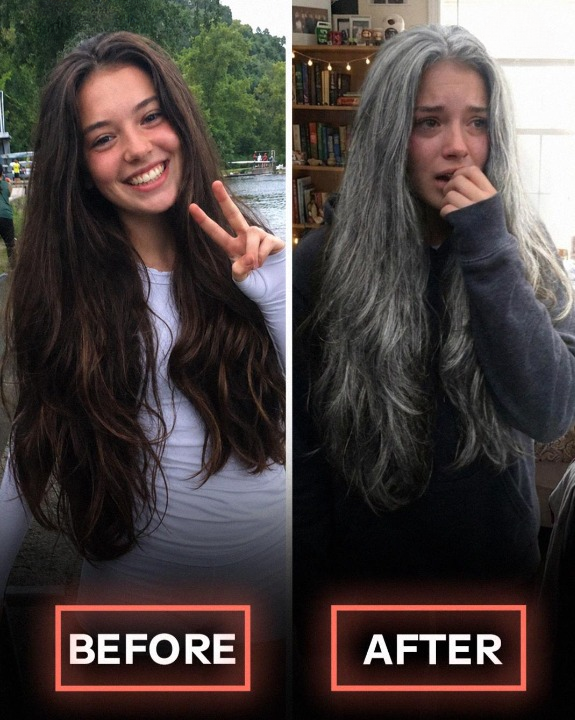
I thought letting my 15-year-old daughter spend the weekend with her grandmother would be harmless. Instead, she came home hiding beneath a hoodie, locked herself away for days, and cried behind a closed door. When I finally forced my way into her room, I was completely unprepared for what I saw.
“Can I stay with Grandma this weekend?” Scarlett asked one afternoon while absentmindedly petting Orry, our cat.
At home, we called her Letty.
Even after divorcing Harry years earlier, I’d tried hard to preserve the healthy relationships that still mattered. Gloria — my former mother-in-law — remained involved in Letty’s life, and I never wanted my daughter to lose family simply because her parents’ marriage had failed.
So when Letty excitedly mentioned baking cookies and sorting through old family photos with Gloria, I agreed without hesitation.
Everything seemed normal at first. She sent a few short texts over the weekend and even shared a blurry picture of cookie dough on Saturday night.
Nothing hinted at what was waiting for me Sunday evening.
Normally, Letty burst through the front door full of energy, talking before she’d even kicked off her shoes. But this time, she slipped quietly into the house with her hood pulled low over her face.
Even Orry seemed confused when she barely acknowledged him.
“How was Grandma’s?” I asked.
“Fine,” she muttered.
Something in her tone instantly unsettled me.
When I asked a few more questions, she avoided eye contact and hurried down the hallway.
“Please don’t start, Mom,” she whispered before locking herself inside her bedroom.
At first, I blamed teenage mood swings. But then Monday came.
And Tuesday.
Letty refused to go to school. She barely ate unless I left food outside her door. Every time I walked by, I heard soft crying from inside the room.
One afternoon, she thought I had walked away when she whispered through the door:
“I didn’t want you to see me like this.”
The fear that hit me in that moment was impossible to ignore.
I immediately called Gloria.
But instead of concern, she sounded irritated.
“She’s just being dramatic,” Gloria sighed dismissively. “Teenage girls overreact to everything.”
When I asked if something had happened over the weekend, her answer came far too quickly.
“No.”
Then she abruptly hung up.
That was when I knew something was terribly wrong.
By the third morning, I couldn’t take it anymore.
I pounded on Letty’s bedroom door.
“Open this door. Right now.”
“NO, MOM! PLEASE!”
I grabbed the spare key from the hallway drawer and unlocked the door myself.
The room was dark except for the faint glow of a lamp she’d quickly switched off.
“Go away!” she cried.
But when I turned the light back on, I froze.
My daughter sat curled up on the floor beneath a blanket, trembling.
And her hair…
Her beautiful dark hair was gone.
Not cut off. Not shaved.
The color had been stripped away completely.
Every strand was a brittle, pale gray-white from root to tip, as though years had suddenly been poured onto her head overnight.
My knees nearly gave out.
“Mom,” she whispered through tears, “please don’t be mad.”
I rushed to her side, trying to understand what I was seeing.
Then she finally told me.
“Grandma said I couldn’t tell you,” Letty cried. “She said you’d ruin everything and never let me see her again.”
Rage flooded through me.
Slowly, between sobs, Letty explained that Gloria had criticized her appearance all weekend — saying her dark hair looked “too heavy,” that she’d look prettier if it were lighter and “more polished.”
Letty had repeatedly said no.
But Gloria kept pressuring her until she finally gave in.
The chemicals burned her scalp during the process.
And afterward, when the damage became obvious, Gloria panicked.
Instead of helping, she told Letty to hide from me.
I wrapped my daughter in my arms, then grabbed my keys and drove straight to Gloria’s house shaking with fury.
The front door wasn’t locked.
The second I stepped inside, my stomach turned.
Hair dye bottles covered the coffee table. Bleach-stained towels were scattered across the floor. Mixing bowls and brushes sat abandoned like evidence from a crime scene.
Gloria appeared in the hallway wearing a robe, immediately defensive.
“What are you doing barging into my house?”
“What did you do to my daughter?”
At first she tried minimizing everything.
“It’s just hair,” she snapped. “You’re overreacting.”
But when I found the bleach containers in the bathroom trash, her confidence cracked.
She admitted she’d wanted Letty to look “better.”
“Her hair was too dark,” Gloria insisted weakly. “I wanted to soften her appearance.”
I stared at her in disbelief.
“You made a 15-year-old child feel ugly in her own skin.”
For the first time, Gloria looked ashamed.
She confessed she had taken Letty to a salon afterward, but the stylist warned that the damage was too severe to fix immediately.
So instead of telling me the truth, she sent my daughter home terrified and humiliated.
I called Harry immediately.
When he realized what his mother had done, his voice turned ice cold.
“She’s fifteen, Mom,” he said sharply over speakerphone. “How could you do this?”
Gloria started crying, insisting she had only been trying to “help.”
But the damage was already done.
Before leaving, I looked directly at her and said:
“You won’t be seeing Letty again for a very long time.”
Then I walked out.
Back home, I held my daughter while she cried and promised her none of this was her fault.
Later that evening, my friend Nina — a salon owner I trusted deeply — came over to assess the damage. She explained that Letty’s hair would eventually recover, but it would take time and careful treatment.
The next day, I bought a soft dark wig that resembled Letty’s natural hair.
At first she refused to wear it, terrified she’d look ridiculous.
But by Monday morning, she quietly put it on and walked into school with more courage than most adults ever have to summon.
No one laughed.
No one stared.
And sitting in my car afterward, watching her disappear into the building, I realized how quickly one cruel opinion from someone trusted can leave scars on a child.
Gloria still calls sometimes.
Harry once asked whether I might eventually forgive her.
I told him forgiveness doesn’t happen simply because the person who caused the pain is tired of waiting.
Letty’s real hair is slowly recovering now — still fragile, still pale, but improving little by little.
Some nights she crawls onto the edge of my bed like she used to when she was younger.
Recently, she looked at me quietly and asked:
“Do you think I’ll ever feel normal again?”
I brushed a hand gently over her wig and answered honestly:
“I think you already are.”