
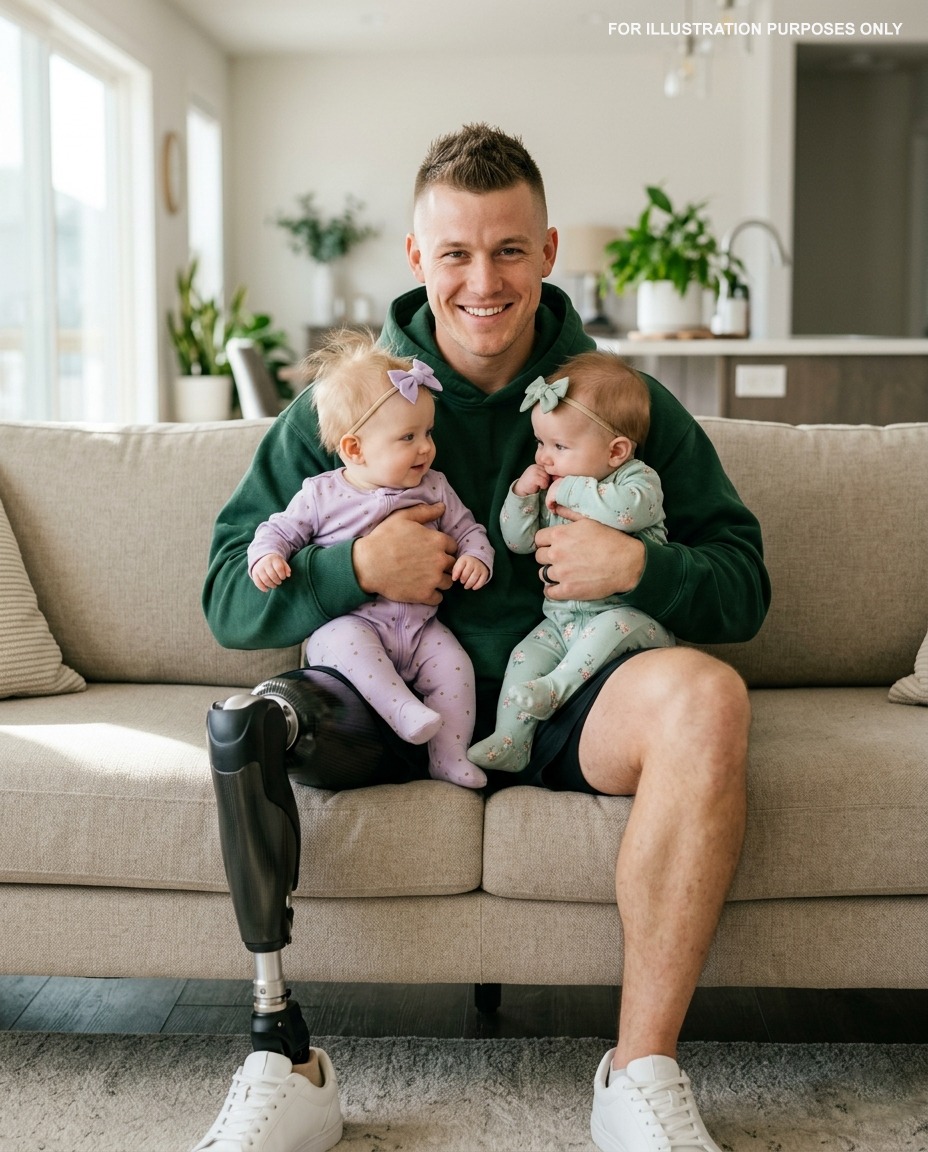
I never thought I’d end up telling this, mostly because even now it still feels unreal—like something that happened to someone else and only brushed past my life on its way out.
Three years ago, I came home early from deployment with a prosthetic leg and one clear thought keeping me going through every hard night: my wife and our newborn twin daughters were waiting for me.
I hadn’t told Mara I was coming back early. I wanted it to be a surprise—the kind you imagine during the worst moments, when you survive by picturing how everything will finally come together again. I could see it: the door opening, her crying, me holding the girls while she stood there smiling like it was all finally over.
But when the taxi stopped outside our house, something immediately felt wrong.
The curtains were missing. The porch swing I’d built was gone. The place looked stripped, like life had already been removed from it.
I told myself not to assume anything. Maybe she changed things. Maybe she was at her mother’s. Maybe I was just exhausted.
Then I went inside.
The house was empty.
Not just quiet—cleared out. Furniture gone, photos removed, every trace of us erased so thoroughly it felt like I’d stepped into a place that had already been abandoned.
For a moment, I thought I had the wrong house.
Then I heard it.
Crying.
Two voices.
I forced myself upstairs, each step heavier than the last. By the time I reached the nursery, my breathing was uneven and my hands were already shaking before I even opened the door.
Emma and Lily were in their cribs, screaming until their tiny bodies trembled.
And sitting between them was my mother.
She looked up at me—and immediately broke.
“Caleb…” she whispered.
“Where’s Mara?” I asked, even though something inside me already knew the answer.
She couldn’t speak properly. She just kept saying, “I’m so sorry,” over and over.
Then I saw the note on the dresser.
Folded neatly.
My hands shook as I opened it.
I’m too young to waste my life on a broken man and diapers. Mark can give me more. As for the babies—keep them.
Everything in me went still.
Mark.
My best friend.
The man I trusted. The man I’d left checking on my family while I was gone.
In that moment, everything I thought I had shattered completely.
That night, I sat on the nursery floor holding both girls. They slowly settled against me, as if they already knew I was all they had left.
“I’m here,” I whispered. “You won’t be abandoned again.”
And I meant it.
The next three years were survival in ways I can’t soften. Learning to raise twins on my own, working through exhaustion, getting through days on barely any sleep. There were nights I broke down in silence so they wouldn’t hear.
But I never stopped.
I rebuilt my life piece by piece—starting with fixing small machines in my garage, turning whatever I could into income. People looked at me with pity at first, especially because of my leg. I hated that look.
So I worked harder.
By the time the girls were three, it wasn’t just survival anymore.
It was a life.
Not perfect—but ours.
Then everything shifted again.
At the county office one day, a clerk hesitated before turning her screen toward me.
“Are Emma and Lily your daughters?” she asked.
“Yes,” I said.
She slid the monitor closer.
An adoption petition.
Mara’s name.
Mark’s name.
And my daughters listed like something to be claimed.
I didn’t react the way I used to.
I simply took the document, folded it, and left.
Because this time, I wasn’t the one being erased.
I went to their house without hesitation.
Gates, wealth, everything I once thought mattered—it didn’t anymore. I knocked steadily.
Mara opened the door.
For a second she didn’t recognize me. Then her face shifted—shock, then something carefully hidden.
“Caleb?”
Mark appeared behind her, trying to laugh it off.
I just held up the paper.
“I’m sure this is inconvenient,” I said.
They tried to explain. They always do.
But some things don’t need explanation.
“You left them,” I said calmly. “In empty cribs.”
Mara tried to excuse it as being overwhelmed.
I placed the old note beside the petition.
Silence followed.
When lawyers got involved, it became clear what this really was—not remorse, but an attempt to take what wasn’t theirs.
Three years ago, that would have broken me.
Now it didn’t.
At the door, Mara asked quietly, “Do they know me?”
I thought for a moment.
“They know they’re loved,” I said. “That’s enough.”
And I left.
A month later, the petition was dismissed.
She tried once more to contact me.
I didn’t respond.
Not out of anger—but because there was nothing left to reopen.
That evening, I picked up Emma and Lily from preschool. They ran to me like they always did, each grabbing a side of me like I was the only thing they needed.
“Daddy!” Emma shouted.
“Lily painted a unicorn dog!” she added.
“It was purple,” Lily corrected seriously.
I laughed, lifting them both, feeling the strain in my body and something steadier in my chest.
My leg hurt.
My shirt was messy.
But none of it mattered.
Because I thought I had lost everything three years ago.
And I hadn’t.
I had just been left with what truly mattered.