
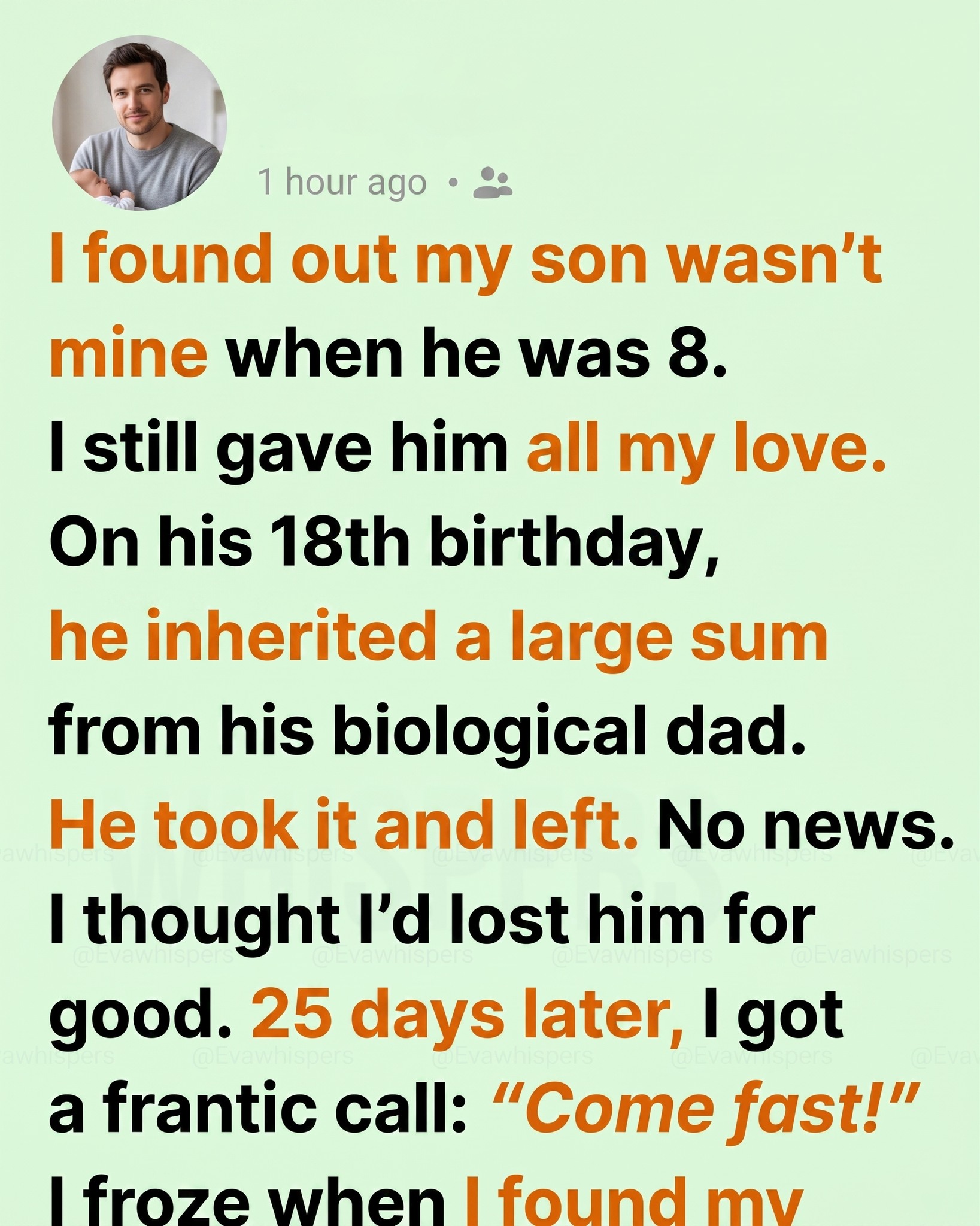
I can still pinpoint the moment everything in my life divided into two parts: before and after.
Caleb was eight, asleep on the sofa with a science book resting on his chest and a pencil still trapped loosely in his fingers. I was doing the dishes when Melissa walked into the kitchen holding a folder so tightly the corners of the papers inside had bent.
One look at her face told me something was seriously wrong.
Not small trouble.
The kind that changes everything.
“We need to talk,” she said quietly.
It wasn’t how people imagine life-altering news—no shouting, no dramatic breaking point. Just a kitchen table, scattered documents, and the steady noise of the refrigerator filling the silence.
The DNA test had started because Caleb needed routine medical work. Something in his results didn’t match mine, so doctors asked questions, then ordered more tests.
Eventually, the truth came out.
I wasn’t his biological father.
Melissa admitted there had been someone else briefly around the time of conception.
“It didn’t mean anything,” she cried. “I really thought he was yours.”
But I barely heard her.
All I could focus on was the sound in my head, like everything solid had just given way beneath me.
Then I looked into the living room.
At Caleb.
Still asleep.
Still holding that pencil.
Freckles on his nose, one sock slipping off his foot.
And unexpectedly, I realized something simple.
It didn’t matter.
Because eight years of raising him meant more than biology ever could.
I was the one who taught him to ride a bike, stayed up through his fevers, checked under his bed for monsters, and clapped through every school performance like it was the most important thing in the world.
No test result could undo that.
So I stayed.
Not out of obligation—but love.
Melissa and I separated two years later for reasons that had little to do with Caleb, though trust never really recovers the same way after something like that.
Life got harder after the divorce. Money was tight. I worked exhausting warehouse shifts and pretended it was normal. Some nights I skipped meals so Caleb could keep playing sports without noticing the struggle. When my boots wore out, I repaired them instead of replacing them. When bills piled up, I hid the notices so he wouldn’t worry.
A kid shouldn’t have to carry adult burdens.
That was my rule.
Then Caleb turned eighteen.
And everything changed again.
A lawyer contacted him about an inheritance from his biological father, Daniel Mercer—who had died unexpectedly. He had quietly followed Caleb’s life from afar and left him nearly three hundred thousand dollars.
I watched Caleb sit at the kitchen table, staring at the documents in disbelief.
“That’s… a lot,” he said quietly.
I tried to smile through the ache in my chest.
“It’s yours.”
Three days later, he left with a suitcase.
“I just need time,” he said, barely meeting my eyes. “To think.”
Then he was gone.
At first I called constantly. No answer. Then less often. Eventually nothing but voicemail.
Weeks passed in silence.
And silence, if you sit in it long enough, starts to feel like abandonment.
I told myself every possible reason.
Maybe he didn’t need me anymore.
Maybe biology had won out.
Maybe I had already been replaced.
Uncertainty was the worst part—because grief at least gives you closure.
Hope doesn’t.
By the third week, I barely slept.
Then one afternoon, my neighbor called urgently.
“There’s someone on your porch,” she said.
I rushed home.
And there he was.
Caleb.
Sitting on the steps with his suitcase beside him, head down, like he wasn’t sure he belonged there anymore.
When I got out of the truck, he looked up.
Red eyes. Exhaustion.
“Hey, Dad,” he said softly.
Dad.
Not anything else.
Just Dad.
He handed me a thick folder.
Inside were bank documents, transfers, and records I didn’t understand at first—until I saw it.
The mortgage.
Paid in full.
Every overdue bill. Every penalty. Gone.
I stared at him in shock.
“You did this?”
He nodded.
“I found the notices,” he admitted. “In the garage.”
My stomach dropped.
“You weren’t supposed to see those.”
“I know,” he said quietly. “That’s why I left.”
Then he explained: legal delays, inheritance processing, tax issues—days spent working with lawyers and banks to access everything.
“I wanted to fix it before coming back,” he said.
“For you,” he added when I asked why he used the money.
I couldn’t respond.
Because nothing I had ever done felt big enough for what he had just done.
“You stayed after finding out I wasn’t yours,” he said. “Most people wouldn’t have.”
I tried to interrupt, but he kept going.
“You gave me everything when you barely had enough for yourself. So when I saw you were about to lose the house because of me…”
“Because of circumstances,” I corrected.
But he shook his head.
“You protected me my whole life,” he said. “This was the least I could do.”
That was when I broke.
Not quietly.
Not politely.
Completely.
Years of fear and exhaustion coming out all at once.
Caleb moved closer and held me like he used to when he was small and scared.
We stayed there on the porch as night settled in, not speaking, just breathing through everything that had built up between us.
Eventually, he gave a small smile.
“I never really cared about biology,” he said.
I let out a shaky laugh.
“Good,” I replied. “Neither did I.”
Later that night, I found him in the garage looking at the cabinet where I used to hide the bills.
“You kept everything together,” he said.
I leaned beside him.
“Not alone.”
He looked at me, then nodded.
“Yeah,” he said quietly. “I guess not.”
People often think family is defined by blood.
But blood only explains where life starts.
Not what it becomes.
Family is built in sleepless nights, small sacrifices, and choosing someone again and again when it would be easier not to.
And that night, standing beside my son, I understood something I had known all along.
I didn’t have to create him to be his father.
I just had to stay.