
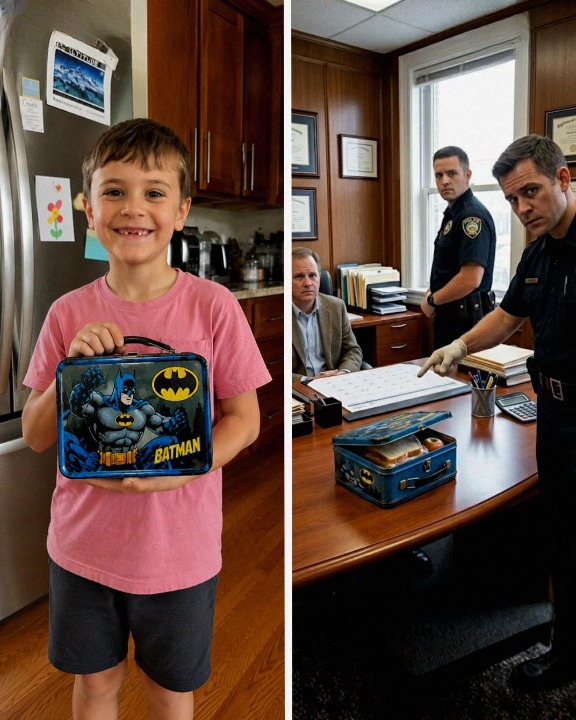
It began with a call from my son’s school in the middle of a Tuesday — the kind of call you expect to be about a forgotten snack, a scraped knee, or maybe a fever.
Instead, everything escalated the moment I walked through the doors.
Police were already there. An ambulance was outside. And my mother-in-law’s name kept coming up in a way no one wanted to fully explain.
I left work immediately.
When I arrived, the principal met me near the office, looking visibly shaken. She told me my son was safe, but insisted I come inside right away because of something found in his lunchbox.
Inside the office, a police officer stood beside a desk where my son’s lunchbox had been opened and partially unpacked.
I was asked to look inside.
Food was normal at first — a sandwich, fruit, a drink. But then I saw it: a sealed envelope tucked beneath the sandwich and a thick bundle of cash beside it.
My stomach dropped.
The teacher explained it had fallen out during snack time before my son could touch it. That’s when I asked who had packed his lunch.
My mother-in-law.
The officer carefully opened the envelope. Inside was a handwritten note addressed to me.
As he read it aloud, everything in my head stopped making sense. It was a desperate message — asking me not to call, saying she was being watched, that someone had taken her phone and keys, and that this was the only way she could think of to get help.
For a moment, no one spoke.
The principal added that my mother-in-law had arrived that morning and that there had already been signs something was wrong — including visible bruising on her wrist.
Then I learned she had been found nearby after a panic episode and taken to the hospital.
I went straight there.
Without her usual composure, my mother-in-law looked smaller, shaken, and exhausted. Bruises marked her skin. And for the first time, she didn’t seem sharp or controlling — just afraid.
She told me she didn’t know who else to trust.
Slowly, the truth came out.
She had been in a relationship with a man who initially seemed kind but gradually became controlling — isolating her, monitoring her, restricting her movements, and escalating into violence. She hadn’t told anyone because she feared it would turn into something worse.
When I asked why she used my son’s lunchbox, she admitted it was the only way she could think of to ensure someone noticed quickly without putting him in direct danger. It was a desperate choice made under pressure, not a calculated one.
Even so, it had pulled my child into something he never should have been near.
Police got involved immediately. A protection plan was put in place, and she handed over her phone so it couldn’t be used to track her. I made it clear my son would be kept completely out of the situation from that moment on.
I called my husband, told him everything, and warned him not to escalate things with the man involved. This had to be handled legally and safely.
Over the next days, things slowly began to settle into structure — reports, orders, therapy, and supervised safety measures.
My mother-in-law stayed with us for a time afterward. It wasn’t easy. Years of tension and judgment didn’t disappear overnight. But beneath all of it was something I couldn’t ignore anymore: she hadn’t come to us as an enemy that day — she had come because she was trapped.
And somewhere between fear, truth, and consequences, our family stopped being something divided into sides.
It became something we had to rebuild together.