
I glanced at the clock and realized I couldn’t afford even a moment of distraction. Then I noticed something that made it feel impossible to just walk away—something that ended up putting my livelihood at risk.
I had 30 minutes to finish a cold sandwich and prepare the pitch that could determine whether I made rent this month or slept in my car.
The café wasn’t ideal—crowded, noisy, cups clinking, conversations overlapping, and an espresso machine hissing nonstop.
I tried to concentrate. Notebook open. Phone beside it.
But it was useless.
That’s when I saw her.
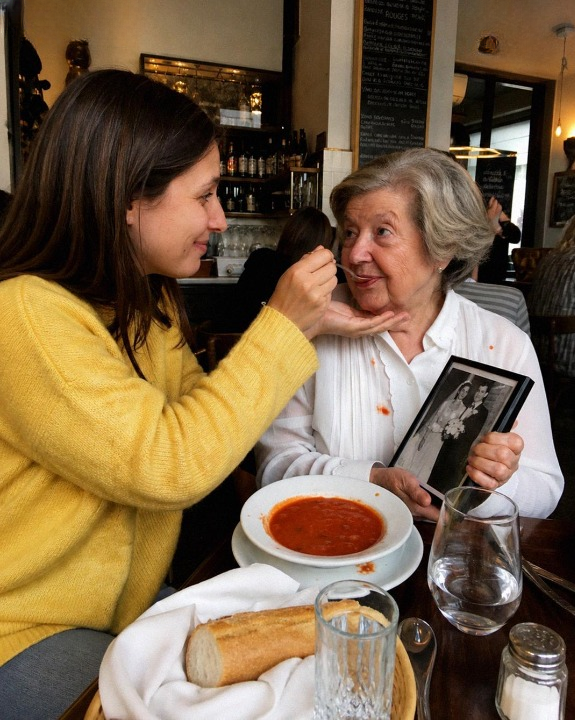
An elderly woman sitting alone across from me, small and frail, wearing a white blouse. In front of her was a bowl of hot tomato soup.
Her hands trembled badly every time she tried to lift the spoon. Soup spilled over the sides, onto the table, her clothes, even her lap. A little ran down her chin.
Two nearby women leaned in, whispering and laughing behind their hands.
The woman noticed.
And her face turned red with embarrassment.
I checked my watch—25 minutes left. My phone buzzed again: Tom, the hiring manager.
I flipped it over and tried to ignore everything.
But then she looked up.
For a brief moment, our eyes met—and I knew I couldn’t just sit there.
So I got up.
I sat down across from her and asked if I could help.
She looked startled, then nodded.
She told me she had Parkinson’s, and that it was her 55th wedding anniversary. She and her late husband used to celebrate at that café.
That changed everything.
I picked up the spoon.
At first she hesitated, then allowed me to help. I fed her slowly, one bite at a time, while she talked about her husband, Frank—the way he always ordered for both of them, the traditions they had.
“He never once told me to stop talking,” she said softly, smiling through tears.
I stopped checking my phone. The interview. The time. Everything faded.
But I felt someone watching.
A man in a suit sat quietly at the counter, observing us.
I ignored it and kept going.
When she finished, she thanked me and held my hand.
I returned to my table—only to realize I was already late.
Missed calls. Messages. Panic.
I called Tom.
Too late. They’d moved on.
My stomach dropped.
Then I found a folded napkin the man had left behind.
“You shouldn’t have helped her. Meet me tomorrow. 6 a.m.”
It didn’t feel like a thank-you. It felt like a warning.
I couldn’t stop thinking about it.
Still, I went.
At 6 a.m. the next day, the man returned.
He introduced himself as Clarence.
Then he told me the truth:
The woman was his mother. She had Parkinson’s and dementia. Every year on her anniversary, she believed her husband was still alive and came to the café to meet him. He always followed her quietly to make sure she was safe.
He’d misunderstood what he saw the day before.
But when he spoke to his mother afterward, she was happier than she’d been in a long time—because someone had simply stayed with her and treated her with kindness.
Then everything shifted.
He told me he was the CEO of the company I was supposed to interview for.
The missed interview didn’t matter anymore.
What mattered was the choice I made.
Instead of a junior position, he offered me a leadership role—and even promised support while I got back on my feet.
All because of a decision I thought had cost me everything.
In the end, I realized I hadn’t lost my opportunity.
I had stumbled into a far bigger one—by choosing compassion when I thought I couldn’t afford it.